EU's Inaction on Israel's Military Actions Draws Sharp Criticism
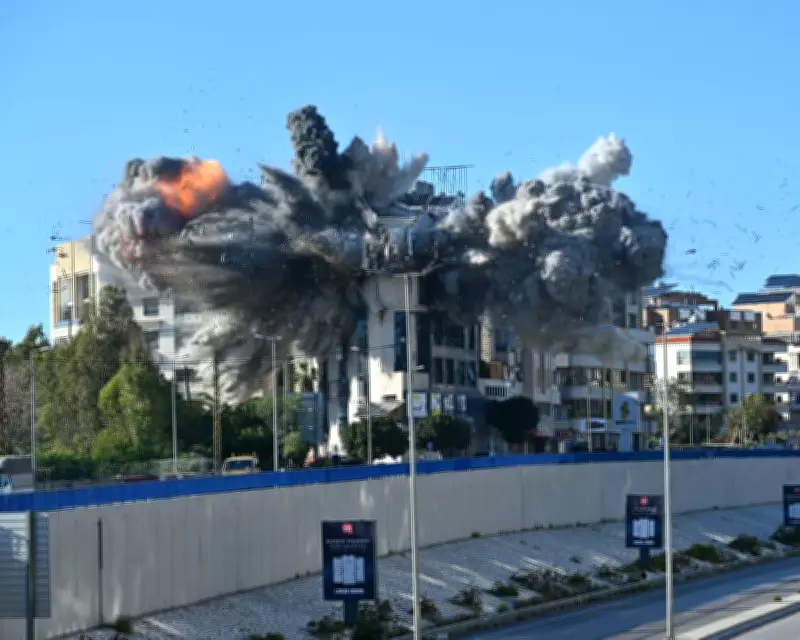
A dramatic fireball erupted from the site of an Israeli strike targeting a building near the highway to Beirut's international airport, highlighting the escalating violence in Lebanon. This visual evidence underscores the human costs of the conflict that European officials are struggling to address effectively.
Humanitarian Crisis in Lebanese Shelters
During a recent visit to Beirut, Irish MEP Barry Andrews witnessed firsthand the devastating impact of Israeli airstrikes on Lebanese civilians. He visited makeshift shelters in converted schools where conditions have deteriorated significantly since Israel's previous military actions in 2024.
"The situation is dire," Andrews reported. "Displaced families are sleeping on dirty mattresses with filthy blankets, leading to widespread infections and skin rashes among vulnerable populations." The misery has been compounded by severe cuts to international aid budgets, creating what Andrews described as a perfect storm of suffering.
Andrews chairs the European Parliament's development committee and traveled to Lebanon shortly after Hezbollah launched rocket attacks into Israel, which triggered massive retaliatory strikes by Israeli forces. Upon his return, he became one of the first European lawmakers to advocate for reviving EU sanctions against Israel.
Multiple Fronts of Concern
The Irish MEP believes the European Union must respond not only to Israel's attacks on Lebanon but also to several other concerning developments:
- State-backed settler violence against Palestinians in the West Bank
- Attacks on healthcare workers and facilities in Gaza
- Israel's potential reinstatement of the death penalty specifically for Palestinians
Despite these multiple crises, the European Union has failed to move beyond verbal condemnations. As one of Israel's closest allies and most significant economic partners, the EU possesses substantial leverage that remains largely unused.
Economic Leverage Available but Unused
The EU-Israel Association Agreement represents a powerful tool for potential pressure. This commerce and cooperation accord underpins a massive €68 billion trading relationship and promotes collaboration in energy, scientific research, and other strategic areas.
Sven Kühn von Burgsdorff, who served as the EU representative to Palestinian territories until 2023, advocates for suspending this agreement entirely. He also recommends halting all military support to Israel and ceasing trade with illegal settlements in occupied territories.
"The usual words of concern and condemnation are insufficient," von Burgsdorff emphasized. "They become meaningless when not followed by concrete measures to hold Israel accountable for violations of international law."
Internal Divisions Paralyze EU Action
The European Union's response has been hampered by deep internal divisions among member states. Ireland, Spain, and Slovenia have consistently advocated for stronger support of Palestinian rights, while Germany and Austria maintain historical reluctance to criticize Israel.
Adding to the complexity, Hungarian Prime Minister Viktor Orbán has emerged as a crucial ally of Israeli Prime Minister Benjamin Netanyahu, frequently vetoing measures that might otherwise gain majority support within the EU.
Andrews described the EU's overall response as "weak and pathetic," arguing that "Israel has repeatedly been given what amounts to a permission slip for endless war crimes without meaningful consequences."
Death Penalty Vote Draws International Condemnation
Israel's recent parliamentary vote to potentially reinstate the death penalty specifically for Palestinians convicted of fatal attacks has drawn sharp criticism from European institutions. The European Commission described the measure as "very concerning" and "a clear step backward," while the Council of Europe called it "a legal anachronism incompatible with contemporary human rights standards."
Humanitarian Toll Continues to Mount
The human costs of the conflicts continue to escalate dramatically. In Lebanon alone, more than 1,240 people have been killed in recent weeks, including at least 124 children. Over 1.1 million Lebanese residents have been forced to flee their homes due to the violence.
Meanwhile in Gaza, at least 673 additional deaths have been recorded since the October ceasefire, bringing the total death toll in the devastated territory to 72,260 people. The humanitarian situation remains catastrophic, with accusations of genocide continuing to surface.
Historical Patterns of Inaction
The EU's current reluctance to take substantive measures against Israel follows a familiar pattern. Last September, European Commission President Ursula von der Leyen proposed unprecedented sanctions citing the "manmade famine" in Gaza and settlement expansion undermining the two-state solution.
These proposals never gained sufficient support among member states, and momentum dissipated when international attention shifted to ceasefire negotiations. Von der Leyen herself has faced criticism for what some describe as an uncritical defense of Israeli policies.
One senior EU diplomat acknowledged in mid-March that "there may come a point when we need to increase pressure on Israel again," describing conditions in Gaza and the West Bank as "highly problematic."
Strategic Considerations and Future Prospects
Diplomats suggest the EU's cautious approach stems partly from complex geopolitical considerations. The initial conflict involved Israel and the United States targeting Iran, a regime the EU strongly condemns for human rights abuses and regional destabilization.
Some European officials emphasize the importance of maintaining engagement with Israeli civil society, pointing to an open letter from 600 Israeli security officials last August calling for an end to the Gaza war. "These are not peaceniks," noted one EU diplomat. "These are security establishment figures concerned about their government's policies."
Von Burgsdorff argues for a more independent European stance: "How can it serve Europe to be seen as a sidekick of an erratic US president or a warmongering Israeli prime minister? This damages our relations with other parts of the world."
As the conflicts continue with no resolution in sight, pressure mounts on European leaders to translate their concerns into concrete actions that might alter the trajectory of violence and suffering across the region.