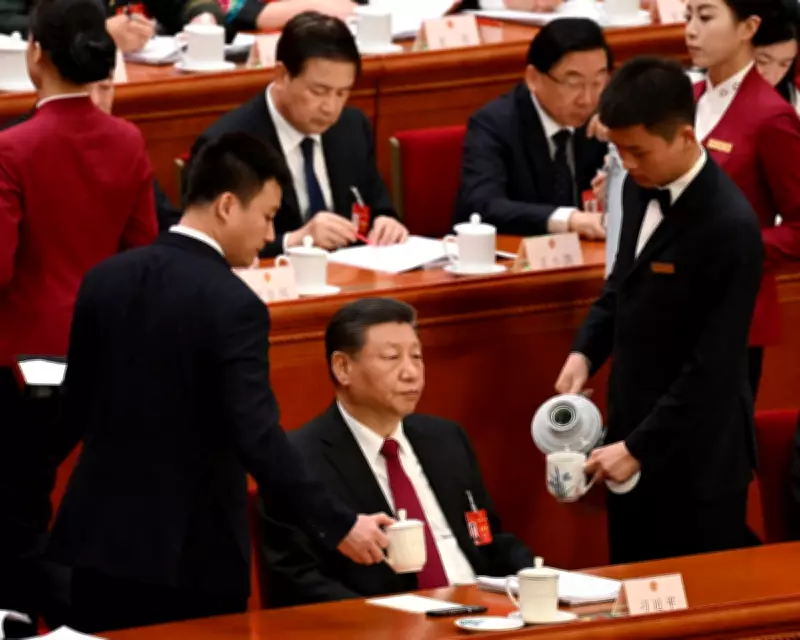
China's Two Sessions to Reveal Xi's Economic and Defense Plans as Military Purge Casts Shadow
Top politicians will gather in Beijing this week to set growth targets with a focus on technology self-reliance amid rising US competition. Thousands of delegates will arrive for China's annual Two Sessions, one of the most important events in the country's political calendar and a rare opportunity for global media to observe Beijing's top lawmakers up close.
The Significance of the Two Sessions
The Two Sessions are concurrent gatherings of the National People's Congress (NPC) and the Chinese People's Political Consultative Conference (CPPCC), an advisory body. Of the two, the NPC, China's legislature, holds more formal power, including the authority to amend the constitution, appoint political officials, enact laws, and approve the budget. In 2018, the NPC amended China's constitution to remove term limits for the president, and in 2023, it elected Xi Jinping to an unprecedented third term.
However, in modern China, the Chinese Communist Party (CCP) wields greater influence than any state organ, making the NPC effectively a rubber-stamp parliament that has never rejected any agenda item. Real decision-making occurs within the CCP at separate meetings. Despite this, the opening of the CPPCC on Wednesday and the NPC on Thursday will be marked by pomp and circumstance.
Economic and Strategic Priorities
The NPC serves as the forum for releasing the annual government work report, which outlines goals for the coming year, including the GDP growth target. This year, the target is expected to drop below 5% for the first time, signaling a shift in priorities. Additionally, this session is crucial as it marks the official launch of the 15th five-year plan, covering 2026-2030, which will detail Beijing's economic and strategic priorities.
Ruby Osman, a senior policy adviser at the Tony Blair Institute for Global Change, notes that this year's Two Sessions will be unusually busy. The Two Sessions usually tell us what Beijing wants to do over the next 12 months. This year, they'll also set out a much bigger strategy for navigating a decisive period of geopolitical and technological change, she says. Osman adds that there may be a mismatch between the annual report's priorities and the longer-term goals of the five-year plan, emphasizing innovative capacity and resilience against US pressures.
Focus on Technology and Defense
The 2026-2030 period is critical for China's strategic objectives. President Xi aims for the military to be capable of a successful assault on Taiwan by 2027, requiring an economy that is self-sufficient and resilient to potential sanctions. Taiwan, a self-governing island claimed by Beijing, remains a focal point, with China not ruling out force for reunification. Consequently, the 15th five-year plan is expected to prioritize industrial self-reliance, particularly in advanced semiconductors, to counter US sanctions and boost capabilities in artificial intelligence and military applications.
Impact of Military Purges
Recent high-level purges in the military will overshadow defense discussions. Xi recently placed his top general, Zhang Youxia, under investigation for suspected corruption, a move reflecting ongoing turmoil in the world's largest armed forces. A report from the Center for Strategic and International Studies in Washington, DC, found that over 100 senior officers have been purged or potentially purged since 2022, a staggering number. On Thursday, the NPC's leadership body revoked the membership of nine military delegates without explanation, according to Xinhua news agency.
Neil Thomas, a fellow on Chinese politics at the Asia Society thinktank, comments, Xi's military purges will leave empty seats where senior officers once sat – a stark reminder that political loyalty is non-negotiable and that even top generals are expendable if they displease the top leader.
Economic Indicators and Domestic Challenges
Beyond political intrigue, this year's Two Sessions will reveal key economic indicators, with the GDP growth target expected around 4.5%, the first time below 5%. Analysts suggest this reflects Beijing's shift toward technological self-reliance, even at the cost of rapid growth. While this strategy may address geopolitical uncertainties, particularly with the US, it may not solve domestic issues like high youth unemployment and an ageing population. Other sectors, such as real estate, continue to struggle, highlighting broader economic challenges.