Vice President's Diplomatic Tour Ends in Dual Failures
US Vice President JD Vance has endured one of the most challenging weeks of his political career, returning to Washington after two significant foreign policy setbacks that have exposed vulnerabilities in the Trump administration's international agenda. The ill-fated diplomatic mission has raised serious questions about Vance's effectiveness as a global representative and the broader MAGA movement's foreign policy objectives.
Hungarian Mission Backfires Spectacularly
The vice president's troubles began in Budapest, where he traveled to support Hungarian Prime Minister Viktor Orbán's re-election campaign. Orbán, widely regarded as the MAGA movement's closest European ally, was facing his toughest electoral challenge after sixteen consecutive years in power. Vance's involvement marked a significant departure from traditional US diplomatic protocol, which typically avoids direct interference in allied nations' democratic processes.
During a campaign rally appearance, Vance delivered a passionate speech criticizing European Union officials in Brussels while urging Hungarian voters to "stand with Viktor Orbán." The visual imagery of America's second-highest ranking official sharing a stage with one of Europe's most controversial leaders generated immediate criticism back in Washington, where officials questioned the timing of such a high-profile visit during escalating tensions with Iran.
The diplomatic intervention proved completely ineffective. Hungarian voters delivered a historic landslide victory to opposition leader Péter Magyar's Tisza party, which secured an overwhelming 138 seats in the 199-seat parliament. This decisive outcome grants the new government a coveted two-thirds supermajority, enabling them to reverse numerous constitutional changes implemented during Orbán's lengthy tenure. The political shift threatens to dismantle Hungary's position as a global hub for conservative thought, where government-backed rightwing thinktanks and conventions have attracted ultra-conservatives from the United States, Russia, and other nations worldwide.
Iran Nuclear Negotiations Collapse
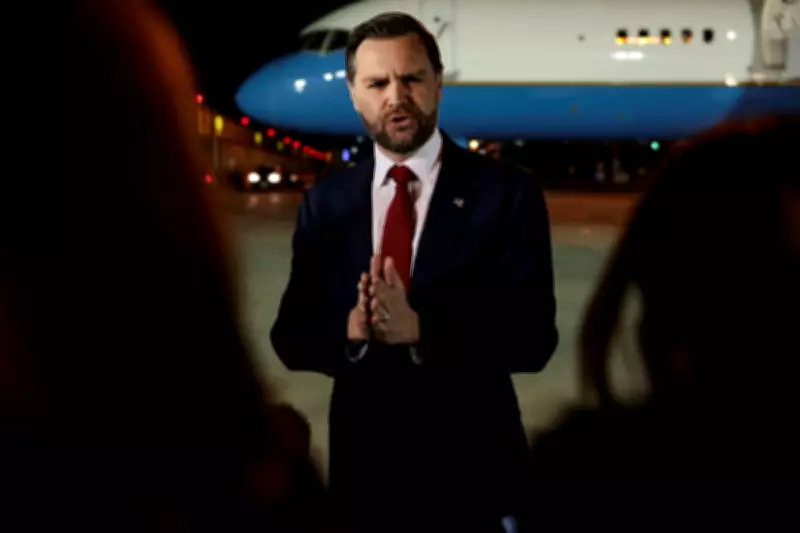
Even before the Hungarian election results were finalized, Vance had already departed for Islamabad, where he led a high-stakes American delegation attempting to negotiate the reopening of the Strait of Hormuz and resolution of Iran's nuclear program. The delegation included special envoys Steve Witkoff and Jared Kushner, President Trump's son-in-law, meeting directly with Iranian leadership in what represented the highest-level talks between the two nations since Iran's 1979 revolution.
The marathon negotiations lasted twenty-one grueling hours but ultimately failed to produce any meaningful breakthrough. Vance was compelled to deliver what he described as "bad news" to reporters, stating that "we did not reach an agreement, and I think that is much worse news for Iran than for the United States." This assessment appeared overly optimistic as President Trump responded by imposing a unilateral American blockade on the strategic Strait of Hormuz, further escalating regional tensions.
Vance represented an unconventional choice for leading such sensitive nuclear negotiations. Along with former Secretary of State Tulsi Gabbard, he ranks among the most anti-war members of Trump's cabinet and has consistently campaigned against returning to the "forever wars" he experienced firsthand as a soldier in Iraq. During the negotiations, Vance maintained regular communication with President Trump, but sources indicate this back-and-forth consultation created perceptions among Iranian officials that the vice president lacked sufficient authority to make binding decisions on America's behalf.
Political Fallout and Future Implications
The dual failures have positioned Vance as the public face of two significant foreign policy disappointments within a single week, dealing a substantial blow to his political standing and future aspirations. The vice president had hoped to secure a landmark diplomatic achievement that could bolster his expected 2028 presidential campaign, but instead finds himself associated with setbacks on two crucial international fronts.
Compounding these challenges, President Trump's recent criticism of Pope Leo XIV as "weak on crime" and "terrible" has created additional complications for Vance, a Catholic convert who now faces potential entanglement in yet another international controversy. The administration's apparent willingness to publicly blame subordinates for failures while claiming credit for successes was highlighted during a private Easter brunch when Trump joked about the Iran negotiations, telling Vance: "If it doesn't happen, I'm blaming JD Vance. If it does happen, I'm taking full credit."
This difficult week has exposed fundamental weaknesses in the MAGA movement's foreign policy approach, particularly its ambitions to empower rightwing populism across Europe and extract the United States from Middle Eastern conflicts. As Vance returns to Washington, he faces mounting questions about his diplomatic capabilities and the administration's overall international strategy during a period of global uncertainty and shifting alliances.