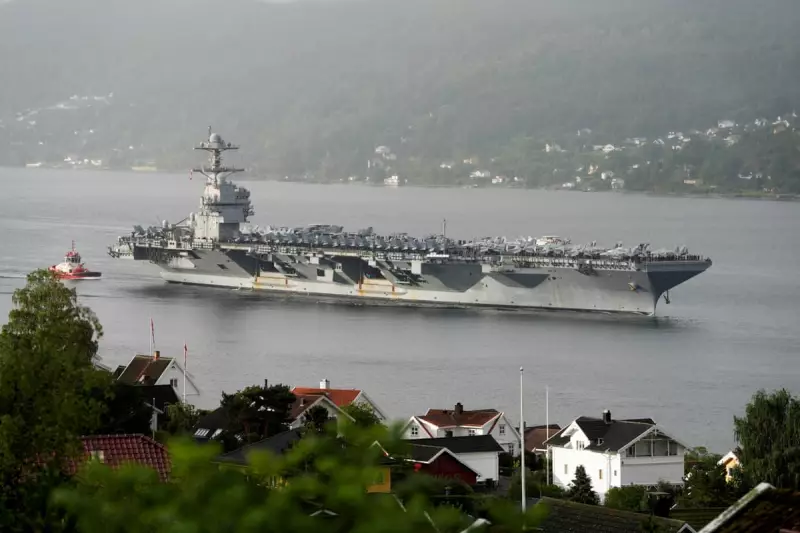
The United States Navy has confirmed that the USS Gerald R Ford, the world's newest and largest aircraft carrier, has entered the operational area of US Southern Command, covering Latin America and the Caribbean. This deployment represents the most significant American military presence in the region since the invasion of Panama in 1989.
Military Buildup Escalates Regional Tensions
The arrival of the nuclear-powered carrier and its accompanying strike group - comprising numerous aircraft and destroyer ships - signals a substantial escalation in military tensions between the US and Venezuela. The deployment had been announced nearly three weeks prior, but its implementation marks a new phase in the ongoing standoff.
In response to the American naval presence, the regime of Venezuelan leader Nicolás Maduro announced what it described as a "massive deployment" of military forces. This includes land, sea, air, river and missile units, alongside civilian militia, positioned to counter the US vessels operating near Venezuelan waters.

US Justifies Deployment as Part of Drug War
The Trump administration has framed this substantial military buildup as an extension of its "war on drugs" campaign, targeting traffickers allegedly moving narcotics through Caribbean and Pacific routes. This initiative has already involved airstrikes on vessels that have resulted in at least 76 fatalities in South American waters since September.
Sean Parnell, the chief Pentagon spokesperson, stated that the USS Gerald R Ford's arrival with more than 4,000 sailors and dozens of tactical aircraft would enhance American capability to "detect, monitor and disrupt illicit actors and activities" in the region. He added that these forces would "enhance and augment existing capabilities to disrupt narcotics trafficking and degrade and dismantle transnational criminal organisations."
Regional Reactions and Diplomatic Fallout
Many security analysts interpret the military movements and boat attacks as pressure tactics aimed at compelling Maduro to relinquish power following allegations of election manipulation last year.
Maduro has accused the United States of "fabricating a new war" and described the naval deployment as "the greatest threat our continent has faced in the past 100 years."
Before the US navy officially confirmed the carrier's arrival, the Venezuelan government announced a new phase of its military deployment against what it termed US "imperial threats." State television broadcast footage showing military leaders delivering speeches across multiple states.
The diplomatic landscape revealed divisions during the recent Community of Latin American and Caribbean States (Celac) summit in Colombia. A joint declaration signed by 58 of the 60 attending nations rejected "the use or threat of use of force and any action not in accordance with international law and the Charter of the United Nations" - though notably without directly referencing the United States.
Venezuela and Nicaragua stood as the only countries refusing to sign the declaration, despite Maduro's regime reportedly anticipating a stronger condemnation of American actions.
Brazil's President Luiz Inácio Lula da Silva, who is currently negotiating a trade agreement with Donald Trump that would reduce tariffs on Brazilian imports by more than 50%, avoided direct criticism of Washington. He stated: "We are a zone of peace. We don't need war here. The problem in Venezuela is a political one, and it must be resolved through politics."
The American carrier joins other warships, a nuclear-powered submarine and aircraft based in Puerto Rico, creating the most substantial US military footprint in Latin America in over three decades.