
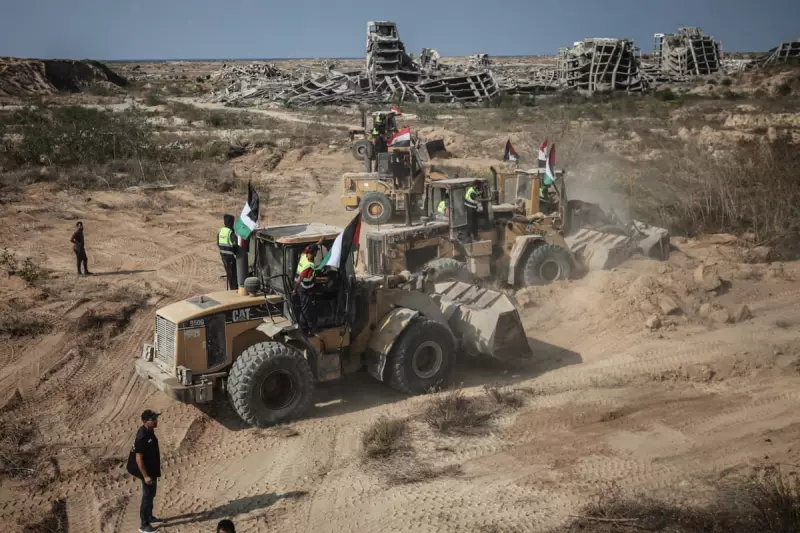
Exclusive US military planning documents, seen by the Guardian, outline a controversial long-term strategy for a divided Gaza, featuring a secured 'green zone' and a largely ruined 'red zone' where the vast majority of displaced Palestinians currently reside.
The plans, which raise serious questions about Washington's commitment to a unified Palestinian rule, propose that foreign forces will initially deploy alongside Israeli soldiers in the eastern part of the strip, reinforcing the current Israeli-controlled 'yellow line' as a de facto border.
A Partitioned Future for Gaza
According to the documents and sources briefed on the American strategy, the proposed 'green zone' would be the only area where reconstruction efforts would begin, secured by a combination of international and Israeli troops. In stark contrast, the 'red zone'—a coastal strip where more than 2 million Palestinians are now crowded—is slated to be left in ruins with no immediate plans for rebuilding.
"Ideally you would want to make it all whole, right? But that's aspirational," a US official, speaking anonymously, admitted. "It's going to take some time. It's not going to be easy."
This approach appears to mark a shift from earlier US proposals for fenced-in camps, referred to as "alternative safe communities" (ASC), which were reportedly dropped this week.
The Challenge of an International Force
The entire plan hinges on the creation of an international stabilisation force (ISF), a concept embedded in Donald Trump's 20-point 'peace plan'. The US hopes a UN Security Council resolution mandating the force will pass soon, but firm troop commitments remain elusive.
Initial US military plans, drawn up by Centcom, envisioned a core of European troops, including:
- Up to 1,500 infantry soldiers from the UK
- Up to 1,000 French troops
- Contributions from Germany, the Netherlands, and Nordic countries
However, these plans were described by one source as "delusional," given the extreme reluctance of European nations to risk soldiers' lives in Gaza after long missions in Iraq and Afghanistan. A US official later stated the documents contained "many inaccuracies."
Further complicating matters, Jordan—listed in the plans as a potential contributor of thousands of personnel—has explicitly ruled out sending troops, with King Abdullah stating the country is "too close politically" to Gaza.
Limbo and Lasting Consequences
Without a workable plan for a peacekeeping force, Israeli troop withdrawal, and large-scale rebuilding, mediators warn Gaza risks slipping into a perilous limbo—a state of "not war but not peace."
The US 'concept of operation' specifies that the ISF would operate in the 'green zone only', starting with a few hundred troops and potentially expanding to 20,000. They would not operate on the western side of the 'yellow line', where Hamas is reasserting control.
The strategy aims to use reconstruction in the secured zone to eventually tempt Palestinian civilians to move across the line, a plan with echoes of failed US policies in Afghanistan. However, with over 80% of structures in Gaza damaged or destroyed and Israel continuing to limit aid, including basic shelter materials, the humanitarian crisis remains acute.
Nearly 1.5 million Palestinians are awaiting emergency shelter, and hundreds of thousands are living in tents without access to clean water, highlighting the immense challenges facing any future administration.




