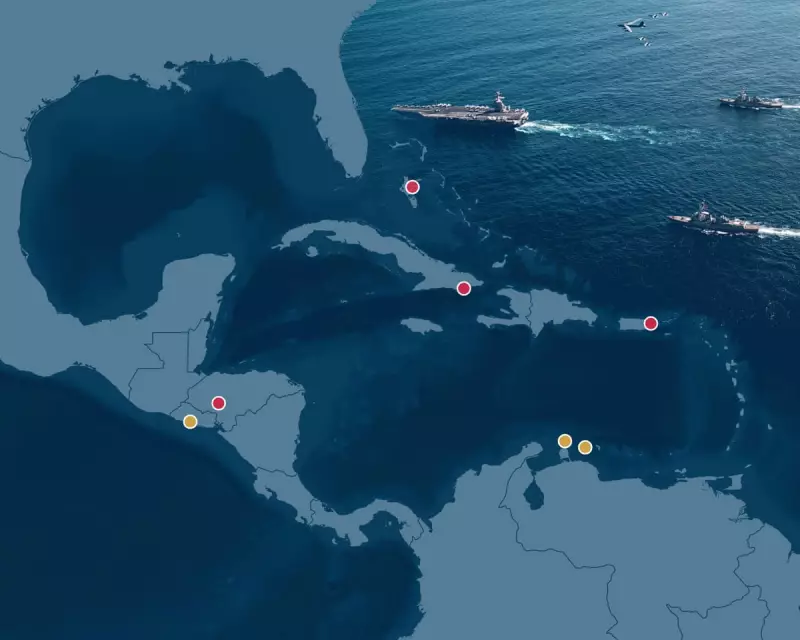
The United States has assembled its most significant military presence in the Caribbean since the 1989 Panama invasion, creating escalating tensions with Venezuela's government in Caracas.
Military Buildup and Allegations
The Trump administration has dramatically increased pressure on Venezuelan leader Nicolás Maduro, accusing him of operating the 'Cartel of the Suns' drug-trafficking organisation. Washington has placed a $50 million bounty on Maduro's head while remaining ambiguous about its ultimate intentions.
US officials in Washington DC have indicated that a 'new phase' in operations is imminent. This warning prompted several international airlines to cancel Venezuela flights over the weekend after the US Federal Aviation Administration advised civilian aircraft to exercise extreme caution due to 'worsening security situation and heightened military activity'.
The Venezuelan military has vehemently denied the allegations against Maduro, describing them as a 'vile lie to justify an illegitimate and illegal intervention in Venezuela'.
Deadly Anti-Drug Campaign
For weeks, Washington has justified its expanding military presence through its so-called 'war on drugs' campaign. The operation began in September when US forces struck a small open boat allegedly carrying narcotics, resulting in eleven fatalities.
Since that initial attack, American forces have targeted at least 21 additional vessels in Caribbean and Pacific waters, causing 83 confirmed deaths. The United Nations and various humanitarian organisations have characterised these strikes as extrajudicial executions.
Legal experts note that the US has failed to provide evidence that the targeted vessels were actually transporting drugs. Even if they were, specialists argue they presented no immediate threat requiring lethal force.
The only two survivors of these attacks were returned to their home countries of Ecuador and Colombia, where they have faced no charges because American authorities have provided no evidence against them.
Questionable Justifications
Contradicting the US administration's narrative, a 2020 US Drug Enforcement Administration report indicates that 74% of cocaine reaching the United States arrives via the Pacific route, with only 8% coming through Caribbean fast boats.
While Venezuela serves as a transit country for some cocaine destined primarily for Europe, the scale appears significantly smaller than US claims suggest. President Trump has additionally asserted that targeted boats were 'stacked up with fentanyl', despite the fact this drug is neither produced nor significantly consumed in South America.
Military Assets Deployed
The current US naval presence includes the Iwo Jima Amphibious Ready Group, comprising an amphibious assault ship and two transport dock ships. In October, the Pentagon announced deployment of the USS Gerald R Ford, the world's newest and largest aircraft carrier, which arrived in the Caribbean on November 11 with more than 4,000 sailors, tactical fighter jets, and accompanying warships.
Analysts estimate total US military personnel in the region at approximately 12,700 troops, though this falls significantly short of the 50,000-150,000 soldiers typically required for a ground invasion. Most specialists believe any US action would likely begin with airstrikes targeting specific regime facilities or criminal gang operations.
The US maintains military bases in Puerto Rico, Honduras, and Cuba, plus Cooperative Security Locations in El Salvador, Aruba, and Curaçao. The surveillance hubs in Aruba and Curaçao sit closest to the Venezuelan coast, though their use for offensive operations would theoretically require authorisation from the Netherlands.
Satellite imagery reveals upgrades underway at the Roosevelt Road naval station in Puerto Rico, including resurfacing and expansion of taxiways, with US Marines conducting exercises there since August.
Humanitarian Concerns
Any military action risks affecting much of Venezuela's population, which concentrates along the northern coast and immediate inland areas. The capital Caracas, home to approximately 3 million people, lies just nine miles from the sea, placing it within easy reach of potential airstrikes or missile attacks.
As tensions continue to mount, the international community watches closely, with many questioning the validity of the US administration's justifications for its aggressive military posture toward Venezuela.