
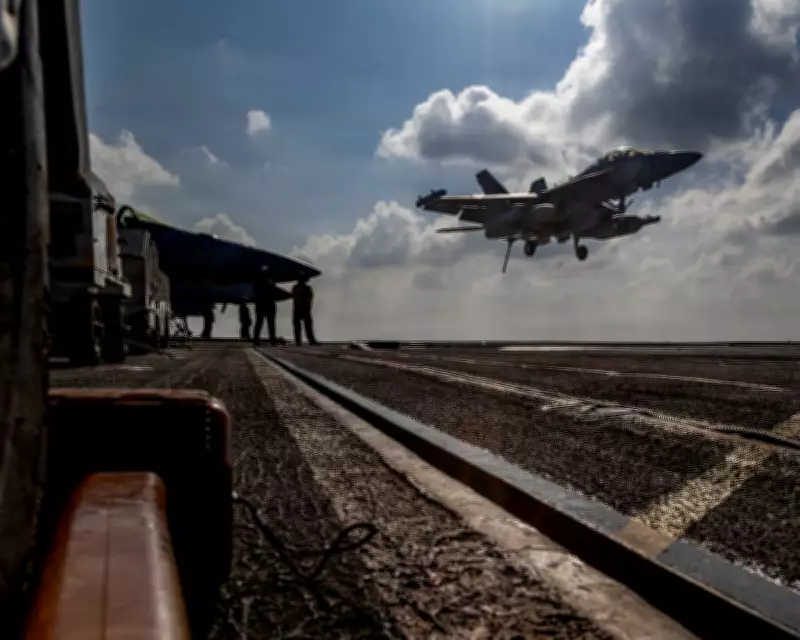
US Military Buildup Near Iran Raises Questions About Potential Strike Objectives
An EA-18G Growler aircraft has been photographed landing on the flight deck of the USS Abraham Lincoln aircraft carrier, symbolising the significant US military presence now positioned near Iran. This deployment comes amidst escalating rhetoric from former President Donald Trump, who recently told Iranian protesters that "help is coming," raising serious questions about what military action against Iran could realistically achieve.
Substantial Military Assets Now in Position
The strategic landscape has transformed dramatically in recent weeks. The USS Abraham Lincoln aircraft carrier has arrived in the Indian Ocean after being redirected from the South China Sea, accompanied by three destroyers equipped with Tomahawk cruise missiles. The carrier's air wing includes eight squadrons featuring advanced F-35C and F/A-18 jets, along with critical EA-18G Growlers designed to suppress any remaining elements of Iran's air defence systems.
Open-source intelligence monitors have observed transport planes delivering what appear to be US air defence systems to the Gulf region. This aligns with reports that Patriot and Thaad antimissile batteries are being deployed to protect US bases from potential Iranian drone and missile counterattacks against military installations throughout the Middle East.
Furthermore, approximately 35 F-15 fighter jets have been redeployed from RAF Lakenheath in Norfolk to Muwaffaq Salti airbase in Jordan. Originally scheduled to return to the United States, these aircraft now provide additional defensive coverage for Israel, Jordan, Iraq, and the broader region should hostilities escalate.
Potential Targets and Strategic Considerations
Michael Carpenter, a former member of the US National Security Council under President Joe Biden, suggests the most plausible military option would involve targeting Iran's supreme leader, Ayatollah Ali Khamenei. This would resemble a capture-or-kill operation similar to the planned seizure of Venezuela's former president Nicolás Maduro. Carpenter argues that attacking other key Iranian military sites would unlikely significantly degrade the country's regime, stating: "I find it unlikely, dubious, that these would have the strategic effects sought."
However, targeting Khamenei presents substantial challenges. Carpenter describes such an operation as "a very fraught operation with a dubious outcome." The successful planning for Maduro's capture relied on "exquisite intelligence from the inside" developed over five months of CIA preparation with sources within Maduro's government. It remains unclear whether similar intelligence exists regarding Iran, even with potential Israeli assistance.
During last June's 12-day conflict, Israel demonstrated chilling effectiveness in assassinating Iranian leaders, with Israeli sources revealing they tracked bodyguards' mobile phones to locate targets. Security procedures have likely been tightened since then, and as Israeli Foreign Minister Israel Katz acknowledged, Khamenei's security precautions kept him beyond their reach during that summer conflict.
Military Capabilities and Limitations
Iran possesses limited air defence capabilities to protect against Tomahawk missiles or incoming aircraft. Last June, Israeli jets operated over large portions of Iranian territory without suffering losses, enabling subsequent US bombing of the nuclear enrichment facility at Fordow. This month, US forces suppressed Venezuela's air defence systems within hours, demonstrating similar capabilities.
However, a capture operation would need to cover considerable distances—Tehran lies approximately 1,000 miles from the Indian Ocean—potentially favouring an assassination attempt over capture. Such action would represent extraordinary escalation: an attempt by the United States to kill the leader of another country with which it is not formally at war and from which it faces no immediate threat.
A western analyst, speaking anonymously, suggested a US attempt to kill Iran's supreme leader "is more likely than a capture attempt—and also less risky if it were to involve a standoff munition," though this would "depend heavily on the intelligence and the number of people who've been co-opted (if any have been) from his protective detail."
Potential Consequences and Iranian Response
The critical question remains what would follow any attack. Iran's regime has demonstrated sufficient cohesion to violently suppress demonstrators, with estimates suggesting up to 30,000 deaths. If Khamenei were killed, it's uncertain whether any successor would shift policy in directions desired by the White House. Although Khamenei has reportedly shortlisted three potential successors, a power struggle could emerge that the United States cannot control.
An immediate military response would almost certainly follow. On Sunday, Iran's President Masoud Pezeshkian warned that any attack on Khamenei would constitute a declaration of war. Iran's most potent defensive capability lies in offensive action, particularly through high-speed ballistic missiles—estimated at 2,000 units—stored in underground "missile cities."
The most obvious target for Iranian retaliation would be the USS Abraham Lincoln and accompanying warships. However, Matthew Savill of the Royal United Services Institute notes Iran "may not be able to fix its position" with available surveillance if the carrier remains in the Indian Ocean. "The US knows the closer to the Persian Gulf it goes, the more visible it is to the Iranians," he added.
Alternative counterstrikes could target US military bases in the Gulf, such as the al-Udeid airbase in Qatar, which serves as headquarters for US Central Command. Although recently reinforced with new Patriot air defence systems according to Chinese satellite imagery, last June demonstrated that 14% of Iranian ballistic missiles penetrated sophisticated Israeli and US air defences.
Such retaliation risks international escalation, potentially drawing Gulf states and their allies into conflict. The United Kingdom has already forward-deployed the RAF's 12 Squadron, a joint UK-Qatari unit at al-Udeid, to deter possible attacks and assist Qatari self-defence. Iran might alternatively attempt to mine the Strait of Hormuz, closing it to merchant shipping, though this would require submarines that US forces would closely monitor.
While Iran's military options appear limited, the White House similarly faces constrained prospects for achieving an instant strategic knockout through military action alone. The substantial US military buildup near Iran creates significant capability but raises fundamental questions about achievable objectives and potential consequences in an already volatile region.




