Potential US Military Action Against Iran: All Possible Scenarios Analysed
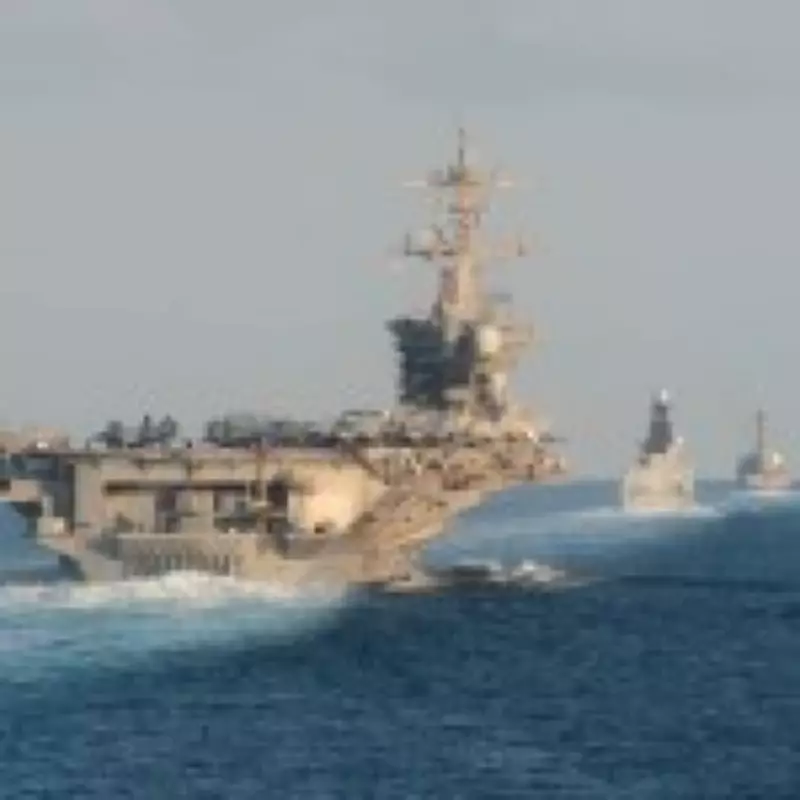
Iranian authorities are growing increasingly concerned about the possibility of American military intervention following widespread domestic protests that have led to violent suppression. The United States has strategically deployed the USS Abraham Lincoln aircraft carrier alongside several guided missile destroyers to the Middle Eastern region, creating significant naval strike capabilities that could facilitate attacks from maritime positions.
The ultimate decision regarding potential force usage rests with US President Donald Trump, whose intentions remain ambiguous despite establishing two clear red lines: the killing of peaceful demonstrators and potential mass executions of detainees. Trump recently communicated via Truth Social, stating: 'Hopefully Iran will quickly 'Come to the Table' and negotiate a fair and equitable deal – NO NUCLEAR WEAPONS – one that is good for all parties.'
Conflict Dynamics: Easy to Initiate, Difficult to Contain
As apprehension about American military action intensifies, Dr Bamo Nouri, an International Relations professor at the University of West London, emphasises that while Washington could easily commence hostilities, controlling the subsequent escalation would prove substantially more challenging.
'The United States possesses capability for precision strikes against military or nuclear facilities, but Iran's retaliation would likely involve indirect regional responses rather than conventional warfare,' Dr Nouri explained. 'These could include missile attacks, activation of regional proxies, sophisticated cyber operations, and maritime pressure tactics.'
Dr Nouri further cautioned that contemporary Iran differs fundamentally from Iraq in 2003, having spent over forty years developing survival strategies rather than defeat capabilities against American military might. The primary danger, according to his analysis, lies not in deliberate war decisions but in escalation through miscalculation, where even limited strikes could trigger unexpectedly broad conflict.
Regional Disruption and Global Economic Consequences
Experts warn that Middle Eastern instability could trigger severe worldwide economic repercussions, including dramatic oil price increases, heightened inflation rates, and political pressures extending far beyond regional boundaries.
Arshin Adib-Moghaddam, Professor at SOAS University whose ancestry connects to Persia's historic Zand dynasty rulers, identifies energy supplies as merely the most visible aspect of potential disruption. 'Furthermore, regional security would deteriorate significantly from current volatile conditions, with US allies hosting American military installations becoming probable retaliation targets following any unprovoked attack on Iran,' he added.
Dr Nouri reinforced this perspective, noting that current American military deployments and rhetoric should be interpreted as coercive signalling rather than invasion preparation. 'The United States can certainly threaten war with Iran, but cannot realistically afford the comprehensive conflict that would inevitably follow,' he concluded.
Governance Scenarios Following Targeted Military Action
Dr Dafydd Townley, Senior Teaching Fellow in International Security at the University of Portsmouth, suggests President Trump perceives Iran as a major destabilising influence in the Middle East, potentially explaining his interventionist inclinations.
'Trump clearly desires establishment of more Western-aligned governance structures,' Dr Townley observed. 'However, non-military interventions including technological assistance and diplomatic support for protesters might ultimately serve American interests more effectively.'
Should precision strikes eliminate key military and governmental infrastructure, this could theoretically create opportunities for pro-democracy protesters to assume control. Alternatively, the Iranian regime might collapse while the Islamic Revolutionary Guard Corps maintains population control, potentially resulting in further violent suppression.
American Naval Deployment and Iranian Response Capabilities
The USS Abraham Lincoln strike group, accompanied by three additional warships, has arrived in the Middle East with stated objectives of promoting regional security and stability according to US Central Command. Notably, the naval contingent remains positioned in the Indian Ocean rather than the Iranian-bordering Arabian Sea.
This deployment introduces thousands of additional military personnel to a region that has lacked American aircraft carrier presence since the USS Gerald R Ford's October redeployment to the Caribbean during Venezuelan political pressures. While Iranian military capabilities cannot match American armed forces directly, the country has warned of readiness to respond if attacked.
Potential Iranian retaliation could target numerous American military bases distributed throughout the region using ballistic missile systems, or alternatively focus on US regional allies including Jordan and Israel. The strategic situation remains fluid, with multiple escalation pathways possible depending on political decisions and military developments.