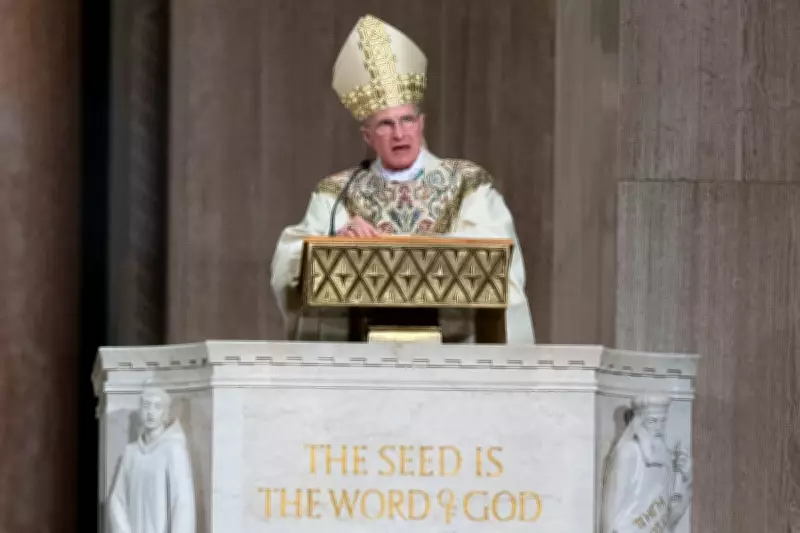
US Military Archbishop Challenges Moral Justification for Iran Conflict
Archbishop Timothy Broglio, the spiritual leader overseeing all Catholic chaplains serving within the United States armed forces, has publicly questioned the moral righteousness of the ongoing US military campaign against Iran. In a significant theological and political statement, Broglio asserted that the conflict fails to satisfy the established criteria of the "just war" theory, a centuries-old framework for evaluating the morality of warfare.
The Just War Framework and Its Application
The just war theory, deeply rooted in the theological works of Saints Augustine and Thomas Aquinas, provides a philosophical and legal structure to assess when initiating war is morally permissible—known as jus ad bellum—and how such wars should be conducted, termed jus in bello. Core principles mandate that war must be an absolute last resort, undertaken by legitimate authority to correct a grave wrong, with right intent and proportional means, all aimed at achieving a lasting peace.
In a pre-recorded interview for CBS News's Face the Nation, Archbishop Broglio directly applied this framework to the current Iran situation. While acknowledging Iran as "a threat with nuclear arms," he argued that the US military action constitutes "compensating for a threat before the threat is actually realized." This preemptive stance, he suggested, conflicts with the just war requirement that all peaceful alternatives be exhausted first.
Broglio's Theological and Pastoral Perspective
"The Lord Jesus certainly brought a message of peace and also—I think war is always a last resort," Broglio told CBS. He carefully noted he was not making a definitive judgment due to incomplete information, but emphasized, "I do think that it's hard to cast this war... as something that would be sponsored by the Lord."
His comments extend to the rhetoric used by some US officials. When asked about Defense Secretary Pete Hegseth's call for Americans to pray daily "on bended knee" for military victory "in the name of Jesus Christ," Broglio found it "a little problematic." He reiterated that Jesus preached peace and viewed war strictly as a final option, though he conceded officials might possess undisclosed intelligence justifying their stance as the "only choice."
Broglio aligns himself with Pope Leo XIV, the first US-born pontiff, who has consistently urged for negotiation and de-escalation. The Pope recently warned against the "desire for domination" distorting Christian mission, calling it "entirely foreign to the way of Jesus Christ."
Political Divisions and Military Dilemmas
These theological critiques are poised to inflame existing political divisions. The Trump administration defends the campaign, citing Iran's sponsorship of terrorism, its missile program, and production of highly enriched uranium. Conversely, Democratic critics label it a "war of choice" and accuse the President of bypassing congressional authorization. As the conflict prolongs, recent polling indicates President Trump's approval rating stands at 35%.
For Catholic service members, Broglio offers pastoral counsel: "do as little harm as you can—and to try to preserve innocent lives." He highlighted a structural dilemma within the US military's conscientious objection policy, which only permits objection to war in general, not to specific conflicts or actions. This leaves service members and even senior commanders in a moral bind. "The question might be, would generals or admirals have space to perhaps, say, 'Can we look at this a different way?'" Broglio pondered, adding that many leaders face the "same dilemma."
Archbishop Broglio's intervention places the Iran conflict under a rigorous moral and theological spotlight, challenging both political narratives and military policy from a foundational religious perspective centered on peace and last-resort justification.