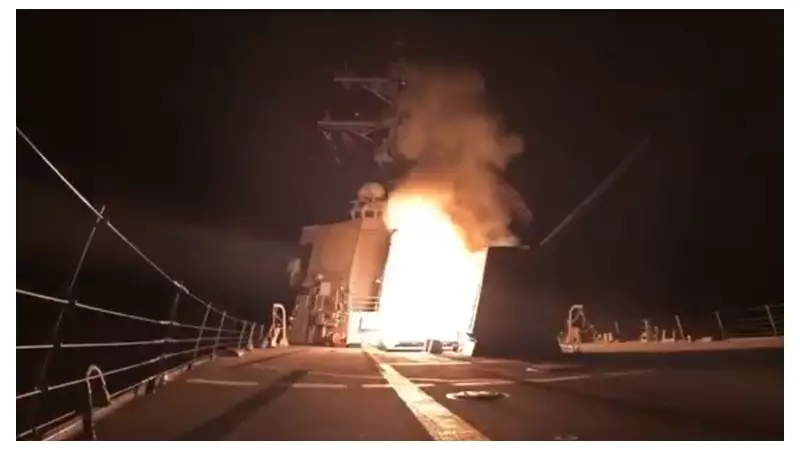
The United States military has carried out a series of airstrikes against Islamic State (ISIS) militants in northwest Nigeria, an operation announced directly by US President Donald Trump. The strikes, described by the President as "powerful and deadly," were conducted in coordination with the Nigerian government and reportedly resulted in multiple militant casualties.
Trump's 'Hell to Pay' Warning Executed
President Trump revealed the military action on his Truth Social platform on Friday 26 December 2025. He stated the strikes were directed against "ISIS Terrorist Scum" in Nigeria's Sokoto State, whom he accused of targeting and killing innocent Christians "at levels not seen for many years."
"I have previously warned these Terrorists that if they did not stop the slaughtering of Christians, there would be hell to pay, and tonight, there was," Trump wrote. He credited the US Department of War with executing "numerous perfect strikes, as only the United States is capable of doing."
Coordinated Response with Nigerian Authorities
The US Africa Command confirmed the operation was conducted "in coordination with Nigerian authorities." This cooperation was echoed by US Defence Secretary Pete Hegseth, who posted on X that he was grateful for Nigeria's "support and cooperation." Hegseth added the message was delivered specifically "on Christmas," signalling a pointed response to the persecution of Christians.
Nigeria's foreign ministry later confirmed that "precision air strikes by the US had hit 'terrorist targets'" in the country's northwest. The ministry affirmed Nigeria's ongoing cooperation with the US to address "the persistent threat of terrorism and violent extremism."
Background of Tensions and Designation
This military intervention follows a month of escalating rhetoric from the Trump administration regarding Nigeria. In November 2025, Trump said he had ordered the Pentagon to plan for potential action in response to reports of Christian persecution.
His administration also designated Nigeria a "country of particular concern" under the International Religious Freedom Act. This move paved the way for visa restrictions on Nigerians believed to be involved in mass killings and violence against Christians.
The Nigerian government has previously challenged the characterisation of the conflict as solely religious, stating that Trump's claims misrepresent complex security challenges where armed groups also target Muslims. However, it has consistently agreed to work with the US to bolster counter-terrorism efforts.
In a statement after the strikes, Nigeria's foreign ministry emphasised that all counter-terrorism efforts must protect civilian lives and national unity, upholding the rights of all citizens "irrespective of faith or ethnicity."
The security situation in northern Nigeria remains severe, underscored by a mass abduction of over 300 students from a Catholic school in November. Those students were fortunately freed by 22 December.