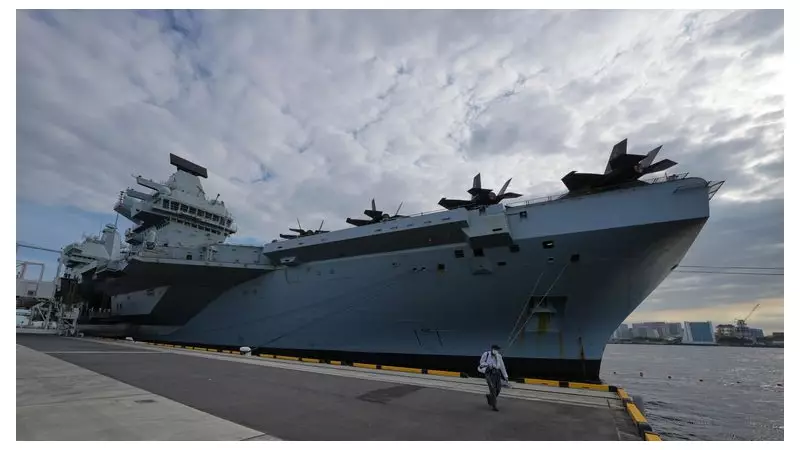
Britain's flagship aircraft carrier, HMS Prince of Wales, has been declared fully operational and ready for potential conflict, Defence Secretary John Healey announced during a visit to the warship off the coast of Naples. The vessel, representing a significant component of NATO's maritime strength, is on standby to mobilise within five to ten days in a crisis situation.
A Show of Force and a Stark Reality
Speaking from the deck of the 65,000-tonne carrier, Mr Healey positioned the ship's readiness as a direct message to potential adversaries. "This today sends a message to Putin and any would-be adversaries," he stated, emphasising the collective power of the UK and the 20 nations that participated in the carrier's recent eight-month global deployment.
The demonstration of this capability was made clear when F-35B stealth jets conducted 36 sorties from the carrier's deck within a single 24-hour period in the Mediterranean. This marked the highest rate of sorties from a British aircraft carrier since the Falklands War in 1982.

However, defence sources provided a crucial caveat to this show of force. They revealed to Sky News that the UK cannot operate the £3.1 billion vessel—the Royal Navy's largest and most expensive ship—without assistance from allied nations. The sources cited a shortage of British warships, support vessels, stores, and sailors necessary for solo operations.
Global Deployment Tests UK's Resolve
The HMS Prince of Wales has just completed a nearly eight-month deployment that strategically tested its mettle against three of the UK's primary security concerns. The deployment, which began in April from Portsmouth, saw the carrier and its strike group navigate a series of global hotspots.
The carrier travelled through the Red Sea amidst high tension due to threats from Iranian-backed Houthi militants in Yemen. It also passed approximately 200 miles from the Russian coast during a visit to Japan and transited the contentious Taiwan Strait while moving through the South China Sea—a move often viewed as provocative by China.
Commodore James Blackmore, commander of the carrier strike group, expressed absolute confidence in his force's readiness. "We have returned to the Mediterranean and the Euro-Atlantic stronger than we departed for NATO, having declared full operating capability," he told Sky News.
The Two-Carrier Strategy and Its Limitations
With HMS Prince of Wales now joining its sister ship, HMS Queen Elizabeth, in being declared ready for operations, the Royal Navy has achieved a long-awaited strategic goal. The two-carrier programme, first agreed upon in 1998, now ensures that one vessel can be on standby for deployment while the other undergoes maintenance.
During its recent deployment, the carrier strike group, which included a Royal Navy destroyer, a frigate, and a Norwegian vessel, worked with a total of 20 ships from 10 nations. Its F-35 jets carried out more than 1,000 sorties over the eight-month period.
Yet, the reliance on NATO for escort vessels underscores a critical gap in the UK's independent naval capabilities. As one source bluntly put it, the strike group "can only support NATO if NATO provides escorts!" They added that operating the carrier independently would require "turning off other UK commitments," a capability the United States possesses but the UK currently lacks.