
Trump's Midnight Declaration Upends Decades of US Foreign Policy
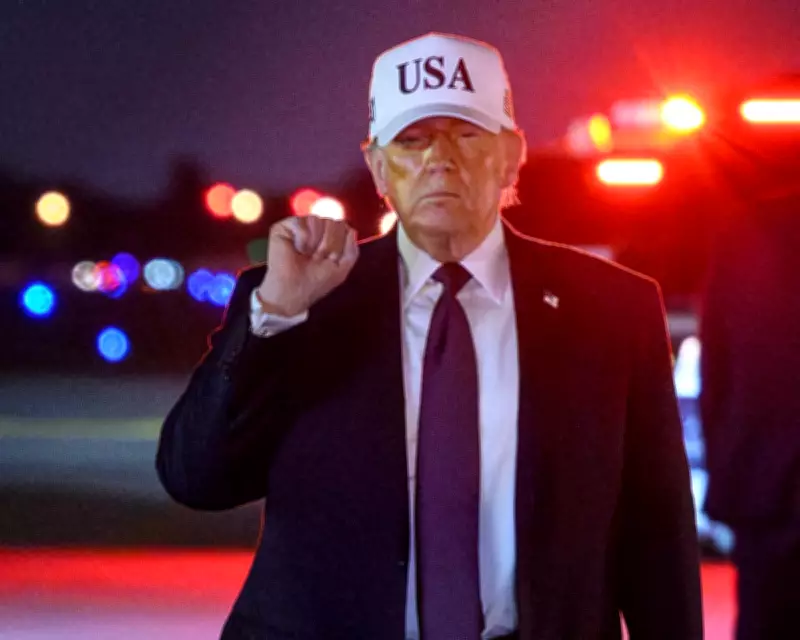
In the early hours of Saturday morning, while most Americans slept, Donald Trump delivered an eight-minute video message that fundamentally altered half a century of United States foreign policy. The president, wearing his signature "USA" cap and speaking from what appeared to be his Mar-a-Lago residence in Florida, announced a major military operation against Iran through his Truth Social platform at 2:30 AM.
A Historic Foreign Policy Shift
This dramatic announcement represents Trump's latest departure from his campaign promises to avoid prolonged foreign conflicts. The president, who previously received a questionable peace medal from FIFA president Gianni Infantino, now finds himself compared to George W. Bush, whose 2003 Iraq invasion was recently declared the worst foreign policy decision in history by the Council on Foreign Relations.
Unlike Bush, who at least attempted to justify his actions through the United Nations, Trump offered minimal explanation to Congress or the American public before initiating military action. The president had amassed significant military assets in the Middle East with little transparency, mentioning Iran only briefly during his recent State of the Union address.
The Justification and Its Gaps
In his video statement, Trump characterized the Iranian regime as "a vicious group of very hard, terrible people" whose activities "directly endanger" the United States and its allies. He recounted historical grievances including the Iran hostage crisis, Marine barracks bombing, USS Cole attack, and Iranian involvement in harming US troops in Iraq.
"It's been mass terror, and we're not going to put up with it any longer," Trump declared. However, the president failed to address the crucial question of timing—why this action was necessary now, after years of Iranian activities.
The president referenced Iranian proxy groups, Hamas's October 7 attacks on Israel, and Iran's status as "the world's number one state sponsor of terror." He reiterated US opposition to Iranian nuclear weapons while acknowledging Tehran's refusal to abandon its nuclear ambitions.
Regime Change and Its Consequences
Most remarkably, Trump explicitly called for regime change in Iran, urging the Iranian people to "take over your government" after military operations concluded. "This will be, probably, your only chance for generations," he told Iranian citizens, positioning himself as the first president willing to provide the assistance they had supposedly requested for years.
This represents a stunning reversal for a president who previously criticized foreign interventions and regime change operations. The ghost of Donald Rumsfeld's Iraq policies seemed to haunt the announcement, while Trump's former critics like John Bolton and Lindsey Graham likely celebrated the aggressive stance.
The Human Cost and Political Fallout
Trump acknowledged the potential human cost of his decision, stating that "the lives of courageous American heroes may be lost, and we may have casualties. That often happens in war." This admission reflects the reality television president's understanding of how American casualties could damage public perception of the conflict.
Democratic Senator Ruben Gallego, an Iraq war veteran from Arizona, responded sharply on social media: "Draft dodger is willing to sacrifice working-class kids. How charitable of him."
A Pattern of High-Stakes Gambles
This latest action continues Trump's pattern of high-risk foreign policy decisions, including moving the US embassy to Jerusalem, killing Iranian commander Qassem Suleimani, imposing sweeping tariffs, and capturing Venezuelan president Nicolás Maduro. Each previous action drew warnings of catastrophe that failed to materialize fully, emboldening the president to take increasingly dramatic steps.
However, Iran represents a gamble of unprecedented scale. The lessons of Iraq demonstrate that while regime change might be achievable, the aftermath can create lasting instability and suffering. Trump has yet to articulate a comprehensive long-term strategy beyond hoping for positive outcomes from military action.
As Ben Rhodes, former deputy national security adviser under President Barack Obama, noted on social media: "Trump's second term has been the worst-case scenario." Operation Epic Fury, as the Iran action has been dubbed, launches the United States into uncertain territory with potentially generational consequences for Middle Eastern stability and American foreign policy credibility.




