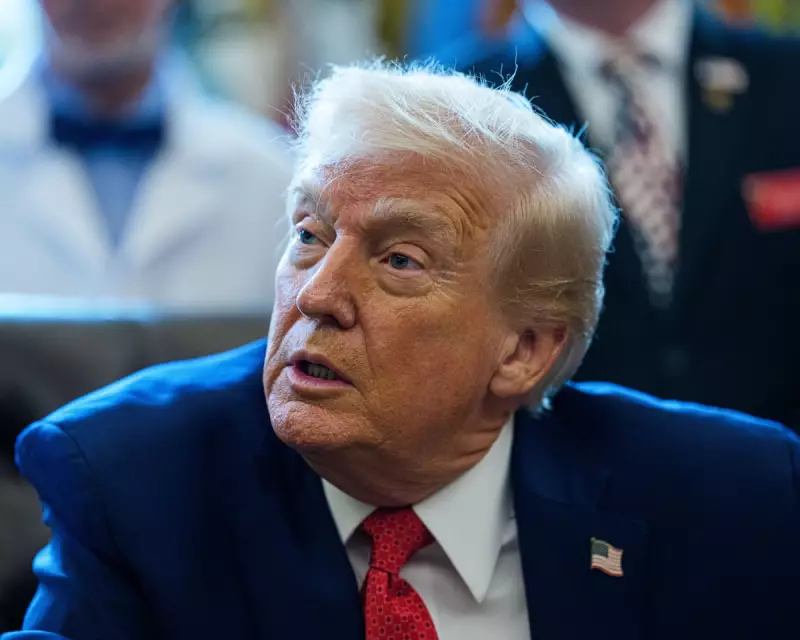
President Donald Trump has signed the United States' colossal annual defence policy bill into law, authorising a record level of military expenditure and providing continued support for Ukraine, despite his administration's stated desire to reassess America's role in Europe.
A Record-Setting Defence Authorisation
The fiscal 2026 National Defense Authorization Act (NDAA) was signed by the President at the White House on Thursday. The legislation green-lights a staggering $901 billion in annual military spending, which is $8 billion more than the Trump administration itself had initially requested. The total value of the bill approaches one trillion dollars.
This sweeping act dictates a vast range of military matters, from procurement of ships and aircraft to troop pay rises and strategies for confronting global threats. Notably, the signing was a subdued event, breaking with the tradition of a ceremonial Oval Office gathering with the press.
Provisions Clash with Trump's 'America First' Stance
The passage of the NDAA represents a significant compromise, merging versions from the Republican-controlled House and Senate. It contains several measures that appear to run counter to President Trump's publicly stated foreign policy objectives.
Trump has been notably cool towards bolstering European security alliances, frequently arguing that NATO allies should shoulder more of the financial burden. His recently published national security strategy is widely viewed as favourable towards Russia and sceptical of the European Union.
Despite this, the 2026 NDAA includes $800 million for Ukraine – allocated as $400 million in each of the next two years – under the Ukraine Security Assistance Initiative. This funding is designated to pay American defence companies for weapons destined for Kyiv's military. This legislative move comes as Trump's diplomatic team continues protracted negotiations aimed at halting Russia's ongoing invasion.
The defence law also reinforces US commitments in Eastern Europe by:
- Authorising the Baltic Security Initiative.
- Providing $175 million to support the defences of Latvia, Lithuania, and Estonia.
- Limiting the Pentagon's ability to reduce US troop levels in Europe below 76,000.
- Barring the US European commander from relinquishing the title of NATO Supreme Allied Commander.
White House Highlights Domestic Policy Wins
In a statement, the White House framed the President's support for the bill by focusing on domestic policy victories it enshrines into law. The administration highlighted that the NDAA codifies aspects of several Trump executive orders, including funding for his proposed "Golden Dome" missile defence system and the elimination of diversity, equity, and inclusion (DEI) programmes within the Pentagon.
This year's signing stands in contrast to the end of Trump's first term. In December 2020, he vetoed the NDAA over objections to renaming military bases honouring Confederate figures and disagreements on tech company liability shields. That veto was overridden by Congress in January 2021, marking the only such override of his first presidency.
The annual defence bill has now been passed by Congress for 65 consecutive years, a streak that was nearly broken during that earlier political standoff.