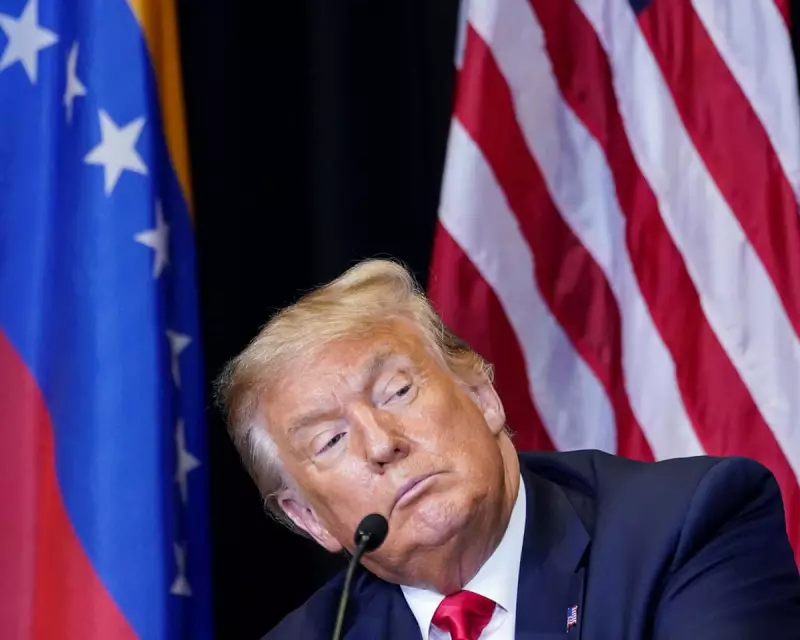
The Trump administration has initiated a concerning new chapter in America's long-running 'war on terror', with recent military actions targeting Venezuela raising alarm among experts and human rights advocates. Over the past two months, US forces have gathered near Venezuelan territory and conducted lethal strikes against civilian vessels, resulting in more than 80 fatalities.
Expanding Presidential War Powers
The White House justifies these aggressive measures under the banner of combating 'narco-terrorists' - a broadly defined term that appears to encompass anyone suspected of drug trafficking activities near Latin American coastlines. This development represents a significant escalation in Trump's approach to executive power, particularly regarding military authority.
According to analysis by Daniel Mendiola, a professor of Latin American history at Vassar College, the administration is systematically dismantling oversight mechanisms that traditionally constrained presidential war powers. The justice department has argued that officials aren't required to publicly identify which foreign organisations they classify as legitimate targets, nor provide evidence supporting these designations.
Historical Context of Civilian Casualties
The grim history of the war on terror provides sobering context for these recent developments. Research from Brown University's Costs of War project reveals that US-led interventions between 2001 and 2023 directly killed over 400,000 civilians through combat violence. When accounting for indirect deaths - including those resulting from destroyed infrastructure and disrupted medical services - the estimated death toll rises dramatically to at least 3.5 million people.
Furthermore, a recent Lancet study highlights the devastating impact of sanctions during this period, linking them to approximately 500,000 excess deaths annually from 2010 to 2021. These figures underscore the enormous human cost of anti-terror policies that Trump now seeks to expand with even fewer restrictions.
Legal Challenges and Authoritarian Trends
The administration's approach to military deployment faces legal challenges that reveal its broader authoritarian tendencies. In court cases involving protest suppression in Chicago, Trump's lawyers have advanced a radical legal theory suggesting the president possesses unilateral authority to define what constitutes a 'rebellion' justifying military deployment, regardless of factual circumstances.
This same logic now extends to Venezuela, where the administration claims essentially unchecked power to designate targets as terrorists and authorise lethal force. Trump has defended targeting drug smugglers as terrorists by citing overdose deaths in the United States, despite Venezuela not being a significant producer of fentanyl, the primary driver of America's overdose crisis.
The president has even made mathematically implausible claims that each boat strike saves 25,000 lives, while officials have provided no public evidence that targeted vessels were actually carrying drugs. More troubling still, they've offered no explanation how destroying boats would meaningfully impact drug abuse in the US.
This new phase in the war on terror represents a dangerous escalation with potentially catastrophic humanitarian consequences. As recent history demonstrates, when presidential war powers operate without meaningful oversight, the results often prove devastating for civilian populations. The situation in Venezuela demands careful scrutiny, as countless lives hang in the balance.