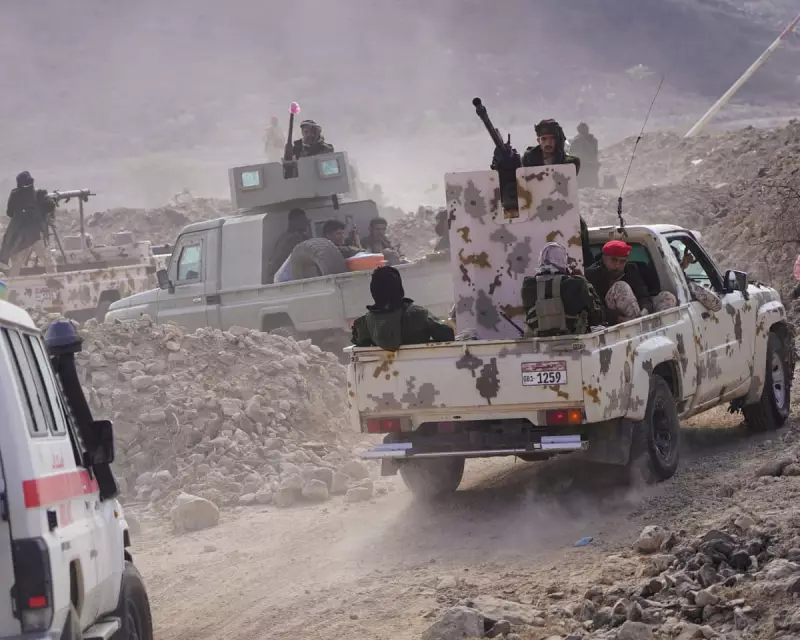
Forces loyal to Saudi Arabia are amassing on Yemen's border, creating a tense standoff with the UAE-backed Southern Transitional Council (STC) which is refusing orders to withdraw from significant territorial gains made in recent weeks. The development threatens to fracture the anti-Houthi coalition and risks a direct confrontation between the two Gulf powers on Yemeni soil.
Military Buildup and Defiant Separatists
The crisis escalated after the STC, a separatist group seeking to restore the former independent state of South Yemen, launched a sudden military operation. Over the past month, its forces have advanced into the vast, oil-rich governorate of Hadramaut and the neighbouring regions of al-Mahra and Abyan. This swift move stunned Riyadh, which had been the dominant external player in Yemen's complex war.
In response, Saudi Arabia has reportedly warned the STC it could face direct airstrikes if it does not pull back. Meanwhile, as many as 20,000 well-paid troops from the Saudi-funded National Shield militia have been gathering in the al-Wadeeah and al-Abr areas near the border. The STC, however, has been publicly defiant. Following talks in its Aden stronghold last Friday, it stated it would not obey Saudi demands for withdrawal.
A Fracturing Coalition and Regional Warnings
The situation exposes a deep rift within the coalition that has been fighting the Houthi movement in northern Yemen. The STC is backed by the United Arab Emirates, while the opposing forces are aligned with Saudi Arabia. The UN Secretary-General, António Guterres, issued a stark warning on Wednesday, stating that a full-scale resumption of fighting "could have consequences across the Red Sea, the Gulf of Aden and the Horn of Africa." He urged all parties, including external actors, to avoid unilateral actions that deepen divisions and risk wider escalation.
Guterres emphasised that "the sovereignty and territorial integrity of Yemen must be preserved," noting that nearly five million Yemenis are already displaced from their homes. The STC is using its military gains to push for a return to a two-state solution, arguing an independent south could act as a bulwark against Houthi and al-Qaida terrorism. However, not all southern groups support this secessionist aim.
Local Opposition and Accusations of Abuse
Within the newly captured territories, there is significant local opposition to the STC's presence. Abdulrazak al-Hijri, acting secretary general of Yemen's largest political party, Islah, told the Guardian that calls for the STC to leave Hadramaut were growing. He accused the group's "irregular forces" of invading stable areas and throwing them into chaos, citing reports of human rights abuses including theft and mass arrests.
Islah, which is opposed to southern secession and denies links to the Muslim Brotherhood as alleged by the UAE, was until recently part of a Saudi-organised presidential leadership council that uneasily included the STC. Al-Hijri warned that "the only beneficiary of these intensified divisions will be the Houthis." With control of Hadramaut, which spans 36% of Yemen's territory and holds its largest oil reserves, the STC can now claim authority over all land that constituted the pre-1990 southern state.
Analyst Farea al-Muslimi of Chatham House suggested Saudi Arabia's "strategic patience" was wearing thin. "While much of what has happened is not surprising for Yemen observers, the optics is too humiliating for Saudi Arabia. This is playing out on its borders, not those of the UAE," he said, highlighting the high-stakes proxy conflict now unfolding.