Odesa Under Sustained Russian Assault as Black Sea Conflict Escalates
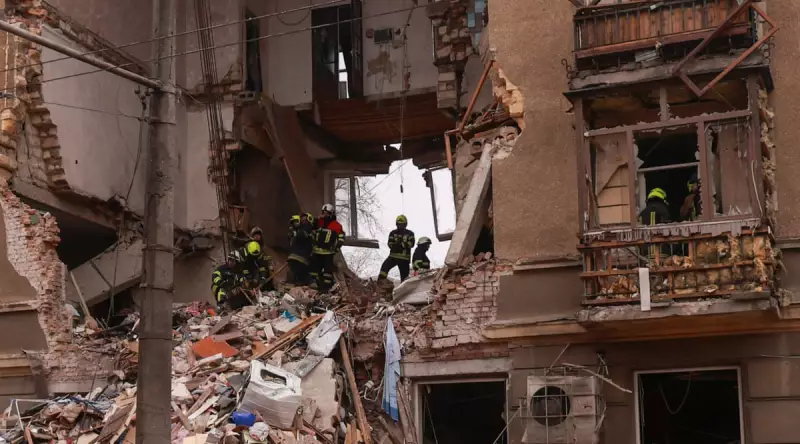
In the freezing temperatures of Odesa, residents and rescue workers gather outside the Kadorr apartment complex, approximately 500 metres from the Black Sea coastline. The scene reveals the devastating aftermath of a Russian drone strike that has blown out a section of wall on the 25th floor of an office building. Below, rubble and shattered glass have been hastily piled up, while car owners survey vehicles crushed by falling masonry.
Civilian Lives Disrupted by Relentless Attacks
Anastasia, a 35-year-old resident displaced from Donetsk following Russia's invasion and occupation of eastern Ukraine, now faces renewed danger in Odesa. "I was sleeping when the building shook. At first, I thought it was a dream," she recounts. "I didn't hear the explosion, but I heard another Russian Shahed drone that was extremely loud. It had been quite quiet since I've been here, but recently it's started to feel more dangerous. I haven't decided whether to move, but right now I'm scared."
Her experience reflects a broader pattern of escalating violence. Russian strikes against Odesa have intensified dramatically in recent months, reigniting conflict in the Black Sea region after a period of stalemate. This escalation coincides with Ukrainian operations targeting Russian oil tankers and the naval base at Novorossiysk, prompting renewed Russian focus on what Vladimir Putin has long claimed as historically Russian territory.

Strategic Importance and Military Reality
Despite Putin's December threat to cut Odesa off from the sea, capturing or blockading the port remains beyond Moscow's military capabilities. Ukrainian naval missile batteries have proven effective, famously sinking the Moskva warship early in the conflict. Consequently, Russia has adopted a strategy of long-range bombardment using missiles and drones.
The most significant recent attack occurred on 13 December, when 160 drones and missiles targeted energy infrastructure, leaving substantial portions of the city without water and electricity for extended periods. This marked the beginning of near-daily assaults that have created persistent humanitarian challenges.
Defence Challenges and Psychological Warfare
Dmytro Pletenchuk, spokesperson for Ukraine's navy, illustrates the relentless nature of the attacks by referencing a January calendar marked with daily strikes. "The Russians attack the energy infrastructure day after day and night after night because it is so cold now they think we must capitulate," he explains.
The Black Sea presents unique defence complications according to Oleh Kiper, governor of the Odesa region. While the sea provides a natural barrier, it prevents the layered air defence systems protecting inland cities like Kyiv. This vulnerability enables long-range strikes from Russian-occupied Crimea.
Lt Col Denys Nosicov, head of territorial defence groups in southern Ukraine, describes the combined rocket and drone attacks as psychological warfare. "The aim is to put psychological pressure on the population of the Odesa region. They want to damage our morale," he states, noting accompanying Russian psychological operations on social media.
Economic Warfare and Reconstruction Challenges
Ukrainian President Volodymyr Zelenskyy emphasises the economic dimension of the attacks. "They definitely want to cut off Odesa and other cities in terms of infrastructure," he states. "They are striking and killing both people and the economy by reducing our export capabilities through the maritime corridor."
With 90% of Ukraine's agricultural exports passing through Odesa's ports, shipping routes have become active war zones. Military analyst Oleksandr Kovalenko describes the Black Sea as both an economic lifeline and a vulnerability, feeding the nation while exposing it to attack.

The assault extends to educational institutions, as demonstrated at the Lyceum for Construction and Architecture. Director Igor Chernenko supervises cleanup after three Shahed drones struck the trade school on 13 January, destroying archives dating to 1945 and displacing 320 students and 72 staff. "I can't think why the Russians would hit here," he reflects. "My only thought is that they don't want us to prepare workers who will rebuild Ukraine."
Preparing for Continued Conflict
Despite the challenges, Ukrainian forces continue defensive preparations. Nosicov confirms ongoing work to establish circular defences around Odesa with anti-tank traps, kill zones, and mines. "We will always take this Russian threat seriously," he asserts, while expressing confidence that any Russian attempt to capture Odesa would result in significant defeat.
The situation remains precarious for Odesa's civilians, who endure freezing conditions without reliable electricity, water, or heating as Russia pursues its long-range bombardment strategy against this strategically vital Black Sea city.