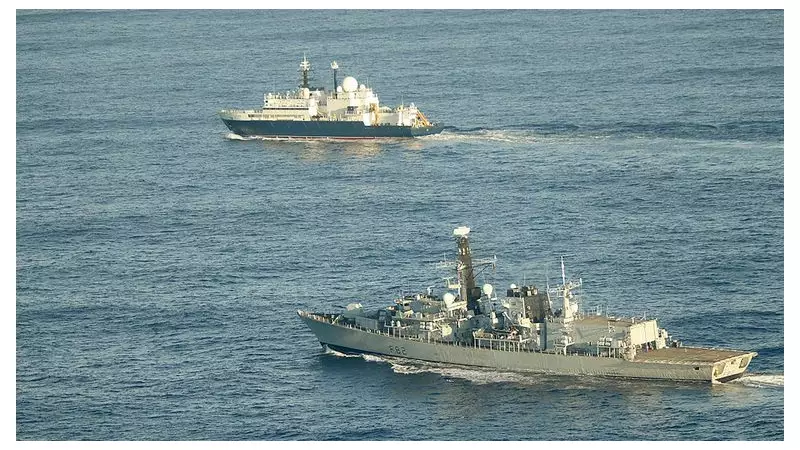
The mysterious Russian ship Yantar, long suspected of being a spy vessel, has been detected operating on the periphery of UK waters once again, raising fresh concerns about the security of Britain's critical undersea infrastructure.
A Vessel with Dual Purpose
Officially classified as a "research" or "survey" ship flying the Russian flag, the Yantar's operations tell a different story. The vessel is operated by the Main Directorate of Deep-Sea Research, a highly secretive branch of the Kremlin's armed forces. This connection immediately casts doubt on its purely scientific mission.
Measuring approximately 34 metres (112 feet) in length, the Yantar is equipped with an array of sophisticated antennae and detection equipment. Its most notable capability is acting as a mothership for two advanced mini-submarines. These submersibles are believed to be capable of diving to depths of 20,000 feet, nearly twice the depth of the Titanic wreck, allowing them to access the most remote seabed environments.
Patterns of Suspicious Activity
This latest sighting marks the second time in a year that the Yantar has entered UK waters, as confirmed by Defence Secretary John Healey on Wednesday, 19 November 2025. While the ship complied with international navigation rules, its repeated presence near sensitive subsea installations is viewed with deep suspicion by security experts.
Mr Healey left little room for ambiguity earlier this year, stating unequivocally that the Yantar is a Russian spy ship used for gathering intelligence and mapping the UK's critical underwater infrastructure. This infrastructure includes the vast networks of undersea cables and pipelines that connect the UK to Europe and the rest of the world, forming the backbone of global internet and energy supplies.
The Vulnerability of Britain's Undersea Lifelines
The recurring presence of vessels like the Yantar has sparked serious questions about the protection of these vital assets. A parliamentary report from the National Security Strategy Committee in September concluded that the government is being "too timid" in its defence of undersea cables.
According to Dr Sidharth Kaushal, an expert in maritime technology at the RUSI thinktank, while there is some redundancy in the undersea cable network, the pipelines supplying gas to British homes are potentially more fragile. He noted that the UK is heavily reliant on a handful of critical pipelines, making them a significant vulnerability in an era of hybrid warfare where deniable sabotage is a real threat.
This activity fits a broader pattern, with experts believing that Russia has spent recent years covertly mapping undersea cables in the West, including some military cables whose locations are not publicly known. The incident in January, when HMS Somerset was dispatched to escort the Yantar, underscores the ongoing concern within UK defence circles about these maritime operations.