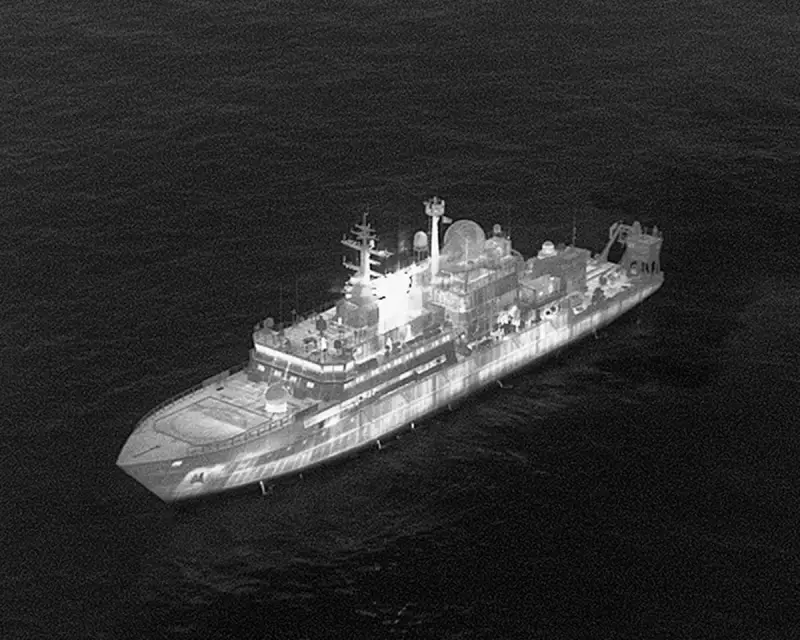
The Defence Secretary, John Healey, has revealed that a Russian surveillance vessel, the Yantar, entered British waters and deliberately directed lasers at Royal Air Force pilots monitoring its movements. This dangerous act marks a significant escalation in Russian incursions near the UK coast.
A Dangerous Escalation in UK Waters
Speaking from Downing Street, John Healey confirmed that the Russian spy ship Yantar has been operating on the edge of UK waters, north of Scotland, crossing in and out of the UK's exclusive economic zone multiple times in recent weeks. This is the second such occurrence this year, but the first time the vessel's crew has targeted British military personnel with lasers.
"We deployed a Royal Navy frigate and RAF P-8 planes to monitor and track this vessel's every move, during which the Yantar directed lasers at our pilots," Healey stated. He emphasised that "anything that impedes, disrupts or puts at risk pilots in charge of British military planes is deeply dangerous."
Tracking the Yantar's Movements
The Yantar, a ship specifically designed for intelligence gathering and mapping undersea infrastructure, was previously tracked in UK waters in January. On that occasion, a British nuclear-powered submarine surfaced close to the vessel. In response to the recent provocations, Healey has authorised a change to the Royal Navy's rules of engagement, permitting British ships to shadow the Yantar much more closely.
Officials believe the ship's primary mission is to map critical British undersea communications cables, a activity that poses a substantial risk to national security. This incident is part of a broader pattern of Russian probes into NATO territory, which has recently included drone flights over Poland and Belgium.
Broader Defence and Political Implications
Healey used the event to underscore the necessity of the government's recent decision to increase defence spending. He announced that a portion of this new funding would be allocated to building 13 new ammunition factories to bolster national security.
The speech also touched upon the UK's complex negotiations regarding a new European defence fund, known as the Safe fund. While the EU is reportedly asking for a contribution of up to €6.5bn, the UK has so far offered only a fraction of that amount. "We're ready to be part of this scheme, but we're not ready to be willing at any price," Healey remarked, indicating a challenging path to an agreement.
This latest confrontation serves as a stark reminder of the persistent and evolving threats facing the UK, reinforcing the government's focus on strengthening the nation's defensive capabilities.