
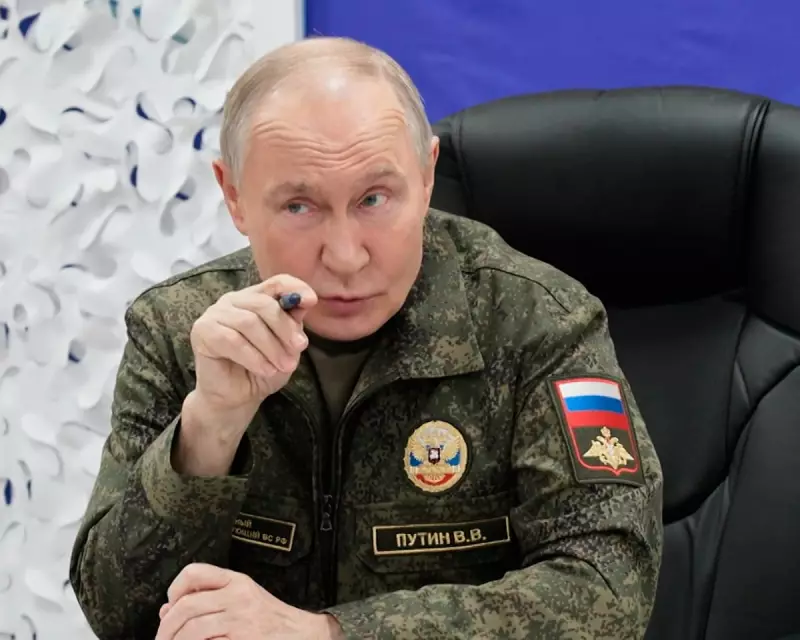
Russian President Vladimir Putin has expressed support for a United States-proposed peace plan to resolve the nearly four-year conflict in Ukraine, while Ukrainian President Volodymyr Zelenskyy faces what he describes as one of the most difficult moments in his country's history.
Putin's Conditional Acceptance
The Russian leader stated that the American proposal could serve as the foundation for a final resolution to the war that has now entered its 1,368th day. Putin characterised Ukraine's resistance to the plan as unrealistic, declaring that "Ukraine and its European allies are still under illusions and dream of inflicting a strategic defeat on Russia on the battlefield."
Addressing Russia's national security council, Putin referred to the 28-point strategy as "a new version" and "a modernised plan" of discussions that had previously taken place with the US ahead of his Alaska summit with Donald Trump in August. The Russian president confirmed that Moscow has officially received the proposal and believes it "could form the basis of a final peace settlement."
Ukrainian Resistance and European Concerns
President Zelenskyy delivered a sombre ten-minute speech outside the presidential palace, warning that agreeing to the US-Russian plan would force Ukraine to make painful concessions that could leave the nation "without freedom, dignity and justice." His comments reinforce concerns among European and Ukrainian officials who view the proposed deal as amounting to capitulation.
The Trump administration has reportedly given Kyiv until Thursday to accept the terms, with the former president stating he considered this "an appropriate time" for Zelenskyy to sign the agreement. According to reports from the Financial Times, US officials have indicated little room for negotiation on the plan's fundamental elements.
International Reactions and Diplomatic Maneuvering
European leaders have moved quickly to reassure Ukraine of their continued support. Zelenskyy held crucial telephone discussions on Friday with German Chancellor Friedrich Merz, French President Emmanuel Macron, and British Prime Minister Keir Starmer.
According to Merz's office, the three European leaders assured Zelenskyy of "their unchanged and full support on the way to a lasting and just peace" in Ukraine. They emphasised that any agreement to end the conflict must be genuinely fair and respect Ukraine's established red lines.
EU Foreign Policy Chief Kaja Kallas issued a stern warning about the implications of the proposed settlement, stating: "Russia's war against Ukraine is an existential threat to Europe. We all want this war to end. But how it ends matters. Russia has no legal right whatsoever to any concessions from the country it invaded."
She firmly asserted that "the terms of any agreement are for Ukraine to decide," reinforcing the principle of Ukrainian sovereignty in determining its future.
Regional Security Concerns
The diplomatic tensions extend beyond immediate European borders, with Poland's ambassador to South Korea voicing "great concerns" over North Korea's involvement in Russia's war effort. Ambassador Bartosz Wisniewski noted that security between the Korean Peninsula, central Europe and the so-called eastern flank has become increasingly interconnected.
The situation has been further complicated by reports that hundreds of North Korean troops have been killed while participating in the conflict, highlighting the international dimensions of what began as a regional dispute.
As the Thursday deadline approaches, the international community watches closely to see whether diplomatic pressures will compel Ukraine to accept terms it considers unfavourable or whether Western allies will unite behind Kyiv's position in seeking a settlement that preserves Ukrainian sovereignty and territorial integrity.




