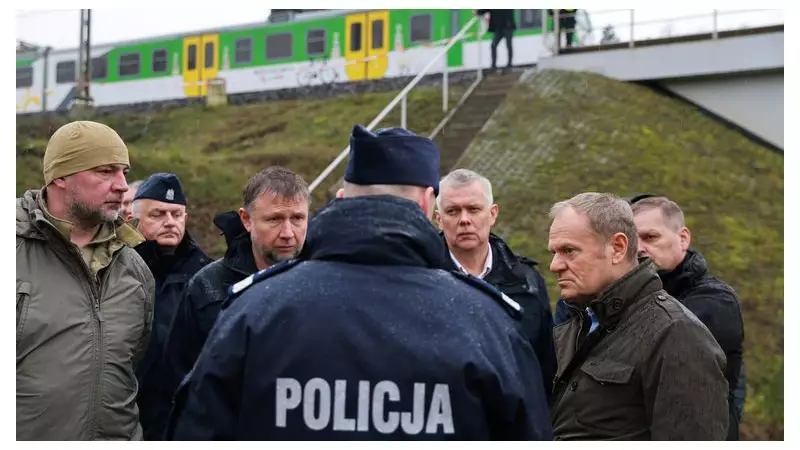
Polish Prime Minister Donald Tusk has described an explosion on a crucial railway line used to transport weapons to Ukraine as an "unprecedented act of sabotage".
The blast, which partially destroyed the track on the Warsaw to Lublin line, represents the latest in a wave of attacks targeting Poland and other European nations.
Investigation and Damage Assessment
Mr Tusk, who visited the site on Monday 17th November 2025, confirmed an investigation is actively underway. He vowed to apprehend those responsible, stating on X: "Just like in previous cases of this kind, we will catch the perpetrators, regardless of who their backers are."
Local police indicated that the incident began when a train driver reported track irregularities at approximately 7:40 am on Sunday. Subsequent inspections revealed significant damage to the railway near the village of Mika, located 62 miles southeast of Warsaw. Further damaged track was discovered at another location along the same route.
Authorities have not yet determined whether the explosion occurred late on Saturday or in the early hours of Sunday. Fortunately, no injuries were reported, with the Prime Minister remarking that it was lucky a greater tragedy had been avoided.
A Critical Artery for Aid and Rising Sabotage
The targeted line is described as "crucially important for delivering aid to Ukraine". Poland has frequently been singled out as a major hub for Western military and humanitarian support destined for Kyiv, a role that has made it a primary target for hostile activities.
This event fits a pattern of arson, sabotage, and cyberattacks across Europe since the onset of the war in Ukraine. While Polish officials have previously pointed the finger at Moscow, the country's deputy interior minister cautioned against automatically attributing blame, noting that "Russia isn't so powerful that every arson, every situation of this kind, is provoked by Russia". However, he conceded that Russian involvement could not be ruled out.
In a related incident, a second passenger train on the Swinoujscie to Rzeszow route, carrying 475 people, was forced to stop 31 miles from Lublin on Sunday night due to damage to overhead electrical cables. This event is also under investigation.
Europe on Alert
European capitals remain on high alert following a series of high-profile sabotage events. In October, Warsaw announced that Poland and Romania had detained eight individuals suspected of planning sabotage on behalf of Russia. Separately, a British court sentenced five men for an arson attack on a London warehouse containing satellite communication devices bound for Ukraine, an incident authorities believe was masterminded by Russian intelligence.
Furthermore, security officials have linked exploding parcels at European logistics depots to a suspected Russian test run for a plot targeting cargo flights to the US. Damage to undersea infrastructure, such as the Baltic Sea's Estlink 2 power cable, has also raised alarms, with Western officials accusing Russia and its proxies of a coordinated campaign of 'grey zone' activities.
Russia has consistently denied any involvement in acts of sabotage, arson, or attacks on critical infrastructure.