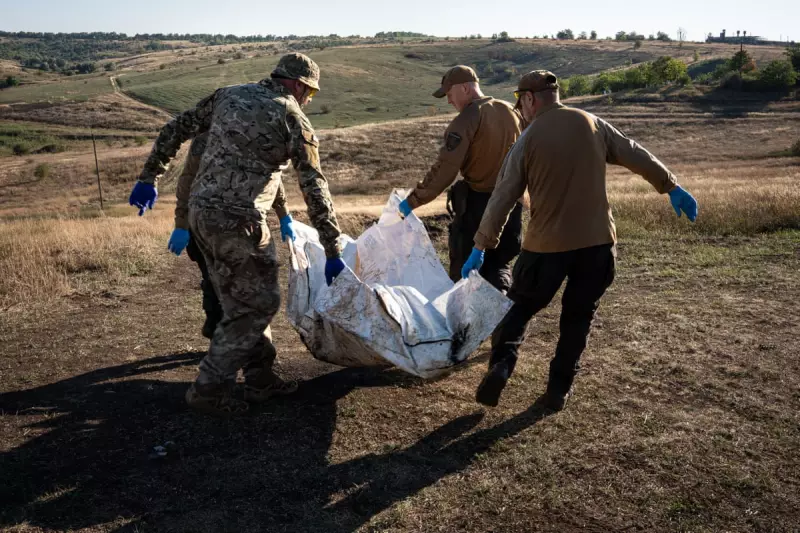
Driven by an unwavering belief in common humanity, the Ukrainian volunteer search group Platzdarm has now recovered the bodies of more than 1,500 fallen soldiers from the brutal frontline of the conflict. Operating in the lethal kill zones of the Donbas region, these dedicated volunteers risk their lives to bring home both Ukrainian and Russian troops, meticulously documenting each discovery to provide closure for grieving families.
A Delicate and Dangerous Mission
Alexei, a veteran searcher with over two decades of experience, describes the complex and perilous nature of their work. "If I were to die, I would want someone to search for me. To bring me home," he explains, articulating the fundamental principle that guides their efforts. The team operates under constant threat from executioner drones, relying on foggy conditions to somewhat hinder visibility as they navigate what Alexei calls "the lethal dome" enveloping the war front.
Meticulous Identification Process
Each recovery involves painstaking documentation. When Alexei recently discovered four bodies in the Donbas region, his team carefully examined every detail. From a worn piece of paper bearing the name "Andrei" and a Moscow phone number to a grimy St George's ribbon symbolising Russian patriotism, each clue is recorded on whiteboards and photographed for identification purposes.
"Sometimes, if we're not sure, we write 'unknown' so DNA testing can be backed up with further checks," Alexei notes, explaining how both Russian and Ukrainian soldiers frequently disguise themselves during combat operations. Even when faced with conflicting evidence - like Ukrainian army socks on what appears to be a Russian soldier - the team works methodically to piece together identities.
Confronting the Horrors of War
Alexei describes his most harrowing experience in the village of Klishchiivka, where he encountered an unimaginable scene. "I had never seen anything like it. So many bodies scattered everywhere. The entire hillside was covered with corpses. There wasn't even space to set a foot down. Bodies of fighters from 2022, 2023 and 2024, accumulated."
Historical Context and Evolution
The Platzdarm team's work has evolved significantly over time. "Until 2014, we dedicated ourselves to searching for those who fell in the first and second world wars and the victims of political repression," Alexei recalls. "We found mass graves where people had been shot by the Nazis or by the NKVD, the USSR's secret police. They were Soviet, German and allied soldiers."
This historical perspective informs their current approach, where nationality and allegiance matter less than basic human dignity. "We buried them, sent their remains to funeral associations, or repatriated them if we managed to contact their families. We brought them home," he says, describing a continuity of purpose that transcends contemporary conflicts.
The Emotional Toll and Human Connection
Alexei speaks candidly about the psychological impact of their work. "It is very painful. To see a destroyed destiny. A human destiny. You feel something for the dead that you never thought you could feel." He describes becoming emotionally connected to families, particularly when he has direct contact with parents before finding their loved ones. "The grief passes through you, because you become part of that family."
Finding Solace in Service
Despite the trauma, Alexei finds meaning in their mission. "It's an honour for us if we can return someone's son, husband, brother or father to their family. It means the effort was worth it." He emphasises that all souls deserve dignity, regardless of which side they fought on. "Nationality does not matter, he says, nor the side on which they fought. Whether Ukrainian or Russian, all souls are the same."
Preserving Humanity Amidst Conflict
Alexei reflects on how war fundamentally changes human beings. "War has taught me to what extent a person can become a non-human. Something worse than an animal. Because in war, human life is worth nothing. War shows black and white, without shades."
He maintains that their work represents a crucial counterbalance to this dehumanisation. "Perhaps I'm too stupid. And I don't fully understand it, or I don't want to. But until people realise that we are all inhabitants of the same planet, nothing will change." His ultimate hope is simple yet profound: "My dream is that it all ends. For everyone. The consequences are terrible. The physical and psychological wounds will last for ever. And many - far too many - will never return."
The Platzdarm team continues their vital work, combing through woods and barren lands where battle lines become entangled, determined to provide what Alexei calls "a final dignified rest" for those lost in conflict. Their mission stands as a powerful testament to humanity's capacity for compassion even in the darkest circumstances.