
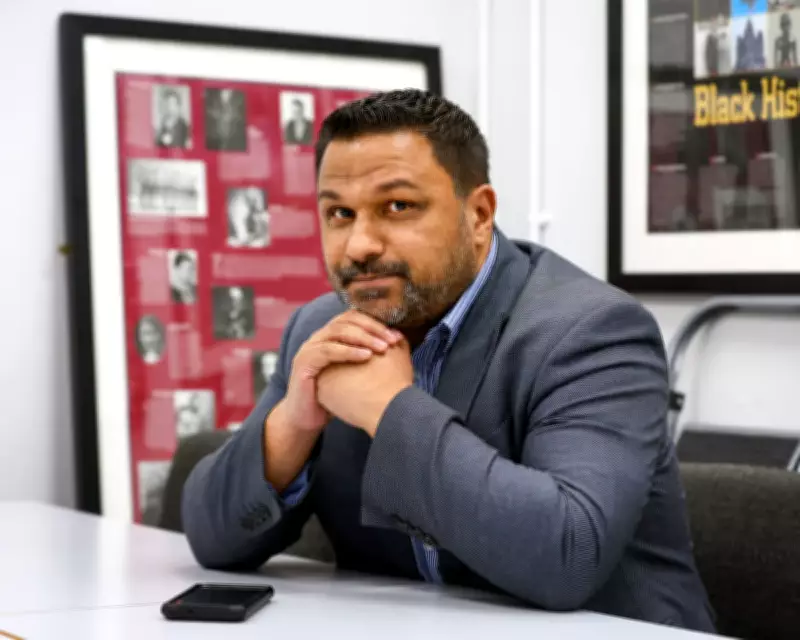
NBPA President Andy George Alleges Systematic Campaign to Silence Him
Andy George, the longest-serving president of the National Black Police Association (NBPA), has revealed he believes there is a concerted effort by senior police figures to marginalise him and silence the voices he represents. Since 2023, George has faced five separate misconduct investigations by the Police Service of Northern Ireland (PSNI) following complaints about his public interventions in the media and on social media platform X.
"An Attempt to Get Rid of Me"
"I tell you now, there is an attempt by some of the longer serving chief constables to get rid of me," states Chief Inspector Andy George in an exclusive interview. "I can guarantee I know exactly what they think of me: that I'm a wee upstart, so I am, that doesn't know my place," he adds with a wry smile.
George, who was first elected to lead the NBPA in July 2020 representing approximately 6,000 members, believes the political environment surrounding policing has shifted dramatically. He points to changing attitudes following the murder of George Floyd and subsequent global conversations about racial injustice.
From Personal Tragedy to Police Advocacy
The 46-year-old officer's journey into police advocacy was profoundly shaped by personal tragedy. His sister Vikki took her own life at age 23 after struggling with mental health issues that George says were compounded by racism. "The racism side was a big part of it," he explains. "She ended up calling herself the N-word and the P-word – it just ended up shattering herself as a person."
George discovered his sister's body in the home he had helped her find, an experience that motivated him to dedicate time to the NBPA, a staff network supporting black officers and improving police service to minority ethnic communities.
Mounting Investigations and Professional Pressure
Despite being twice highly commended during his active service in Northern Ireland, which included nearly a decade in an armed response unit, George now finds himself subject to multiple formal investigations. Of the five misconduct probes initiated since 2023, two were dismissed with no case to answer, while two others resulted in "managed action" – essentially low-key conversations about his communication style.
The fifth and most recent investigation, launched in December, relates to two posts on X responding to the BBC's Panorama investigation into racism at Charing Cross police station. In these posts, George questioned Metropolitan Police Commissioner Sir Mark Rowley's leadership, writing: "How many platitudes and excuses can we hear from the commissioner? @Metpolice commissioner has empowered toxic culture."
Alleged Coordination Between Forces
George has initiated a fair employment case against the PSNI alleging racial discrimination, claiming in his employment claim that Met Police and PSNI are "working together to silence me and the NBPA, undermine my personal and professional reputation and limit my career progression."
He cites as evidence a meeting with PSNI Chief Constable Jon Boutcher in October 2024 where, according to George, Boutcher "confirmed that the [Met police service] regularly contacted the PSNI about putting pressure on me and the NPBA."
Return to Core Duties and Diminished Role
Adding to George's concerns, he was ordered last year to end his secondment to the NBPA and return to core police duties due to "organisational requirements," despite being re-elected to his NBPA position with 75% of the membership vote. He now carries out his association work in his free time.
George also highlights what he perceives as diminishing engagement from police leadership, noting that he has met Commissioner Rowley just twice in more than three years, despite requesting early meetings. This contrasts with what he describes as "challenging but at least existing" conversations with former commissioner Cressida Dick during his early NBPA leadership.
Official Responses and Denials
Both the Metropolitan Police and PSNI have denied George's allegations. A PSNI spokesperson stated that Chief Constable Boutcher had personally supported George throughout his tenure and had "no personal involvement in the misconduct investigations." The spokesperson emphasised that "The Metropolitan police has not influenced the chief constable in any of his decision-making regarding Ch Insp George."
A Met Police spokesperson responded: "We value the contribution of the National Black Police Association in supporting black police officers and staff and ensuring their voices help shape equality in policing. Given the Met's London focus, however, our efforts are concentrated on working primarily with the Met Black Police Association."
Broader Context of Police Race Relations
George's case emerges against a backdrop of increasing scrutiny of police race relations. Racism tribunal claims by Metropolitan Police officers and staff reportedly doubled last year, while the force faces what some term a "Casey 2" inquiry following Baroness Louise Casey's 2023 report that found the Met to be institutionally racist and misogynistic – a characterisation Commissioner Rowley has refused to accept.
George maintains that his approach to championing minority ethnic communities' interests hasn't changed, but rather "the political environment had changed," referencing former Home Secretary Suella Braverman's comments about the "Guardian-reading, tofu-eating wokerati" and Rowley's prohibition of Met officers taking the knee, which the commissioner described as alignment with an interest group.
"I believe that I am being victimised and discriminated against in an attempt to silence me," George concludes, while affirming his commitment to policing: "I do love being a police officer. I say to people, remember how you felt when you first got that email saying you got accepted as police officer, bring yourself back to there. But I can't really stand wholeheartedly and say I am invested in where things are."




