
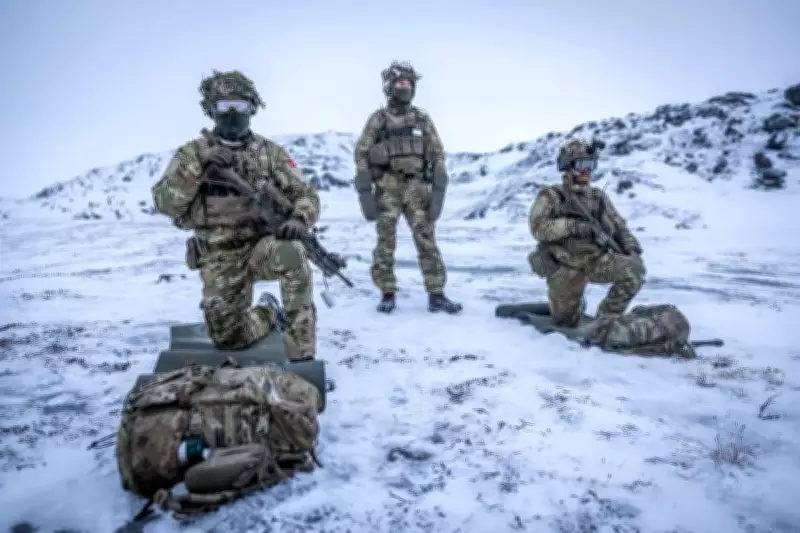
Danish soldiers were seen participating in the Arctic Endurance military exercise in Greenland on 19 January, highlighting ongoing defence activities in the region. This comes amid a heated debate over Europe's military capabilities and dependence on the United States.
NATO Chief's Blunt Assessment Sparks Controversy
Mark Rutte, the NATO secretary general, delivered a stark message to members of the European parliament this week. Speaking from a committee room in Brussels, he asserted that Europe cannot defend itself without US support, stating, "If anyone thinks that the European Union, or Europe as a whole, can defend itself without the US, keep on dreaming. You can't. We can't."
He further emphasised that replacing the US nuclear deterrent would require doubling existing spending commitments, a challenge he met with scepticism. Rutte, a former Dutch prime minister, has previously faced mockery for his comments about Donald Trump, adding to the tension in his remarks.
European Leaders Push Back and Propose Alternatives
In response, France's foreign minister, Jean-Noël Barrot, criticised Rutte on social media, arguing that Europeans must take charge of their own security, a view he claims is shared by the United States. Similarly, Spain's foreign minister, José Manuel Albares, advocated for a European army, acknowledging it would be a gradual process requiring various forms of deterrence.
However, the concept of a European army remains vague and contentious. Sophia Besch, a senior fellow at the Carnegie Endowment for International Peace, noted that it is seen as visionary by supporters but as overreach by critics, with details often left undiscussed.
Consensus on the Need for European Defence Efforts
Despite public disagreements, there is a growing consensus that European NATO members need to increase their contributions. Kaja Kallas, the EU's foreign policy chief, stressed that Europe must step up and not outsource its survival, echoing calls for NATO to become more European.
NATO has pledged to raise defence spending to 5% of national income by 2035, and the EU has launched an €800 billion defence spending plan. Camille Grand, a former NATO assistant secretary-general, expressed optimism that Europe can reduce its dependency on the US through sustained efforts and acquiring the right capabilities.
Challenges and Timelines for Autonomy
Grand highlighted that Europe's path to autonomy lacks a precise launch date, with 2030 often cited as a target for achieving credible deterrence against potential threats, such as from Russia. He explained that military planners view 2030 as imminent, but Europe could make significant progress in areas like intelligence, satellites, and long-range missiles.
However, he cautioned that Europe would still need some American assets beyond 2030, requiring honest discussions with the US. The uncertainty of US commitment, exacerbated by Trump's actions, has raised doubts about Washington's reliability in a crisis.
Trust Issues and Strategic Planning
Tobias Billström, a former Swedish foreign minister, remains confident in US support under NATO's Article 5, citing benefits like Arctic military capabilities. Yet, he warned that Europe must prepare for long-term defence against a revanchistic Russia.
Besch, however, believes trust in US security guarantees has eroded among European policymakers. She argued that Europe's defence planning is too tied to NATO's US-dependent frameworks, risking that increased spending may not lead to greater independence without coordinated efforts.
Fragmentation and Industrial Rivalries
Europe's defence efforts are hampered by fragmentation, as illustrated by the troubled €100 billion Franco-German fighter jet project, which faces disagreements and may be scaled down. Mario Draghi's report highlighted issues like the EU providing 10 different types of howitzers to Ukraine, causing logistical difficulties, and operating 12 types of battle tanks compared to the US's one.
Besch emphasised that Europe needs to define its strategic interests independently, rather than merely trying to replace US capabilities. She suggested focusing on cheaper, faster systems and addressing regions from the Arctic to the Pacific.
Conclusion: A Path Forward
As Europe grapples with these challenges, the debate continues over whether it can achieve true defence autonomy. With rising threats and shifting alliances, the need for a cohesive and effective European defence strategy has never been more urgent.




