
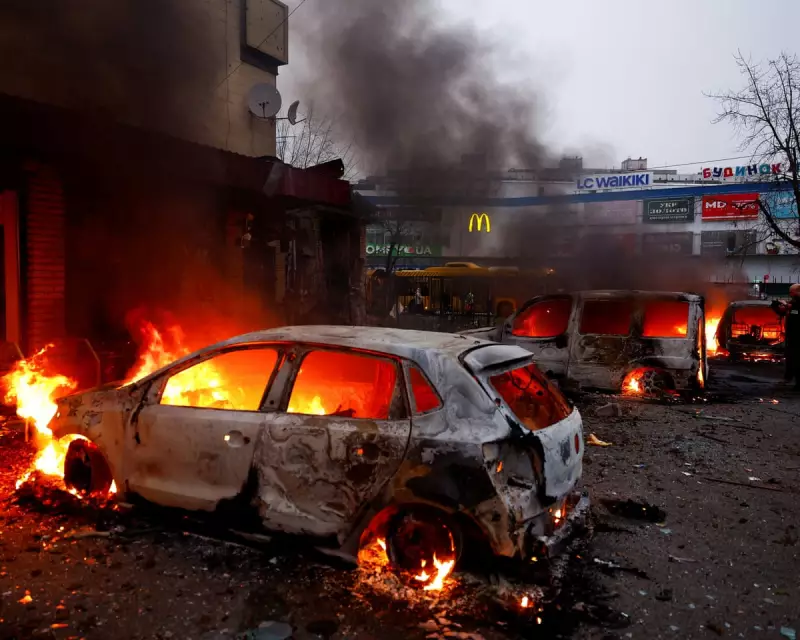
A devastating overnight Russian assault on Ukraine's capital, Kyiv, has left a trail of destruction, with officials confirming three people killed and dozens more injured after hundreds of drones and missiles targeted the city.
The large-scale attack, which saw nearly 600 drones and 36 rockets launched across Ukraine, plunged the western half of Kyiv into darkness, leaving an estimated 500,000 residents without electricity as the city's energy infrastructure sustained heavy damage.
Wave of Destruction and Civilian Casualties
The assault unfolded in two distinct waves, with the first barrage striking around 1am and a second, powerful wave hitting at approximately 7am. An all-clear was not given until nearly 9:30am, after hours of intense aerial bombardment. In Kyiv itself, the attack claimed two lives and left 37 people injured. A third fatality was reported in the surrounding Kyiv region.
Photographs from the scene depicted the immediate aftermath, with vehicles burning in the streets following the impact of the projectiles. The attack forms a central part of Moscow's ongoing campaign to break Ukrainian civil resistance by systematically targeting the nation's energy grid, a strategy intensifying as the war approaches its fourth year.
Zelenskyy's Plea and Ukrainian Retaliation
President Volodymyr Zelenskyy responded to the assault by urgently appealing for increased Western support. He stressed that the attack highlighted Ukraine's critical need for air defence systems, missiles, and sustained financial and political backing from its allies.
"We must work without wasting a single day to ensure that there are enough missiles for our air defence systems, and that everything necessary for our protection and for pressure on Russia is in place," Zelenskyy stated.
In a significant counter-strike, Ukraine's military reported successfully hitting the Afipsky oil refinery in Russia's Krasnodar Krai. The facility, one of the largest in southern Russia and a key supplier of diesel and jet fuel to Russian forces in Ukraine, was left burning.
Political Turmoil and Stalled Negotiations
The military offensive coincides with a serious domestic political crisis for President Zelenskyy, stemming from a high-level corruption scandal. Andriy Yermak, the president's chief of staff, was forced to resign after his flat was searched by anti-corruption officials investigating an alleged kickback scheme.
This development has led to speculation about a potential restructuring of the president's office. Some opposition figures have called for the appointment of Valerii Zaluzhnyi, a former head of the armed forces, to a key role, though his allies expressed uncertainty about whether he would accept.
Meanwhile, diplomatic efforts have stalled. A Ukrainian delegation is en route to Washington, but hopes for a breakthrough are dim. Russian President Vladimir Putin has recently described the Ukrainian leadership as illegitimate, and a proposed €140 billion EU loan for Ukraine, secured against frozen Russian assets, faces opposition from Belgium.




