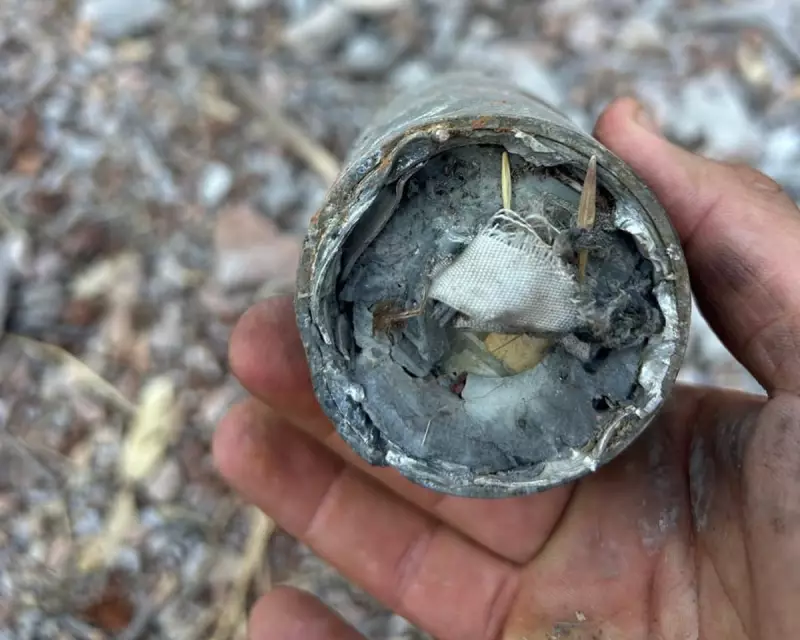
Photographic evidence examined by weapons experts suggests Israel deployed widely prohibited cluster munitions during its recent 13-month conflict with Hezbollah in Lebanon, marking the first indication of such use in nearly two decades.
Weapons Experts Verify Munition Remnants
Six independent arms specialists have confirmed images showing remnants of two distinct Israeli cluster munition types discovered in three separate locations south of the Litani River. The findings point to the first known Israeli deployment of these controversial weapons since the 2006 Lebanon war.
The verified photographs reveal debris from both the 155mm M999 Barak Eitan and 227mm Ra'am Eitan guided missiles - two new cluster munition varieties developed by Israeli defence contractor Elbit Systems. One shell fragment clearly displays the Hebrew word for "cluster," while another shows yellow diamond markers indicating high-explosive submunitions.
What Are Cluster Munitions?
Cluster munitions function as container bombs that disperse numerous smaller "bomblets" across areas equivalent to several football fields. Their use is internationally condemned because approximately 40% of submunitions typically fail to detonate upon impact, creating long-term hazards for civilians who might accidentally trigger them years later.
Tamar Gabelnick, director of the Cluster Munition Coalition, emphasised: "We believe the use of cluster munitions always conflicts with a military's duty to respect international humanitarian law due to their indiscriminate nature during deployment and for decades afterward."
Lebanon's Painful History with Unexploded Ordnance
Lebanon possesses particularly traumatic experience with cluster munitions. During the final days of the 2006 conflict, Israel blanketed Lebanese territory with an estimated 4 million cluster bombs, leaving approximately 1 million unexploded bomblets that continue to endanger communities.
More than 400 people have been killed by unexploded cluster munitions in Lebanon since 2006, with the massive contamination from the 2006 war serving as a primary catalyst for the international Convention on Cluster Munitions in 2008.
The recent conflict, which began in October 2023, resulted in nearly 4,000 Lebanese and about 120 Israeli fatalities, devastating much of southern Lebanon despite a ceasefire agreement last year.
Israeli Response and International Context
The Israeli military neither confirmed nor denied using cluster munitions, stating it "uses only lawful weapons, in accordance with international law while mitigating harm to civilians." This position contrasts with Israel's condemnation of Iran's cluster munition use during summer conflicts, where an Israeli military spokesperson criticised what he called efforts "to harm civilians using weapons with wide dispersal."
While 124 nations have joined the Convention on Cluster Munitions, prohibiting their use, production and transfer, Israel remains outside the agreement and不受其约束.
Brian Castner, Amnesty International's head of crisis research, affirmed: "Cluster munitions are banned internationally for a reason. They are inherently indiscriminate and there is no way to employ them lawfully, with civilians bearing the brunt of risk for decades."
The munition remnants were discovered in heavily forested valleys that Israel accused Hezbollah of exploiting for cover during hostilities, suggesting the wide-area weapons were potentially deployed against dispersed combatants in wooded terrain.