Tensions continue to simmer along Israel's northern border with Lebanon, where communities are gradually returning to rebuild their lives amid fears of renewed conflict with Hezbollah.
A Landscape of Destruction and Renewal
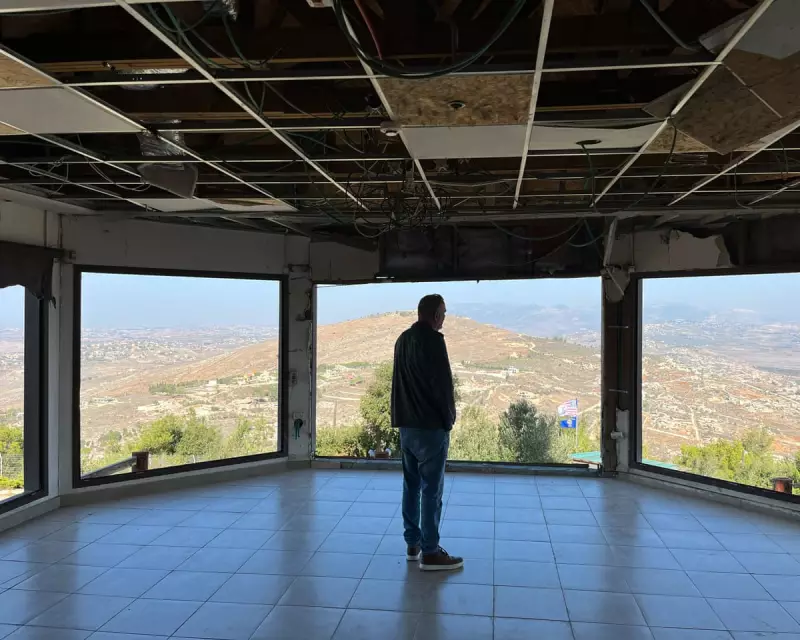
Noam Erlich surveys the remains of his beer garden at Manara kibbutz, where disordered chairs and tables stand as silent witnesses to recent violence. The 44-year-old brewer's property, built by his grandfather in the 1940s, suffered repeated missile strikes during last year's conflict and now faces demolition.
"Wars destroy things, but bring opportunities too," Erlich reflects, demonstrating the complex reality for those living in the shadow of ongoing hostilities.
The current political climate suggests escalating military action, with a bipartisan consensus emerging in Israel that a fresh offensive to destroy Hezbollah's military capabilities appears imminent. Both left-leaning Haaretz and journalists aligned with Prime Minister Benjamin Netanyahu's government have indicated that dramatic escalation against Hezbollah represents a likely scenario.
Rebuilding Amid Uncertainty
Along the border, a tense calm prevails as reconstruction efforts gather pace. While Israel's air defence systems protected many communities from rocket barrages, the human cost remains significant: 47 Israeli civilians and 83 soldiers died, with hundreds more wounded and tens of thousands displaced.
The conflict's impact extended deeply into Lebanon, where an estimated 3,800 people lost their lives, including many civilians, and 1.2 million were forced from their homes. The economic damage reached approximately $8.5 billion.
Despite losing both his home and microbrewery, Erlich has transformed his circumstances by shifting production to commercial breweries in central Israel, now selling ten times more beer than before the conflict. He describes the war as "a blessing in disguise," embodying the resilience characterizing many border residents.
Changing Demographics in Border Towns
Metula, Israel's northernmost town, serves as a microcosm of the region's challenges. During the conflict, it became an army base with 80% of houses damaged by Hezbollah missiles launched from just hundreds of metres away. The pre-war population of 1,670 has dwindled to approximately 900.
"Some won, some lost," acknowledges David Azoulay, Metula's mayor, as reconstruction of the town's 130-year-old synagogue progresses alongside road repaving and municipal building repairs.
Azoulay sees opportunity in the devastation: "We didn't have funds to fix many buildings before the war. Now we're going to make the whole town way better than it was."
However, demographic shifts are evident. Families with children established in schools elsewhere, and those who found new employment opportunities show little inclination to return. Students who previously rented cheap accommodation have stayed away, replaced by 40 families of nationalist and religious Israelis viewing Metula's reconstruction as a worthy cause.
Economic and Social Consequences
In Kiryat Shmona, considered the northern region's capital city, approximately a quarter of the pre-war population remains absent. At a small mall on the northern outskirts, a third of shops and restaurants stay closed, while those that reopened struggle financially.
"I have to work my ass off to make ends meet," confesses Sergio Helman, who continued serving hummus and salad in his Blue Bus cafe throughout the rocket attacks.
The conflict has created profound social disruptions, with Helman noting that his children have adapted to life elsewhere in Israel and show no urgency to return. "Things are slowly getting back to normal but the war created inner conflicts within communities here," he observes. "There are kids who went to three schools in two years."
Local commentator Yamit Malul Yanai emphasizes the strategic importance of northern cities like Kiryat Shmona, which "anchor all our defences across the north," while lamenting its current state as a "ghost town."
Military Preparations and Border Fortifications
Along the contested "blue line" border, Israeli forces maintain five hill-top bases up to a mile and a half inside Lebanese territory, constructing sections of high walls despite UN assertions that at least one position lies within Lebanon.
Near Shtula, another evacuated border community, residents have been slow to return as damaged homes face Lebanon, many still unrepaired. The Israeli military has erected a substantial concrete barrier and positioned tanks in the area.
A senior Israeli officer explained the new defensive approach: "We are fortifying the border. We want a barrier and the military between civilians and the enemy. We have learned the lessons of Gaza. We understand that the wall is part of the system, not the whole system, which was the mistake in Gaza."
From military outposts, the devastation in Lebanon becomes visible - slopes cleared of forest during last year's invasion, with the scattered rubble of destroyed houses in now-deserted villages creating stark white patterns against the winter sky.
Prospects for Future Conflict
Israel has accused Hezbollah of attempting to rearm since the US-backed ceasefire and has launched over 1,000 attacks in Lebanon since the 2024 ceasefire, resulting in hundreds of casualties. Recent days have witnessed fresh Israeli airstrikes hitting targets across southern Lebanon.
Hezbollah maintains it has complied with ceasefire requirements to withdraw from border regions and facilitate Lebanese army deployment. Their leader, Naim Qassem, has thus far refrained from ordering the movement's tens of thousands of fighters to mount military responses to Israeli strikes.
Some analysts suggest that Israeli talk of fresh offensives may represent strategic pressure on the Lebanese army to disarm Hezbollah more aggressively, or could serve to bolster support for Israel's rightwing ruling coalition.
Despite the looming threat of renewed violence, Mayor Azoulay remains characteristically defiant: "We will deal with it if it happens. All the Lebanese Shia villages around us are destroyed and basically uninhabitable. If you ask what is our victory, it is that we have been rebuilding for a year and they haven't put a single pipe back in the ground."