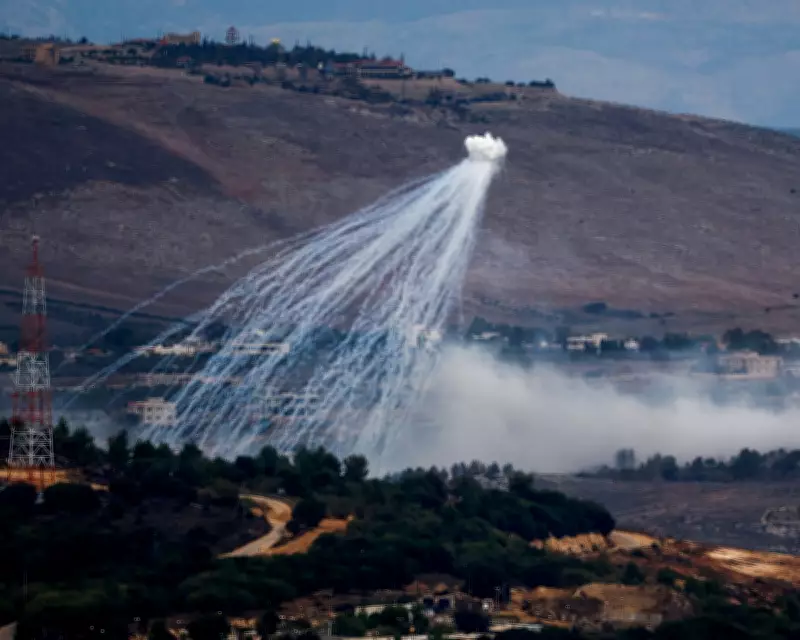
Israel Accused of Deploying White Phosphorus in South Lebanon, Causing Widespread Damage
Human Rights Watch (HRW) has verified and geolocated eight images showing airburst white phosphorus munitions exploding over residential areas in the southern Lebanese town of Yohmor during the opening days of Israel's assault in the Gaza war. This revelation reignites accusations that Israel is violating the laws of war by using this controversial weapon in civilian zones.
Distinctive Plume Identifies Weapon Use
Researchers identified the weapon through the knuckle-shaped plume characteristic of M825-series 155mm artillery projectiles airbursting and expelling felt wedges containing white phosphorus. Since the initial documentation, additional videos have emerged purporting to show white phosphorus munitions detonating over south Lebanon. With approximately 800,000 Lebanese people displaced from the region following Israeli evacuation orders, many more instances may have gone unrecorded.
Intense Conflict and Environmental Consequences
Israeli forces have faced fierce resistance from Hezbollah fighters in south Lebanon despite an intense bombing campaign targeting roads, petrol stations, bridges, and medical centers to isolate the region. White phosphorus, a chemical substance that ignites upon exposure to oxygen, burns at temperatures up to 800°C and emits substantial smoke. While military forces legally employ it for smokescreens, target marking, or terrain illumination, its use in civilian areas is highly contentious due to risks of fires, severe burns, and toxic fumes.
Ahmad Beydoun, an architect and PhD researcher at Delft University of Technology in the Netherlands, documented nearly 250 uses of white phosphorus by Israeli forces between October 2023 and November 2024. His conservative estimates indicate 39% of deployments occurred in residential areas, 17% in agricultural lands, and 44% in forested or open terrain. Beydoun suggests the Israeli army may be using the weapon to burn fields for visibility, preventing concealment by Hezbollah militants.
Extensive Environmental Damage Reported
According to a report by the Lebanese non-profit Public Works Studio, white phosphorus has scorched over 2,000 hectares (4,940 acres) of southern Lebanese countryside, including 873 hectares of dense gum tree forests and vast areas of oak and pine trees. The weapon poses lingering threats as it can lie hidden in soil, spontaneously combusting when disturbed by farmers, and saturating the earth with phosphoric acid and toxic heavy metals like cadmium, lead, and zinc. This contamination reduces microbial diversity, depletes soil fertility, and decreases agricultural productivity, creating systemic environmental harm.
Official Responses and Allegations
An Israel Defense Forces spokesperson declined to comment on HRW's specific allegations regarding illegal use in Yohmor, cautioning against visual determinations due to similarities between smoke shells with and without white phosphorus. Last week, Israel's UN ambassador, Danny Danon, emphasized efforts to minimize civilian casualties by urging residents south of the Litani River to relocate northward, though he did not directly address HRW's claims.
Beydoun's findings suggest Israel may be utilizing white phosphorus to displace populations and establish a buffer zone on the Lebanese side of the border. He describes it as a practical tool for scorching the earth, highlighting its destructive capacity beyond immediate military applications.