
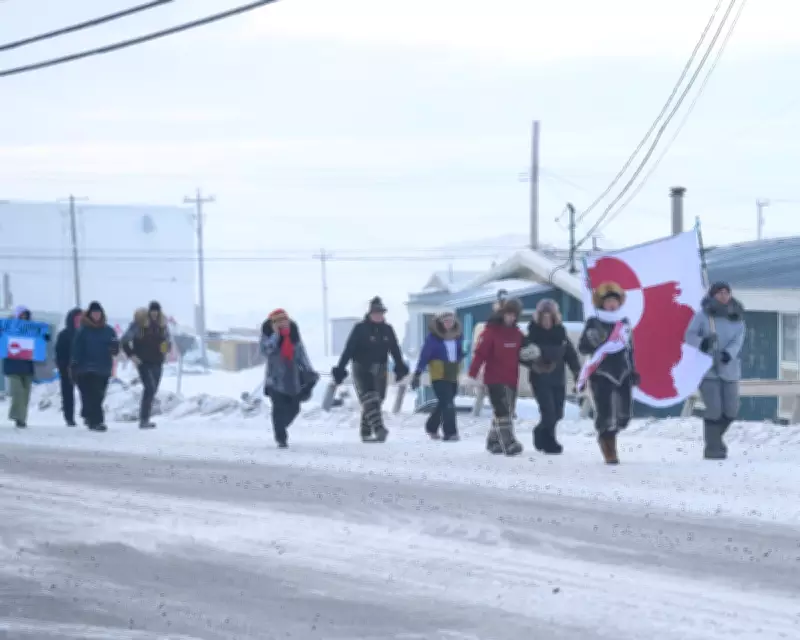
Arctic Communities Unite Against Colonial Rhetoric
On a frigid morning in Canada's northern territories, approximately seventy residents of Iqaluit braved biting winds to march through Nunavut in a powerful display of solidarity with Greenland. Carrying banners proclaiming "We stand with Greenland" and "Greenland is a partner, not a purchase", the demonstration highlighted growing Indigenous resistance to what many perceive as a renewed colonial threat from the United States.
A Troubling Echo of Imperial History
For Arctic Indigenous communities, Donald Trump's persistent attempts to acquire or control Greenland have triggered painful memories of centuries of imperialism and colonisation. Natan Obed, president of Canada's national Inuit organisation Inuit Tapiriit Kanatami, described the situation as particularly alarming given recent geopolitical developments.
"The overtures from the United States make us incredibly worried that we are on the precipice of another age of disrespect for our collective rights," Obed stated. "Inuit have had to figure out how to maintain our society, our culture and our self-determination in the midst of other people wanting different things from us or from our lands and territories."
Greenland's Sovereignty Under Threat
Despite Trump's recent pledge not to seize Greenland by force, the White House continues to signal strong interest in controlling the world's largest island. US Special Envoy to Greenland Jeff Landry recently published a 976-word opinion piece in the New York Times describing Greenland as "one of the world's most strategically consequential regions" while notably omitting any mention of the Indigenous peoples who have stewarded the land for millennia.
Sara Olsvig, chair of the Inuit Circumpolar Council and former leader of Greenland's pro-independence Inuit Ataqatigiit party, emphasised that Greenland is a self-governing territory within the Kingdom of Denmark, not property to be bought or sold. "To us it is our homeland, its riches are what sustain our people, our culture, our children, youth, and elders," she explained.
Widespread Arctic Concerns
The anxiety extends beyond Greenland's borders, with Inuit communities across the Arctic expressing deep concern about the implications of Trump's rhetoric:
- Marie Greene, president of the Inuit Circumpolar Council - Alaska, reported initial disbelief turning to heartbreak as elders and children worried about invasion
- Vivian Korthuis, also of the Inuit Circumpolar Council - Alaska, stressed that peace in the Arctic means protecting homelands and families
- Gunn-Britt Retter of the Saami Council noted how Indigenous rights often become secondary when geopolitical tensions rise
The Geopolitical Stakes
Obed pointed to increasing geopolitical competition in the Arctic region, including:
- Substantial Russian and Chinese investments in Arctic ports and infrastructure
- Growing interest in the Northwest Passage as climate change transforms shipping routes
- Persistent framing of the Arctic as an "empty ice desert" rather than populated homeland
"We understand that we are increasingly in the centre of a geopolitical fight that is not necessarily around our culture or our society, but is in our homeland, in our backyards," Obed observed. "This is the moment to build alliances and strategies and plans to ensure that when those times come, we're ready for that."
A Fundamental Principle of Equality
Olsvig delivered perhaps the most poignant summary of Indigenous perspectives on the situation: "Not repeating the wrongdoings of past imperialism is important. There is no such thing as a better coloniser." This sentiment captures the core concern of Arctic Indigenous communities - that despite progress toward self-determination, their lands and rights remain vulnerable to the geopolitical ambitions of powerful nations.
The solidarity march in Iqaluit represents more than just support for Greenland; it signals a growing pan-Arctic Indigenous movement determined to protect hard-won rights against what many see as a resurgence of colonial thinking in international relations.




