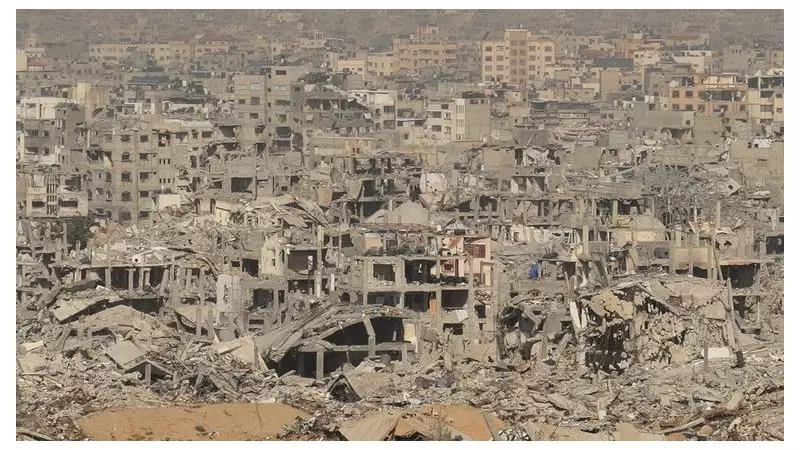
Standing amidst the ruins of what was once a vibrant community, the scale of destruction in Shuja'iyya defies comprehension. This northern Gaza town, previously home to approximately 100,000 residents with an 850-year historical legacy, now presents a heartbreaking panorama of collapsed buildings and shattered lives.
A Controlled Glimpse into the Aftermath
The Israeli military recently escorted a group of international journalists, including Sky News, through areas of the Gaza Strip under their control. This highly regulated visit provided no opportunity to speak with Palestinian residents or access other regions of Gaza. Under Israeli military censorship regulations, all recorded material underwent review by military personnel before publication, though Sky News maintained complete editorial authority over the final report.
From an Israeli military camp positioned at the edge of Shuja'iyya, the evidence of relentless warfare stretches as far as the eye can see. Six-storey structures have imploded into chaotic piles of concrete and steel, while the persistent hum of military drones overhead accompanies the occasional rattle of distant machine gun fire. The only visible inhabitants now are stray dogs navigating the ruins and occasional birds briefly alighting on the debris.
The Dividing Line and Political Realities
The landscape now features what has become known as the Yellow Line, dividing Gaza into distinct territories. This demarcation separates Israeli-controlled areas from regions still under Hamas authority, though no continuous physical barrier yet exists across the entire territory. Concrete blocks are gradually being positioned, starting from the periphery and working inward.
Lieutenant Colonel Nadav Shoshani, spokesperson for the Israeli Defence Forces (IDF), articulated the military's perspective during the visit. "We're not staying here as a hobby," he stated. "We're staying here to secure the people of Israel. We see it right there - it's a two-minute drive to where our civilians live."
The IDF maintains that despite two years of military operations in Gaza, Hamas continues to rearm and eliminate opposition within their territories. Israeli officials stress that Hamas shows no indication of disarming, presenting an ongoing security concern for nearby Israeli communities.
Human Cost and Fragile Peace
The human toll of this prolonged conflict remains staggering. More than 68,000 people have lost their lives in Gaza due to Israeli military actions since the war began on October 7, 2023. That conflict ignited when Hamas militants killed over 1,200 people, predominantly civilians, during surprise attacks.
Currently, an uneasy ceasefire prevails, resulting from a peace initiative developed by former US President Donald Trump's administration and subsequently endorsed by the United Nations. The plan anticipates deployment of an international stabilisation force to protect civilians and facilitate humanitarian assistance delivery, though specific details regarding troop composition, arrival timeline, legal authority, or disarmament responsibilities remain undefined.
Meanwhile, Gaza exists divided between two realities: one section experiences strictly enforced peace but hosts almost no residents, while the other contains millions of people attempting to survive amid post-war chaos and devastation.
Life Amidst the Ruins
Despite the apocalyptic scenery, some residents persevere in the ruins. Sky News colleagues visiting the Hamas-controlled side of the Yellow Line encountered Iman Hasoneh, a 48-year-old woman worn down by relentless hardship. Her family initially fled Shuja'iyya but eventually returned after finding nowhere else to seek shelter.
"Our home collapsed, and it was a miracle we escaped," Hasoneh recounted. "We couldn't find anywhere else. Our struggle was immense. We moved around so much."
Her husband suffers from internal bleeding caused by injuries, while her children battle exhaustion. The family endures constant anxiety, with Hasoneh expressing grim resignation: "One day they will just announce that we have all been killed. We are on the edge of the Yellow Line, and there is so much suffering."
When questioned about the UN-endorsed peace plan, she responded with weary scepticism: "I want to be optimistic, but I'm not sure what is going to happen. They are giving us an anaesthetic to numb the pain. But everything here is destroyed."
Above her damaged home, the same military drone observed from the Israeli camp continues its surveillance, symbolising the persistent tension that hangs over this divided territory and its traumatised inhabitants.