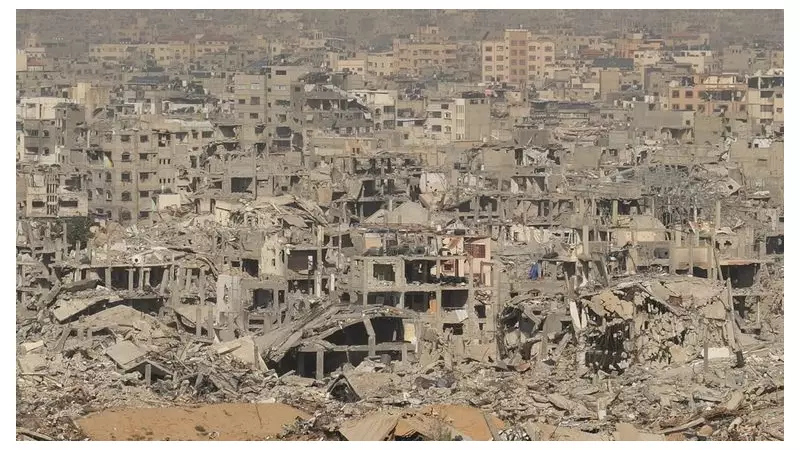
In the northern reaches of Gaza lies Shuja'iyya, a landscape of unimaginable destruction where the echoes of a bustling community have been replaced by the haunting silence of rubble and dust. This town, once home to approximately 100,000 residents and boasting an 850-year historical legacy, now stands as a testament to the devastating impact of prolonged conflict.
A Controlled Glimpse Into the Aftermath
Under strict Israeli military supervision, a group of international journalists including Sky News recently gained rare access to this devastated area. The highly regulated visit provided no opportunity to speak with Palestinian residents or explore other sections of Gaza, with all recorded material undergoing military review before publication. Despite these constraints, Sky News maintained complete editorial authority over their reporting throughout the process.
The scene that unfolded before our correspondent was one of comprehensive ruin. Six-storey buildings have collapsed into themselves, creating mountains of debris where homes and businesses once stood. The occasional wild dog picks through the wreckage while military drones maintain a constant presence overhead, their persistent buzzing accompanied by the distant rattle of machine gun fire.
The Human Cost of Conflict
The statistics behind this physical devastation are staggering. More than 68,000 people have lost their lives in Gaza as a consequence of Israeli military operations since the conflict began on October 7, 2023. That date marks when Hamas militants killed over 1,200 individuals, predominantly civilians, in a surprise assault that triggered the ongoing warfare.
Currently, an uneasy truce prevails across the territory, implemented under a peace framework developed by former US President Donald Trump's administration and subsequently endorsed by the United Nations. This agreement has established what's known as the Yellow Line, dividing Gaza into two distinct zones.
From an Israeli military encampment at the edge of this dividing line, the contrast between the two sectors becomes apparent. The Israeli-controlled portion contains minimal population, while the Hamas-administered side houses the vast majority of Gaza's two million residents.
Life Amid the Rubble
Despite the comprehensive destruction making Shuja'iyya appear uninhabitable, remarkable stories of survival emerge from the ruins. Our colleagues operating on the Palestinian side of the Yellow Line encountered Iman Hasoneh, a 48-year-old woman ground down by the relentless struggle of existence in this shattered environment.
Her family's circumstances reflect the desperate choices facing many Gazans. After their home collapsed during the conflict, they initially fled Shuja'iyya only to discover nowhere else to live, compelling their return to the rubble of their former residence. Her husband suffers from internal bleeding caused by conflict-related injuries, while her children battle exhaustion from their precarious living conditions.
"Our home collapsed, and it was a miracle we escaped," Hasoneh recounted. "We couldn't find anywhere else. Our struggle was immense. We moved around so much." She described a recent rocket attack that knocked her family to the ground, leaving her with little expectation of survival.
When questioned about the newly implemented peace plan, Hasoneh expressed cautious pessimism: "I want to be optimistic, but I'm not sure what is going to happen. They are giving us an anaesthetic to numb the pain. But everything here is destroyed."
Military Perspective and Ongoing Tensions
The Israeli Defence Forces maintain that their continued presence in Gaza remains essential for national security. Lieutenant Colonel Nadav Shoshani, serving as military spokesperson, emphasized that their deployment serves to protect Israeli civilians living mere minutes from the border.
"We're not staying here as a hobby," Shoshani stated. "We're staying here to secure the people of Israel. We see it right there," he added, indicating nearby Israeli communities visible through the afternoon haze.
The military leadership contends that Hamas shows no indication of disarming despite two years of intensive military engagement. According to Shoshani, "They haven't changed who they are. And it's going to need pressure from the international community and maybe also from Israel to make sure they disarm. Hamas are rearming, Hamas are killing their opponents on the street."
An Uncertain Future
The UN-endorsed peace agreement proposes deploying a stabilisation force to safeguard civilians and facilitate humanitarian assistance delivery. However, critical details remain undefined, including the composition of this force, its arrival timeline, legal authority, and whether it will bear responsibility for disarming Hamas.
For now, Gaza exists divided between a sparsely populated sector experiencing strictly enforced calm and another section where millions attempt to rebuild their lives amid post-war chaos and devastation. The same drone observed hovering above Iman Hasoneh's makeshift home in the ruins originates from the Israeli camp where journalists witnessed this fractured landscape, symbolizing the interconnected yet separated realities of this divided territory.
As construction crews gradually position concrete blocks to physically manifest the Yellow Line's division, the people of Shuja'iyya and throughout Gaza face an uncertain future, balancing fragile hope against the daily reality of life amid ruins.