
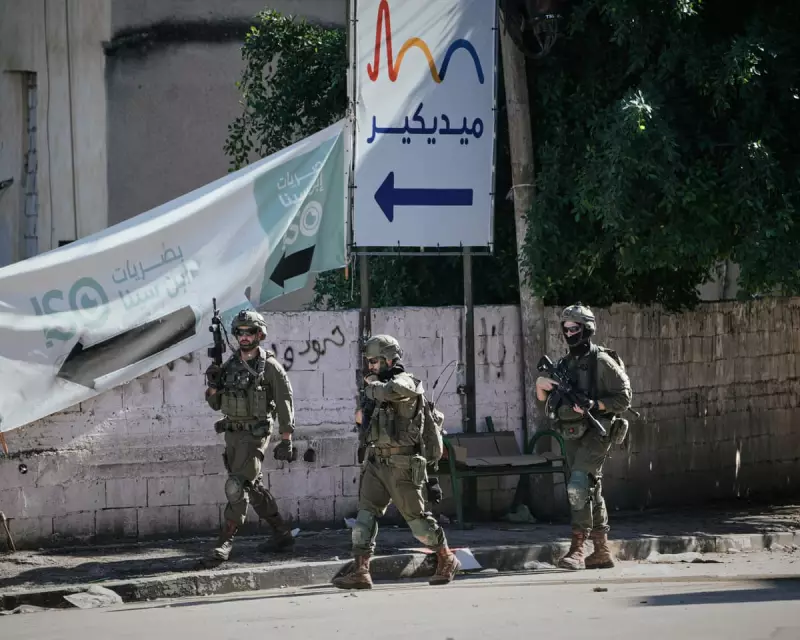
Hundreds of Israeli soldiers have launched one of the largest military operations in the occupied West Bank since the Gaza ceasefire began last month, conducting extensive raids in the Palestinian town of Tubas near Nablus.
Major Military Deployment in Northern West Bank
Israeli armoured vehicles and substantial troop numbers moved through Tubas on Tuesday 26th November, marking the most significant military deployment by Israeli forces in the region since hostilities paused in Gaza. The operation involved the closure of roads with earthen barriers and the imposition of an overnight curfew affecting Tubas and surrounding communities.
Palestinian media reported that Israeli forces compelled families to evacuate their homes to allow military use of the buildings. The Israeli military and internal security service issued a joint statement confirming they had initiated what they described as "a broad counter-terrorism operation" expected to continue for several days.
Warnings and Previous Operations
Leaflets distributed by Israeli forces in Tubas warned residents that the area had "become a haven for terrorism" and threatened further action if the situation didn't change. The communication specifically referenced previous major military assaults in the northern West Bank cities of Jenin and Tulkarm earlier this year, which caused extensive damage and displaced tens of thousands of people.
According to the Israeli newspaper Haaretz, the leaflets stated: "If you do not change this, we will act as we did in Jenin and Tulkarm." These previous operations involved substantial military force and resulted in widespread destruction of infrastructure.
Continuing Violence and Regional Context
The West Bank operation occurs against a backdrop of continuing violence despite the fragile Gaza ceasefire. UN statistics reveal that Israeli troops or settlers have killed more than 1,000 Palestinians in the West Bank since the Gaza conflict began in October 2023. United Nations officials attribute most fatalities to what they describe as "the systematic and excessive use of lethal force by Israeli forces, often involving live fire, airstrikes and shoulder-fired missiles in densely populated areas."
Meanwhile, in Gaza, overnight violence continued with reports of bombardment near the central town of al-Bureij. The Israeli military claimed to have killed six Hamas militants who allegedly emerged from a tunnel near Rafah in southern Gaza, though independent confirmation remains unavailable.
The conflict has resulted in devastating casualties, with militants from Hamas and allied factions killing approximately 1,200 people and abducting 251 during their October 2023 attack on Israel. The subsequent Israeli offensive has claimed nearly 70,000 Palestinian lives with 170,863 injured, including hundreds since the ceasefire took effect.
In a recent development, Hamas handed over the remains of Dror Or, an Israeli hostage killed with his wife during the initial attack. Israel has agreed to release 15 Palestinian bodies for each hostage returned, with the remains of two hostages - one Israeli and one Thai - still held in Gaza.
Broader Implications and International Response
Human Rights Watch recently issued a report alleging that the Israeli government's forced displacement of West Bank refugee camp populations in January and February 2025 constituted war crimes and crimes against humanity. The international campaign group stated that approximately 32,000 displaced people have not been permitted to return to homes that Israeli forces have deliberately demolished.
The violence in the West Bank, which Israel has occupied since 1967, has significantly escalated since October 2023 and continues despite the Gaza ceasefire. At least 44 Israelis, including both soldiers and civilians, have been killed in Palestinian attacks or during military operations in the West Bank according to UN figures.
Looking ahead, proposed international solutions include Donald Trump's 20-point plan to end the Gaza conflict, which envisions creating an international governing body for Gaza under a two-year renewable UN mandate. The plan also calls for an armed international stabilisation force to maintain security and ensure Hamas disarmament, though implementation faces substantial challenges.




