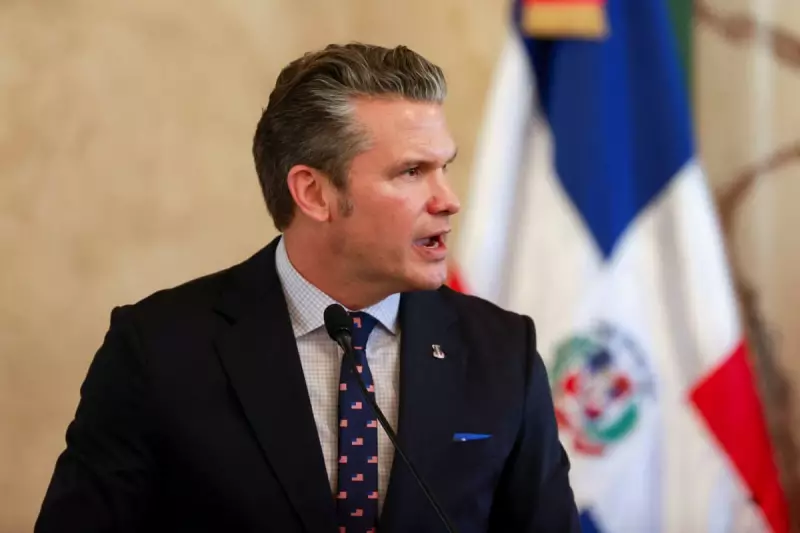
US Defence Secretary Pete Hegseth has vehemently denied allegations that he issued illegal orders to execute all survivors of military strikes in the Caribbean, dismissing the reports as "fake news" intended to discredit American armed forces.
Controversial Orders and Fatal Strikes
The controversy emerged following a Washington Post investigation which claimed that on 2 September, Hegseth instructed defence officials to "kill everybody" aboard a vessel under surveillance. This operation, conducted by the elite Seal Team 6, reportedly involved multiple strikes. According to the report, an initial missile attack left two survivors clinging to wreckage, after which Admiral Frank M "Mitch" Bradley, head of Special Operations Command, ordered a second strike to eliminate them, allegedly to comply with Hegseth's directive.
To date, these operations have resulted in more than 80 fatalities across at least 22 vessels targeted in a series of strikes. The Trump administration has asserted, without providing concrete evidence, that all individuals aboard were drug smugglers affiliated with Tren de Aragua, a Venezuelan gang designated as a terrorist organisation earlier this year.
Legal and International Backlash
The administration's justification for the strikes hinges on framing them as acts of self-defence against narcoterrorists allegedly responsible for poisoning Americans. Hegseth stated the "declared intent is to stop lethal drugs, destroy narco-boats, and kill the narco-terrorists". However, this narrative faces significant challenges. Narcotics experts and lawmakers have rejected the connection to fentanyl, noting it does not originate from Venezuela.
Furthermore, an Associated Press report contradicted official claims, revealing that many of the men killed were low-level drug runners, not leaders of cartels or terrorist organisations. Venezuelan officials and other nations have condemned the strikes as "extrajudicial executions" and a violation of due process.
Internal Military Concerns and Departures
Internally, the Department of Defense has not been unified in its support. Reports from NBC and the New York Times indicate that a senior military lawyer disagreed with the legal basis for the strikes and was subsequently sidelined. Adding to the internal discord, Admiral Alvin Holsey, the commander overseeing the boat strike campaign, stepped down in October. While the official reason remains undisclosed, the New York Times reported he had raised internal concerns about the attacks.
The situation has drawn comparisons to historical US drug interdiction practices, which typically involved intercepting boats and prosecuting suspects in court, rather than employing lethal strikes. The Guardian also reported that the administration is attempting to justify the operations as a self-defence effort for US allies in the region, a legal framework that remains highly contentious.