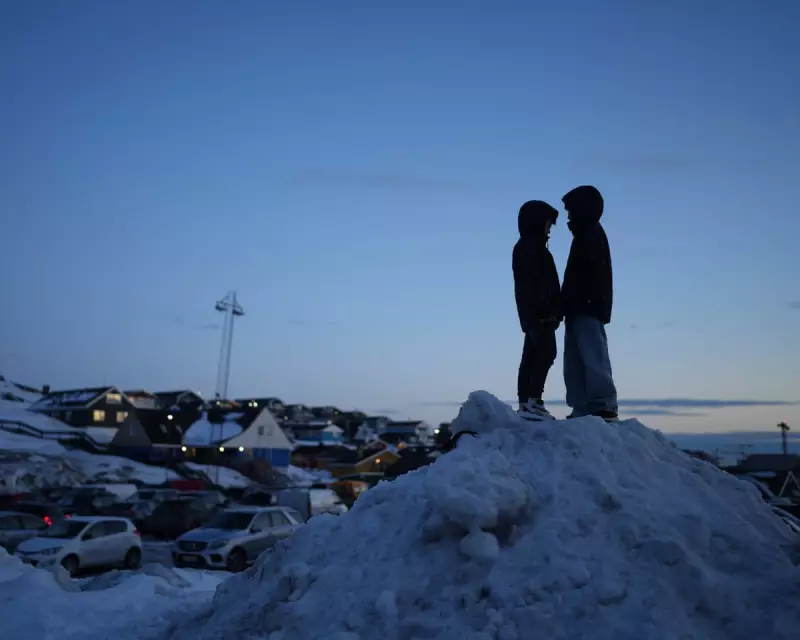
The government of Greenland has issued a forceful rejection of former US President Donald Trump's stated desire to acquire the vast Arctic island, declaring it "cannot under any circumstances accept" such a move. The self-governing territory, which forms part of the Kingdom of Denmark, has simultaneously moved to reinforce its defensive posture firmly within the NATO alliance.
NATO's Arctic Focus Amidst Geopolitical Tensions
This development comes during a critical diplomatic week, with NATO Secretary General Mark Rutte confirming the alliance is actively exploring methods to strengthen security in the strategically vital Arctic region. Rutte, speaking in Croatia, highlighted a collective concern among allies about increased activity from Russia and China as new sea lanes open. He stated NATO is "working on the next steps to make sure that we collectively protect what is at stake."
Trump recently reignited the controversial topic, remarking the United States would take control of the mineral-rich territory "one way or the other," and refused to rule out the use of military force. These comments have sent shockwaves through both the European Union and NATO, as Denmark—and by extension Greenland—is protected by their mutual defence frameworks.
Diplomatic Channels Activated to Defuse Crisis
In response, a flurry of diplomatic activity is underway. Greenland's Foreign Minister, Vivian Motzfeldt, and Denmark's Foreign Minister, Lars Løkke Rasmussen, are scheduled to meet US Secretary of State Marco Rubio in Washington. Concurrently, a delegation of US senators, including Alaska's Lisa Murkowski, plans to visit Copenhagen for talks with the Danish parliament's Greenland committee.
The chair of that committee, Greenlandic politician Aaja Chemnitz, welcomed the planned meeting as "good news," stressing the importance of utilising "all the diplomatic connections we have at our disposal." She emphasised the need to correct "lots" of inaccurate claims circulating about Greenland's status and intentions.
In an official statement, the Greenlandic government reiterated its constitutional position, noting the island is "part of the kingdom of Denmark" and, "as part of the Danish commonwealth, a member of NATO." It pledged to increase efforts to ensure its defence is managed "in the NATO framework" and expressed a belief that Greenland will "for ever be part of the western defence alliance."
Broader International Repercussions and Reactions
The potential ramifications of US action extend far beyond the Arctic. EU Defence Commissioner Andrius Kubilius warned that any US military move against Greenland would mean "the end of NATO." He pointed to Article 42.7 of the EU treaty—the bloc's mutual assistance clause—which could oblige member states to aid Denmark if it faced aggression, though the clause's applicability to non-EU Greenland is legally complex.
Meanwhile, international reactions have been pointed. China criticised the US interest, with foreign ministry spokesperson Mao Ning stating, "The Arctic concerns the overall interests of the international community." She called for the rights of all nations to conduct lawful activities in the region to be respected.
Denmark has consistently dismissed the notion that Greenland is for sale, highlighting that a 1951 defence treaty already permits a significant US military presence on the island. The Danish government remains hopeful a diplomatic solution can be found to de-escalate the situation, even as it speeds up its own national defence investments.
As NATO diplomats discuss preliminary options—such as new missions, equipment deployments, or exercises in the High North—the people and government of Greenland have made their sovereign position unequivocally clear, anchoring their future firmly within existing Atlantic and European alliances.