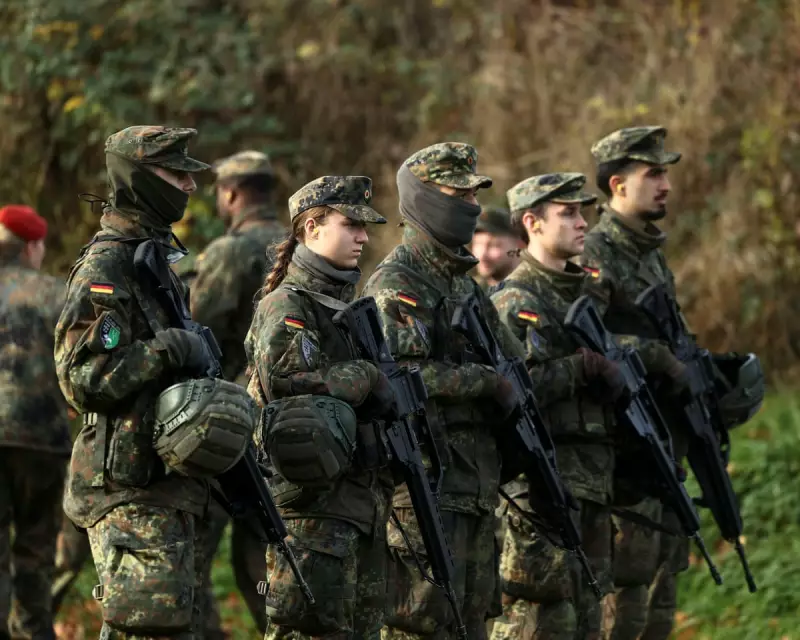
Facing a resurgent Russian threat and pressure to bolster its defences, the German government has chosen a voluntary military recruitment model over a return to compulsory national service. This decision follows intense political debate and aims to address the significant challenge of rebuilding the nation's depleted armed forces for a new era of European security concerns.
A Voluntary Framework with a Compulsory Backstop
The new plan, agreed upon by Chancellor Friedrich Merz's coalition government, will require all young men in Germany to register for potential service from next year. This process will involve a medical screening and a questionnaire where they can indicate their interest in joining. However, actual enrolment will remain voluntary, bolstered by a package of financial and practical incentives.
If this voluntary approach fails to attract the required number of recruits, the government will consider a compulsory nationwide call-up. Such a move would require new legislation and a separate vote in parliament, making it a measure of last resort. Jens Spahn, the parliamentary leader of Merz's Christian Democrats (CDU), described this fallback as a 'Bedarfswehrpflicht', or needs-based recruitment.

Incentives and Strategic Goals
To make voluntary service more appealing, the government is introducing significant perks. These include free driving licences—which can cost thousands of euros in Germany—and a substantial increase in entry-level pre-tax pay, raising it to €2600 per month. Women are also being actively encouraged to volunteer, though they will not be obliged to participate in the initial registration process.
The ambitious goal is to expand the Bundeswehr from its current strength of just over 180,000 uniformed troops to up to 270,000, plus an additional 200,000 reservists, by 2029 at the latest. Defence Minister Boris Pistorius has stated that Germany must be 'kriegstüchtig', or war-ready, by this deadline. This build-up is partly funded by a €100bn military fund established after Russia's full-scale invasion of Ukraine in 2022.
Context and Political Consensus
This strategic shift marks a dramatic reversal from the post-Cold War era when Germany, like many Western nations, drastically downsized its military. Compulsory conscription was suspended in 2011 under Angela Merkel's government, with the belief that future conflicts would require a professional army rather than masses of conscripts.
Security officials have issued stark warnings, suggesting Russia could be in a position to launch a full-scale attack on Europe within a few years. This, combined with pressure from the US for Germany to shoulder more defence responsibility and uncertainties over America's long-term commitment to European security, has created a renewed urgency.
Defence Minister Pistorius expressed confidence that the voluntary model, inspired by the experience of northern European countries, would succeed. He sought to reassure the public, stating that a more capable military lowers the likelihood of conflict. "There are no reasons to worry, or reasons to be afraid," he said, framing the move as a necessary step for deterrence and stability.