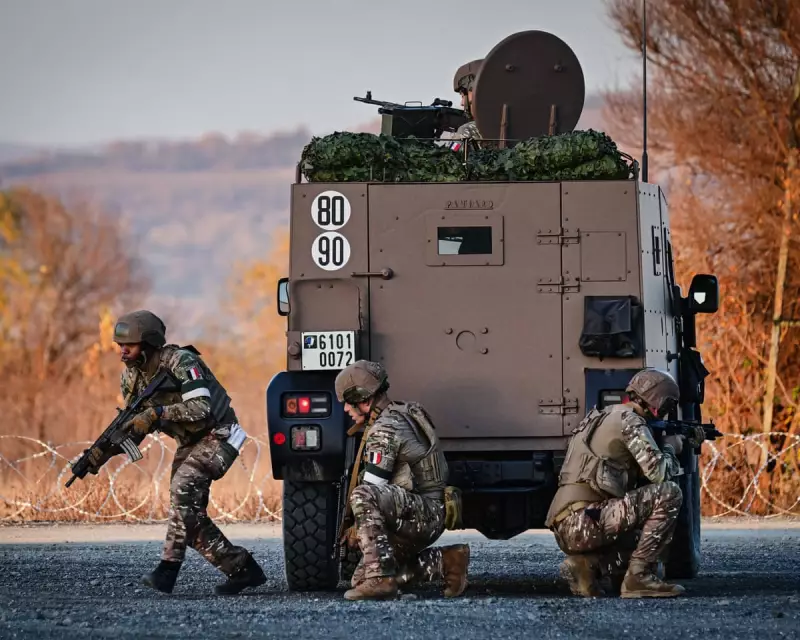
EU Executive Unveils Critical Defence Plan
The European Commission has announced an ambitious plan to dramatically speed up the movement of troops and military hardware across the continent, framing it as an essential insurance policy for European security. This 'military mobility' initiative, revealed on Wednesday, is a core part of a broader effort to ensure Europe is prepared to defend itself by 2030.
The push comes amid stark warnings from security services that Russia could be capable of attacking an EU member state within the next five years. The proposal seeks to address significant logistical hurdles that currently hamper rapid military deployment.
The Infrastructure and Bureaucratic Hurdles
EU officials highlight a series of formidable obstacles that would impede an army moving from a western European port to the EU's eastern border today. The problems are both physical and bureaucratic.
Key issues include bridges too weak for heavy tanks, railway tunnels too narrow for military vehicles, and differing track gauges. On the administrative side, cumbersome EU paperwork concerning customs and working time rules creates further delays.
One particularly striking example cited is an unnamed EU member state that requires a 45-day notice period for cross-border troop movements. This stands in stark contrast to the objective, pledged by EU countries in 2024, of a three-day border procedure. In another instance, a convoy of tanks was reportedly denied entry into a country because they violated local road-traffic weight limits.
"If a bridge cannot carry a 60-tonne tank we have a problem. If a runway is too short for a cargo plane, we cannot resupply our crews," stated the EU's foreign policy chief, Kaja Kallas. She described the 45-day permission rule as "not good enough," especially eleven years after Russia's annexation of Crimea.
Creating a 'Military Schengen' Zone
The commission's solution is the creation of a "military Schengen" zone, allowing armed forces to move through the EU's border-free travel area with an ease comparable to civilians. The proposed measures include an emergency system that grants military convoys priority on transport networks.
In crisis situations, armies would also receive exemptions from standard EU regulations, such as mandatory rest periods for drivers of heavy-goods vehicles. The plan also promises faster customs procedures for military hardware and supplies arriving at the EU's external border.
Kallas was keen to emphasise that these EU proposals are designed to underpin, not duplicate, the defence planning of NATO. She explained, "Military mobility is a critical insurance policy for European security; you hope you never have to use it to the full capacity, but having it ready ensures more credible deterrence and defence."
The Financial Cost and Political Hurdles
To make this plan a reality, EU officials have identified a priority list of 500 critical pieces of infrastructure, including bridges, tunnels, roads, ports, and airports, that need strengthening or adaptation. The estimated cost for these upgrades is approximately €100 billion (£88bn).
Funding is proposed through a tenfold increase in spending on military mobility, with €17.6 billion earmarked in the EU's long-term budget for 2028-34. Member states are typically required to co-fund such infrastructure projects. Most EU countries, also members of NATO, pledged in June to spend 5% of their GDP on defence, with 1.5% specifically allocated for protecting critical infrastructure.
However, the overall €2 trillion EU budget plan faces opposition from several member states seeking to scale back spending. EU officials have suggested that countries could utilise existing EU infrastructure funds and a new €150 billion defence loans programme to meet the necessary investment.