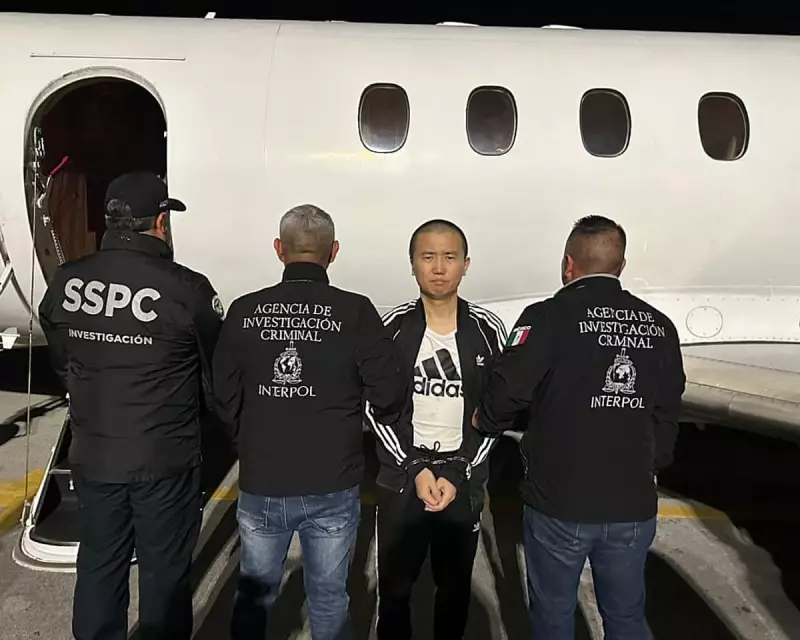
The dramatic international manhunt for alleged drug kingpin Zhi Dong Zhang, known by his alias 'Brother Wang', has culminated in a Brooklyn courtroom after a daring escape from Mexico and a failed attempt to find sanctuary.
Zhang, who also went by the name 'El Chino', found himself escorted by Interpol officers in Mexico City last month, marking a stunning reversal of fortune following his audacious jailbreak in July.
The Great Escape and Global Pursuit
In an escape straight from a crime thriller, Zhang vanished from house arrest in a Mexico City neighbourhood by sneaking through a tunnel into the adjacent property, completely evading the soldiers tasked with guarding him.
His freedom proved short-lived despite reportedly reaching Cuba and potentially Russia. In late October, Cuban authorities announced his arrest and immediately flew him back to Mexico, where he was swiftly extradited to the United States.
Experts suggest his escape was facilitated by corruption rather than criminal genius alone. "It wasn't just his criminal genius that allowed him to escape. It was corruption," stated Vanda Felbab Brown, an organised crime expert at the Brookings Institution.
Convergence Target in the Drug Trade
Appearing in a Brooklyn court this week, Zhang faces serious allegations of smuggling tons of chemical precursors used to manufacture fentanyl for Mexico's most powerful cartels - the Sinaloa and Jalisco organisations.
His charges extend to trafficking cocaine and crystal meth, alongside laundering nearly $100 million through hundreds of shell companies and US bank accounts. Zhang has denied all charges.
Chris Urben, a former Drug Enforcement Administration agent, described Zhang as a "convergence target" - more valuable than a typical kingpin because of his involvement across multiple criminal operations.
The Chinese-Mexican Criminal Nexus
Zhang's case highlights the deepening relationship between Chinese criminal networks and Mexican cartels, which has transformed over the past decade. Chinese groups have become principal money launderers for cartel drug proceeds from US sales.
The money laundering process exploits China's capital controls, which restrict citizens to moving approximately $50,000 annually abroad. The sophisticated system involves cartels delivering US drug cash to Chinese nationals in America, with payment made in pesos to cartels in Mexico through associates.
Dollars in the US are then sold to Chinese citizens seeking to purchase foreign assets like US property, with payment received in yuan within China. This entire process happens nearly instantaneously without money crossing borders, making tracing exceptionally difficult.
Urben noted the revolutionary impact: "The Chinese changed the game," with commissions as low as 1-2% compared to previous methods that took 10 days and cost 7-10%.
While Zhang's extradition provides US law enforcement with valuable intelligence, experts caution that criminal networks' adaptability means his arrest alone is unlikely to significantly disrupt precursor chemical supplies to Mexican cartels for long.