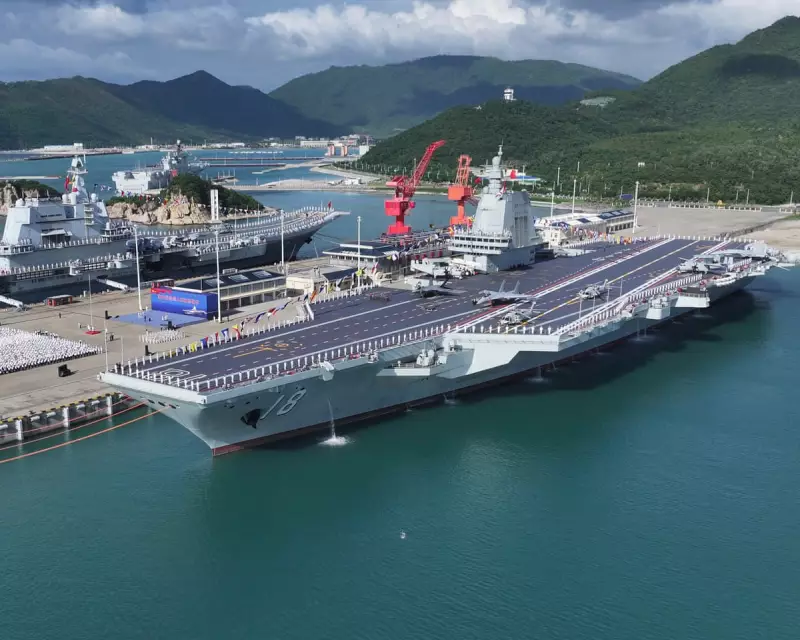
China's Naval Ambitions Take Flight with New Super-Carrier
China has significantly bolstered its naval capabilities with the launch of the formidable Fujian aircraft carrier, an 80,000-tonne behemoth valued at approximately £5.4 billion. The vessel, which measures over 300 metres long and can accommodate around 60 aircraft, represents Beijing's latest step in expanding its global military reach.
Currently stationed at a naval port in Sanya city in southern China, the Fujian places the nation second globally in aircraft carrier numbers with three vessels. However, China still trails significantly behind the United States, which maintains 11 operational aircraft carriers in its fleet.
The Enduring Significance of Carrier Diplomacy
Despite recent naval developments in Ukraine demonstrating how smaller forces can challenge larger fleets using sea drones, military analysts suggest this doesn't diminish the strategic value of aircraft carriers in major power competition. According to defence experts, these massive warships remain crucial for power projection and diplomatic influence in an era of growing US-China rivalry.

The importance of carrier diplomacy was recently demonstrated when former US President Donald Trump deployed the USS Gerald R Ford - valued at $12.8 billion as the world's most expensive warship - to Venezuela. Accompanied by four destroyers and capable of carrying 70 aircraft while operating up to 125 sorties at peak capacity, this display of naval power raised questions about potential military action against President Nicolas Maduro's regime.
China's commitment to carrier development reflects similar strategic thinking. President Xi Jinping attended the formal launch of the Fujian, underscoring the project's significance to Beijing's military ambitions. This represents remarkable progress from China's first carrier, the Liaoning, completed in 2012 using a Soviet-era hull originally constructed in the late 1980s.
Global Carrier Capabilities and Future Conflict Scenarios
Nick Childs of the International Institute for Strategic Studies notes the apparent contradiction in China's military strategy. While Beijing has invested heavily in anti-ship missiles for coastal defence against the US, it simultaneously views aircraft carriers as indispensable for global power projection.
Childs emphasises that carriers remain unrivalled in their flexibility and are incredibly useful in a whole range of potential conflict scenarios. One such scenario that analysts frequently discuss involves a potential forced reunification with Taiwan, where carrier capabilities could prove decisive.
The United Kingdom completed its own carrier programme four years ago, building and deploying two aircraft carriers for £6.2 billion. However, with less global power to project compared to superpowers, Britain's military requirement for these vessels appears less urgent. Neither UK carrier saw deployment during recent Middle East conflicts, though their construction provided valuable employment in Scottish shipyards during the 2010s.
British carriers have primarily served as instruments of floating diplomacy, exemplified by HMS Prince of Wales's visit to Tokyo in August to impress allies rather than intimidate adversaries.
Vulnerability and Defence in Modern Naval Warfare
Contemporary aircraft carriers face diverse threats, from sophisticated peer opponents to asymmetric tactics. Earlier this year, Houthi rebels in Yemen attacked the USS Harry S Truman aircraft carrier and its support destroyers with drones in the Red Sea.
While the most significant damage involved a $70 million F/A-18E Super Hornet fighter that fell overboard as the carrier manoeuvred to avoid incoming fire, the incident demonstrated potential vulnerabilities.
Modern carrier strike groups typically include specialised destroyers like the Royal Navy's HMS Diamond, designed to intercept incoming drones and missiles. Carriers themselves are engineered to withstand significant damage - during the Cold War, Soviet military doctrine estimated that 12 conventional missiles would be required to disable a super-carrier.

In 2005, the United States conducted tests on the decommissioned USS America, discovering it took four weeks of sustained attacks to finally sink the vessel, demonstrating remarkable resilience.
The Ukrainian success in the Black Sea came against a Russian navy that lacks a functioning aircraft carrier since the 40-year-old Admiral Kuznetsov entered repairs in 2017. Russia's inability to modernise or replace this vessel highlights broader geopolitical, military and economic weaknesses compared to both China and the United States.
As global tensions continue to evolve, the strategic value of aircraft carriers remains undisputed among major powers, despite emerging technologies that challenge traditional naval supremacy. The Fujian represents not just another warship, but China's determined entry into the elite club of nations capable of projecting air power across the world's oceans.