Life in Darkness: Chernihiv's Daily Struggle for Power
The northern Ukrainian city of Chernihiv has become emblematic of Russia's systematic campaign to destroy Ukraine's energy infrastructure, with residents now enduring up to 14 hours without electricity daily. Ancient streets that once illuminated medieval cathedrals now remain dark for most of the day, forcing civilians to adapt to a life governed by power schedules and the constant threat of further Russian attacks.
Invincibility Points Become Lifelines
Across the city, warm tents known as "invincibility points" have become essential gathering places where residents charge phones, access Starlink internet, and share warm drinks. Valentyna Ivanivna, a local resident, demonstrates her new head torch - a practical gift from her grandson that has become indispensable for evening chores. "It's impossible to plan anything without power," she explains. "You can't even invite people round for a cup of tea because the kettle won't work. It's stressful and exhausting for everyone."
The situation creates particular difficulties in apartment buildings, where lifts cease functioning during blackouts and water pumps fail above the fourth floor. Pensioner Liudmyla Mykolayivna, 68, visits invincibility points regularly, using the opportunity to charge her phone and access TikTok before returning home to read detective stories by torchlight.
Deliberate Targeting of Civilian Infrastructure
Russian forces have intensified their attacks on energy facilities throughout autumn, with Chernihiv region among the worst affected alongside Sumy and Kharkiv. The campaign reached a critical point two weeks ago when Russian Shahed drones conducted a three-day assault on one of Chernihiv oblast's last functioning substations.
Serhii Pereverz, deputy director of regional power company Chernihivoblenergo, walks through the wreckage of the facility, describing the attack as "deliberate genocide against peaceful people." Despite protective concrete walls, the substation lacked a roof, making it vulnerable to dive-bombing drones. Security footage captured the moment a transformer exploded, sending flames high into the night sky. The attack claimed the lives of two workers traveling from another damaged site.
Among the debris, evidence of Russian-produced Geran-2 drones - originally Iranian designs - lies scattered, with serial numbers still visible on tailfins. Pereverz admits the facility is beyond repair but insists his team employs "cunning" methods to maintain some electricity supply.
Human Cost of the Energy War
The blackouts have created a humanitarian crisis extending to healthcare and education. At Chernihiv's Hospital No. 2, director Vladyslav Kukhar reports frequent cancellation of non-urgent operations due to power shortages. The hospital relies on generators and backup batteries, with staff purchasing personal power banks to manage their work and home lives. "This situation weighs on the soul," Kukhar admits. "There's a psychological and emotional cost."
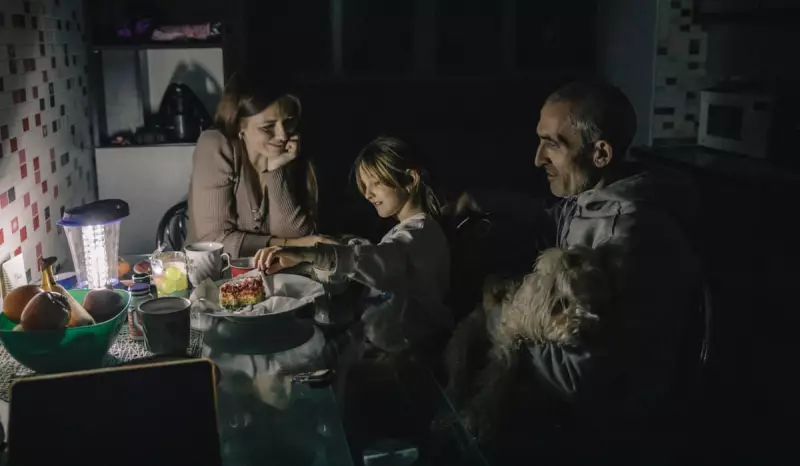
For families with children, the conditions present particular challenges. Anna and Maksym Kuliev worry about their seven-year-old daughter Yeseniia's education, with power cuts disrupting school and home study. Their eighth-floor apartment becomes inaccessible during blackouts when lifts fail, and basic hygiene becomes difficult. "You can't bathe your child. Or clean your apartment," Anna explains, navigating their home by head torch while LED lights illuminate homework.
The family's situation reflects broader community resilience, with portable lamps creating "dainty rectangles of light" across darkened neighbourhoods. Despite the hardships, residents express determination to remain. "People here are amazing," Kulieva says. "There's incredible unity. The more time you spend in this community, the more you value people around you."
This resilience persists even as anger grows over corruption scandals involving senior officials. Local journalist Andriy Podverbnyi describes the revelations as "a knife in the back" for those enduring power cuts and frontline service. Yet he maintains optimism, citing historical resilience through German, Soviet and Russian occupations.
As Chernihiv faces its most difficult winter since the 2022 invasion, residents find strength in community and determination. "It's not hard to live without a light in your home," Anna Kulieva reflects. "It's hard to live without a light in your heart."