
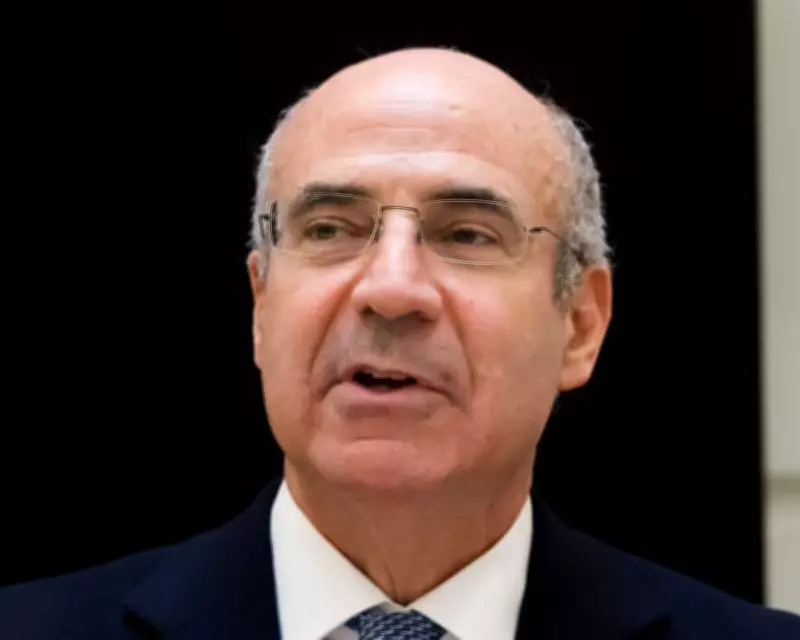
Bill Browder's Crusade: Redirecting Frozen Russian Assets to Ukraine's Defence
Prominent Kremlin critic Bill Browder has issued a forceful call for European nations to redirect more than $200 billion in Russian assets, frozen since 2022, towards bolstering Ukraine's defence efforts. This bold proposal comes as Browder intensifies his long-standing campaign to impose financial pressure on Vladimir Putin's regime, a fight that has spanned over a decade and a half.
A Relentless Pursuit of Justice
Bill Browder's battle against the Kremlin has been marked by personal risk and unwavering determination. Since the tragic death of his friend and lawyer, Sergei Magnitsky, in 2009 at the hands of Russian authorities, Browder has dedicated himself to seeking accountability. His efforts have already cost Putin and his associates billions through asset freezes and sanctions, making him a significant thorn in the side of the Russian leadership.
With the restless energy of a former chief executive of Hermitage Capital Management, who made his fortune in post-Soviet Russia, Browder now channels his intensity into confronting the Kremlin's aggression. His recent activities at the World Economic Forum in Davos saw him lobbying chief executives, European leaders, and US senators to escalate financial measures against Moscow.
The Intractable Nature of the Ukraine Conflict
Browder expresses deep scepticism regarding any potential peace deals that might emerge from prolonged negotiations involving Moscow, Kyiv, and Washington. He argues that Putin's political survival is inextricably linked to the continuation of the war, which he describes as a distraction from domestic failures.
"Putin has no ability to stop the war because he started it as a war of distraction against his own incompetence," Browder states. "This is not about any real problem with Ukraine; it's about creating a foreign enemy to deflect anger from the lousy life he's created for most Russians. If he were to stop, he would lose power and likely face death."
Conversely, he emphasises that Ukraine cannot cease its defence, citing the horrific model of Bucha as a stark reminder of the consequences of occupation. "The Ukrainians understand full well that occupation means women raped, men tortured and killed, and children kidnapped. So neither side has any capacity to stop," he adds.
Targeting Refineries: A New Strategic Focus
With progress on the frozen assets stalled due to opposition, particularly from Belgium, Browder has shifted his attention to refineries in India, China, and Turkey. These facilities process Russian crude oil into products like petrol, diesel, and jet fuel, funnelling an estimated $500 million to $1 billion daily into Kremlin coffers.
Browder is now advocating for sanctions against the owners of these eight refineries, arguing that cutting off this revenue stream is crucial. "It's the most straightforward, obvious thing I've ever seen. How does Putin afford this war? Through the sale of crude oil. If China, India, and Turkey stopped buying, Russia would face enormous discounts, and Putin would be out of business in six months," he asserts.
While recent focus has been on Russia's shadow fleet of oil tankers with opaque ownership, Browder dismisses this as an indirect approach. "It's easier to target the buyers than the transporters," he notes, pointing to signs that some refineries are already reducing Russian crude imports, with deliveries to Indian ports hitting a three-year low in December.
European Hesitation and the Belgian Roadblock
The frozen Russian sovereign assets, primarily held at Belgian depository Euroclear, remain a contentious issue. Despite Europe agreeing in December to lend Ukraine €90 billion, secured independently of these assets, Browder has not abandoned his push for their direct transfer.
Belgian Prime Minister Bart De Wever has resisted, warning that confiscating the assets would constitute an act of war. "Europe is not at war with Russia. You cannot simply confiscate money. That is an act of war. It has never happened in history," De Wever insisted at Davos.
Browder counters that De Wever is prioritising personal safety over national interests, arguing that redirecting the assets would merely extend Europe's existing policy of handing interest payments to Kyiv. "Regardless of peace plans, the war won't end. We'll burn through half that loan in a year and need to think about what's next," he warns.
A Personal Challenge to European Leaders
Reflecting on his own 15-year conflict with Putin, Browder issues a pointed challenge to European policymakers. "I've been at war with Putin for the last 15 years. I don't feel good about it, but I chose to go after them for the murder of my colleague. This guy [De Wever] has infinitely greater resources. So if I can handle it, so can he," he concludes, underscoring the moral and strategic imperative to support Ukraine's defence through all available means.




