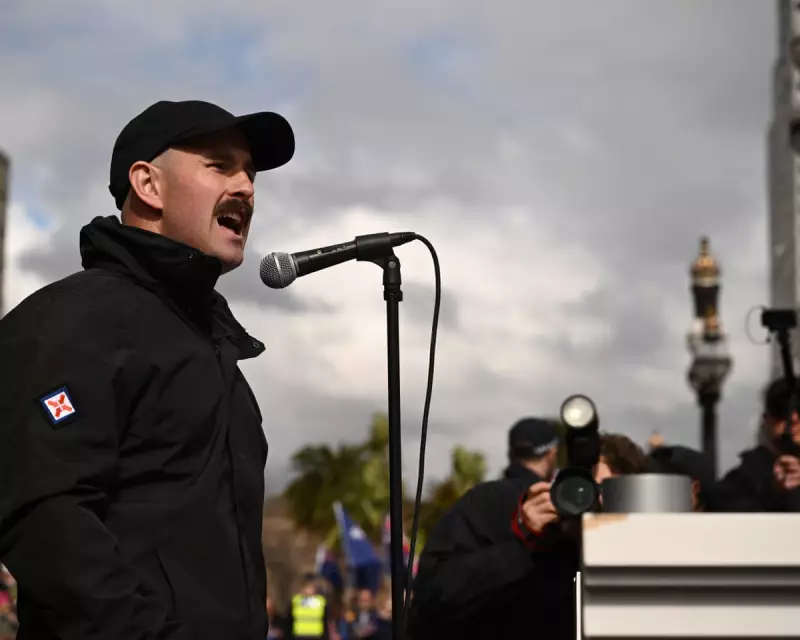
When more than fifty supporters of the National Socialist Network assembled outside New South Wales parliament last weekend, their coordinated display sent shockwaves across Australia. The image of sixty black-clad men standing in formation for twenty minutes represented what observers describe as an escalating pattern of far-right activism demanding new responses.
The Limits of Reactive Law Enforcement
According to Levi West, a counter-terrorism expert and researcher at the Australian National University, reactive lawmaking and impulsive ideas cannot effectively address the problem. "In the absence of a strategy – a whole government strategy – to respond, then we wind up with kind of piecemeal reaction that risks exacerbating the problem," West explains.
The recent Sydney demonstration follows a pattern outlined in a 112-page manual that was leaked to media in 2021, one year after the National Socialist Network launched. Since that time, the anti-Nazi organisation White Rose Society estimates the group has expanded from dozens of active members to approximately two hundred currently.
Growing Concerns About Police Response
The fallout from the Sydney rally prompted swift questions about police awareness and response. Police Commissioner Mal Lanyon attributed the group's immunity from charges under the summary offences act to a communication error, as officers had approved a Form 1 for the rally.
In response, Premier Chris Minns has pledged to grant police additional powers to disrupt hate demonstrations. Prime Minister Anthony Albanese has supported calls for stricter regulations concerning face coverings at protests, despite the notable absence of masks among the National Socialist Network members during this particular event.
Jordan McSwiney, a University of Canberra specialist in far-right movements, emphasises the necessity of moving beyond reactionary legislation. Like many researchers studying extremist groups, he advocates for a comprehensive approach that addresses the underlying social issues driving recruitment, including funding for exit programmes.
"While there is a place for banning gestures and slogans, it will literally do nothing to impede the organisation and growth of Nazi movements in Australia," McSwiney states. "We can't police our way out of fascism."
Civil Liberties and Media Dilemmas
Civil liberty organisations have expressed concerns that enhanced police authority could undermine the broader right to protest. Tim Roberts, president of the NSW Council for Civil Liberties, observes that police have demonstrated more vigorous efforts in dispersing left-wing protests compared to those organised by right-wing groups.
Jeremy King, a lawyer at Robinson Gill specialising in police misconduct, identifies similar patterns in Victoria. "It's my experience that police take a far more vigorous approach to policing and crowd control when it comes to counter protests," King notes.
Both experts contend that law enforcement already possesses sufficient tools to manage such demonstrations. Roberts points out that New South Wales police maintain the authority to relocate individuals when reasonable grounds exist to believe they are harassing or intimidating others.
The White Rose Society acknowledges the challenges in prosecution, noting that ASIO director Mike Burgess has characterised neo-Nazi activities as "awful but lawful." However, the organisation highlights that several demonstrations have included racist and homophobic language on banners and in speeches, which clearly crosses into hate speech or incitement territory.
West identifies a fundamental dilemma in policing these demonstrations that remains unavoidable. "Every time you undertake counter-terrorism activity, arresting people, using surveillance on people, whatever it might be you feed into their own narratives that they use to recruit people," he explains.
The media's role in covering these events presents additional complications. While some outlets have responded by avoiding coverage of certain stunts, West notes that the prominence of social media means these movements no longer depend on traditional media to disseminate their message.
McSwiney stresses the importance of media developing strategies to avoid legitimising the movement through coverage. "The time for a detailed media strategy was six years ago," he remarks, recommending practices such as blurring out slogans and banners as suggested by the White Rose Society.
Questions have emerged regarding whether the Form 1 submitted before Saturday's rally constituted a deliberate strategy to attract media attention. In parliament on Tuesday, Labor MP and former barrister Stephen Lawrence questioned why the group submitted the form when they didn't require immunity from the summary offences act to stand on the footpath outside parliament house.
As Australia grapples with this growing threat, experts agree that a coordinated, multi-faceted approach addressing both security concerns and underlying social drivers remains essential to effectively countering neo-Nazi movements.