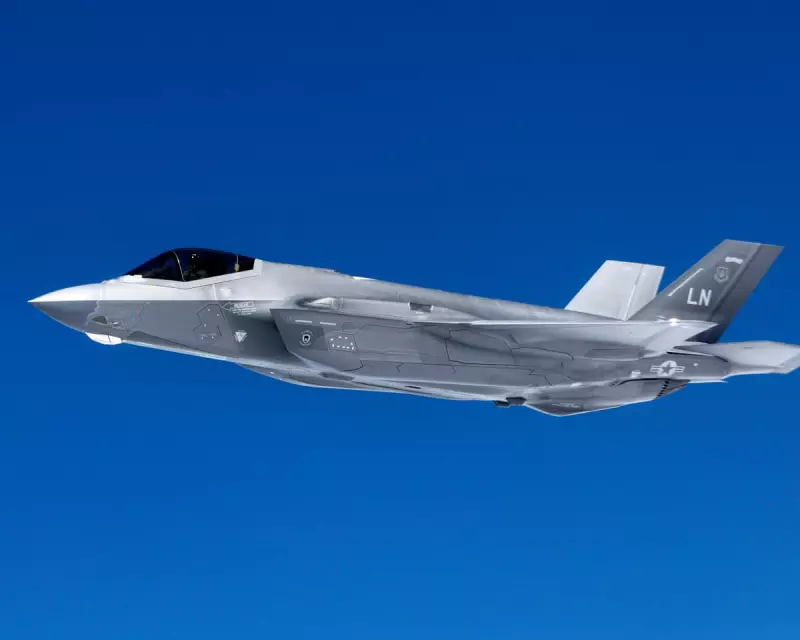
The controversial sale of American F-35 fighter jets to Saudi Arabia has placed Australia in a precarious ethical position, as the advanced stealth aircraft rely heavily on critical components manufactured by Australian companies.
Australia's Critical Role in Global F-35 Supply Chain
US President Donald Trump announced the deal during a meeting with Saudi Crown Prince Mohammed bin Salman, bypassing longstanding concerns about the Saudi regime's human rights record. The decision carries significant implications for Australia, which plays an integral role in the F-35's global production network.
More than 70 Australian companies hold production and sustainment contracts with the F-35 program, with over 700 critical pieces manufactured in Victoria alone. Australia also hosts a regional distribution hub for F-35 parts in New South Wales, making the nation an indispensable partner in the fighter jet's supply chain.
Duncan Frewin, clerk of the pacifist group Quakers Australia, emphasised that "every F-35 contains crucial parts made in Australia". He warned that "any bomb dropped by these planes can only do so because the Australian government has written a blank cheque to Lockheed Martin, selling them Australian-made parts with no human rights restrictions or monitoring."
Human Rights Concerns and Legal Implications
The sale of up to 48 F-35s to Saudi Arabia raises alarming questions about Australia's potential complicity in human rights violations. Saudi Arabia's involvement in the Yemeni civil war has drawn international condemnation, with bombing campaigns on Yemeni targets killing thousands of civilians.
Between 2015 and 2022, an estimated 377,000 people died as a result of the conflict, according to the Campaign Against Arms Trade. Nearly 15,000 civilians were killed by direct military action, most in airstrikes by the Saudi-led coalition.
Dr Sue Wareham, national president of the Medical Association for Prevention of War, stated that Saudi Arabia maintains an "appalling human rights record", particularly in its prosecution of the war in Yemen. She argued that "to pretend that weaponry in the hands of the Saudi rulers would only be used lawfully and in accordance with human rights principles is not plausible."
Wareham highlighted that the Arms Trade Treaty prevents Australia from exporting "weapons or associated items" if there's a risk they will be used to breach international law. "There is no doubt at all that such a risk exists in the case of Saudi Arabia," she asserted, warning that this makes Australia complicit in any crimes where the F-35s are deployed.
Systemic Failures in Weapons Monitoring
The complex global supply chain of the F-35 program presents significant challenges for accountability and oversight. Defence department deputy secretary Hugh Jeffrey recently told Senate estimates that the arrangement is "unique", with Australia participating in a global supply chain where goods are US-owned and managed by Lockheed Martin.
Critically, Australia has no control over where these parts are shipped, even when they leave Australian soil. The Department of Defence declined to answer whether Australia could or would refuse to supply parts for jets destined for Saudi Arabia.
Compounding these concerns are deficiencies in American monitoring systems. The State Department's Blue Lantern program, designed to monitor end-use of commercial weapons sales, reviewed fewer than 2% of export applications in its last available report from 2022. Of 18,143 export authorisations approved, only 305 underwent targeted checks, with 30% of those revealing "unfavourable" inconsistencies.
Michael Shoebridge, founder of Strategic Analysis Australia and former senior defence policy official in Washington, noted that the sale presents issues Australia has "tried desperately to ignore with the Israelis". He warned that "we will be supporting the Saudis' use of the aircraft however they choose to use it", citing Saudi involvement in Yemen as evidence this isn't hypothetical.
Additional concerns have emerged about potential technology transfer to China, given Riyadh and Beijing's security partnership. A US Defense Intelligence Agency report flagged worries that China could access F-35 technology through Saudi Arabia.
The F-35, described by manufacturer Lockheed Martin as the "most lethal" warplane globally and costing between $123-155 million Australian dollars each, represents a significant escalation in military capability for Saudi Arabia. As the deal progresses, Australia faces increasing pressure to address its role in potentially enabling human rights abuses through its indispensable contributions to the world's most advanced fighter jet program.