
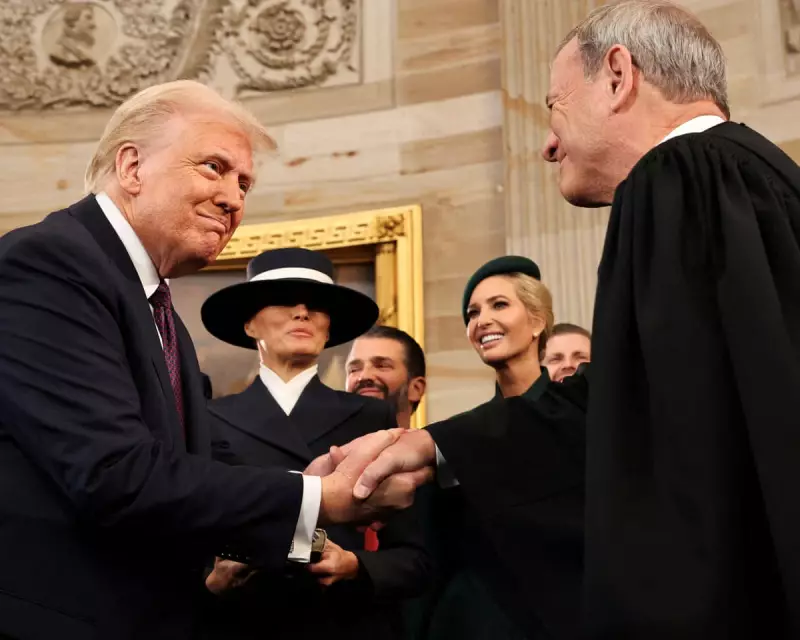
For two decades, John Roberts has presided as Chief Justice of the United States Supreme Court, often portraying himself as an institutional guardian committed to preserving the foundations of American democracy. Yet a growing chorus of legal observers contends his legacy will be defined by a series of rulings that have critically weakened the very democratic institutions he claims to protect.
The Erosion of Electoral Integrity
Central to the critique is Roberts' role in reshaping the American electoral landscape. In the 2019 case Rucho v. Common Cause, Roberts authored the majority opinion that declared federal courts powerless to intervene in cases of partisan gerrymandering. This decision effectively greenlit a hyper-partisan redistricting arms race, allowing state legislators to draw congressional maps that predetermine election outcomes, a process where, critics argue, politicians choose their voters rather than voters choosing their representatives.
Furthermore, Roberts orchestrated the court's approach in the 2010 Citizens United decision, which dismantled longstanding federal campaign finance limits. The ruling opened the floodgates for unprecedented political spending by corporations and billionaires, creating a system where figures like Elon Musk can donate hundreds of millions. Many argue this has tilted the US toward plutocracy, where the average citizen's voice is drowned out by 'dark money' and colossal contributions.
Dismantling Protections and Expanding Power
Roberts has also led the charge in rolling back the Voting Rights Act of 1965. His 2013 opinion in Shelby County v. Holder invalidated key provisions that required areas with a history of racial discrimination to obtain federal approval before changing election laws. Roberts controversially asserted that such discriminatory intent had largely faded—a claim swiftly challenged by subsequent state-level voting restrictions.
The court's current term threatens the last major pillar of the Act, Section 2, which prohibits racial discrimination in voting practices. A pending Louisiana case could rule it unconstitutional to consider race when drawing electoral districts, potentially eliminating Black-majority districts in Southern states and diluting minority voting power.
Perhaps most consequentially, Roberts wrote the majority opinion in Trump v. United States, granting sweeping immunity from prosecution to presidents for official acts. Legal experts warn this places a president above the law and could embolden authoritarian actions without fear of legal accountability.
A Court Accused of Partisanship
Under Roberts, the Supreme Court's reputation for non-partisanship has severely fractured. Its rulings on campaign finance, voting rights, and gerrymandering are widely perceived to favour Republican electoral chances. Statistics underscore this perception: since Donald Trump returned to the political forefront, the court has ruled wholly or partially in his favour in 20 out of 23 emergency docket cases concerning his administrative actions.
Additionally, through a series of emergency orders, the Roberts court has allowed a sitting president to freeze congressionally approved funds, such as $5bn in foreign aid, effectively transferring spending power from Congress to the executive branch—a move critics see as undermining constitutional separation of powers.
The cumulative effect, detractors state, is a Supreme Court that has bolstered authoritarian agendas, empowered wealth over voter equality, and undermined core democratic tenets. Some historians now compare Roberts' impact to that of Chief Justice Roger Taney, infamous for the 1857 Dred Scott decision.
As Steven Greenhouse notes, it may not be too late for Roberts to recalibrate his legacy. A recent signal of scepticism towards Trump's use of 'emergency' tariffs without clear congressional authorisation offers a glimmer of hope. The fundamental question remains: will John Roberts and the conservative supermajority develop the backbone to curb an endless presidential power grab, or will their rulings pave the way for a further erosion of American democracy?




