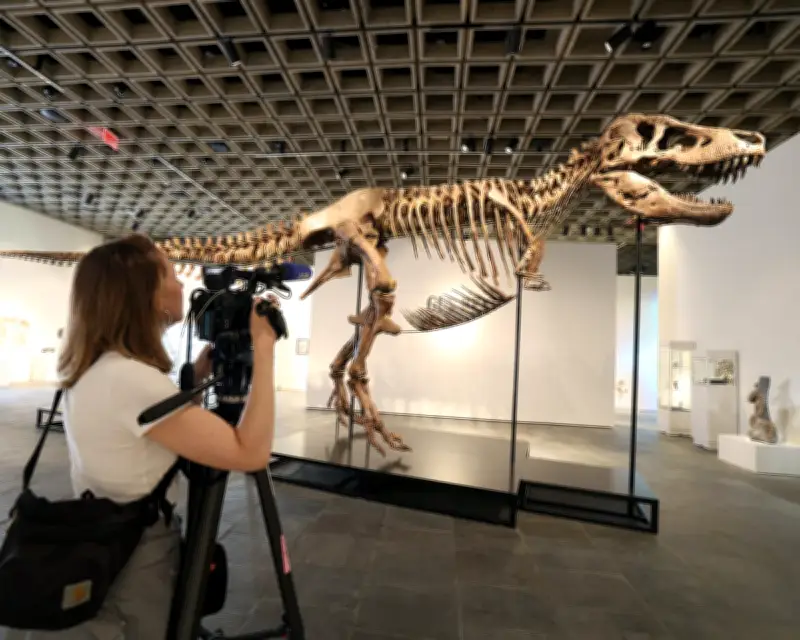
On Tuesday, Sotheby's in New York will auction one of the largest and most complete Tyrannosaurus rex skeletons ever discovered, known as 'Gus', with an estimated price of $20 million to $30 million. The sale has drawn sharp criticism from palaeontologists who argue that the commercialization of fossils threatens scientific research.
A massive specimen with a hefty price tag
Gus stands 3.8 metres tall and is thought to be about 67 million years old. The skeleton was discovered on a ranch in Harding County, South Dakota, by Theropoda Expeditions, a commercial fossil hunting company. It was excavated over three years starting in 2021, with permission from landowner Gary 'Gus' Licking, after whom the dinosaur is named. Cole Jacobs, a field prospector, recalled finding the first bone protruding from the ground on the first day of the search.
The auction could surpass the record set by Apex, a stegosaurus that sold at Sotheby's in 2024 for $44.6 million—11 times its listing price. Experts at Sotheby's defend the high valuation as reflecting the fossil's importance and the effort required to recover it.

Scientists raise alarms over lost research opportunities
Professor Richard Butler, a vertebrate palaeontologist at the University of Birmingham, stated: 'The current trend towards dinosaur fossils being marketed and sold like rare artworks at vast prices by auction houses is very concerning, as is the idea of buying dinosaur fossils as a status symbol or a commodity.' He added that a fossil not in a recognised museum collection cannot be studied and is therefore lost to research.
Professor Stephen Brusatte of the University of Edinburgh echoed these concerns, noting that while the auction appears legal because the fossil was found on private land in the US, it still worries him. 'If a dinosaur like this fetches tens of millions of dollars at auction, then there’s little that scientists or museums or universities can do. Those prices can only be paid by the super-rich,' he said.
History of fossil auctions and private ownership
The first T rex sold at auction was Sue, a 4-metre-tall specimen found in South Dakota, purchased in 1997 for $8 million by the Field Museum in Chicago with support from private donors and McDonald's. Since then, fossil collecting has become a hobby for wealthy celebrities, including actor Leonardo DiCaprio. In some countries like Brazil and Mongolia, all fossils belong to the state, preventing such sales.
Professor Michael Benton of the University of Bristol noted that occasionally private purchases benefit science when owners loan or donate fossils to museums. For example, Apex was bought by billionaire Ken Griffin and loaned to the American Museum of Natural History for four years.
Need for permanent public access
Dr Thomas Carr, a vertebrate palaeontologist at Carthage College, argued that private ownership is insufficient. 'A private collection has no guarantee that a fossil will stay in a collection for all time, whereas a public trust’s mission is to maintain, conserve and curate its collection indefinitely,' he said. Museum loans are problematic because a privately owned fossil can be recalled at any moment, undermining the principles of availability and replicability required for scientific research.
Brusatte added: 'When we publish research, we need to make sure that research is repeatable, meaning that other scientists can check our data and results and verify our conclusions. The only way for our research to be repeatable is if the dinosaur fossils we study are in a museum, where other scientists are guaranteed access to them.' Many journals now require that research papers be based on fossils housed in permanent public repositories.
Call for legal protections and donation
Carr suggested that fossils like Gus should have legal protection from commercial exploitation on private land, with rare specimens collected only by scientific institutions. Brusatte admitted he would buy a dinosaur fossil if he were a billionaire but would donate it to a museum. 'I hope that is what happens here,' he said. Carr hoped Gus would eventually be donated to a public trust, saying: 'A fossil in a public trust is a win for science and society all around, rather than being hoarded in some McBillionaire’s living room.'