
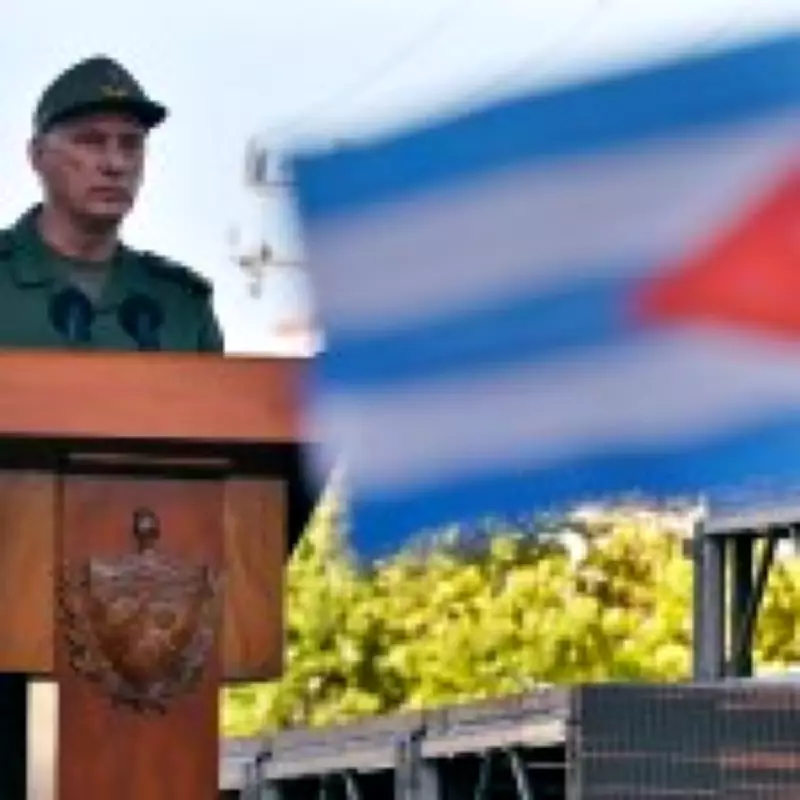
The US blockade on Cuba is straining an already tense relationship, as Donald Trump accuses Havana of possessing drones capable of striking mainland America. A months-long energy blockade by the Trump administration has plunged the island into darkness, with food and medical supplies running critically low. By the end of 2026, the US government aims to 'change leadership' in Cuba, seeking insiders to 'cut a deal' to facilitate this, according to reports from January.
US Claims Dismissed as 'Fraudulent'
US allegations that Cuba has drones that could attack Florida have been rejected by the Cuban government as 'fraudulent'. There are growing fears that Trump might use this as a pretext for military intervention, which he has hinted at for months. Dr. Stephen Wilkinson of the International Institute for the Study of Cuba at The University of Buckingham told Metro that a continued blockade or attempted military coup would be the biggest tragedy in American foreign policy in years.
'Taking over Cuba is just another fantasy, just like the idea that the US can defeat Iran is a fantasy,' he explained. 'They've underestimated the Iranians, and they're underestimating the Cubans. The Cubans are made of very tough stuff. They're not going to give up.'
Cuban Nationalism and Historical Resistance
Dr. Wilkinson added: 'The Cuban people are very nationalistic and have really been fighting for 200 years for their independence. First against the Spanish, and then the United States, after it imposed a government on them which they didn't really want. The revolution of 1959 was really an assertion of Cuban independence and sovereignty from the United States. By trying to reassert its dominance over Cuba, the United States will only deepen the resistance of Cubans towards it.'
The US government has been meeting with Cuban exiles in Miami and Washington, hoping to find a government official in Havana willing to facilitate change. However, Dr. Wilkinson noted that these talks reveal the conflict as another 'class conflict'.
Historical Context of US-Cuba Relations
The relationship is not solely about communism, Dr. Wilkinson told Metro. In 1803, the US began to desire Cuba as a state. At that time, Cuba was a Spanish colony. Later attempts to take over failed, but decades later, politicians tried again. Cuba's location at the mouth of the Gulf of Mexico made it strategically important for protecting sea lanes to the Mississippi Delta and the Panama Canal. American investments in Cuban sugar and economic ties further deepened the connection.
'The relationship has very little to do with 20th-century ideological struggles. It has mainly to do with 19th-century anti-colonial struggles,' Dr. Wilkinson said. 'The Cubans have wanted their sovereignty and independence and have fought for it for a long time.'
In 1902, after Cuba won independence from Spain, the US intervened and imposed a constitution and settlement, sparking backlash. Throughout the 20th century, Cubans fought for independence again, finally achieving it in 1959 when Fidel Castro took power. The US then attempted to assassinate Castro and invaded at the Bay of Pigs, which failed. For decades after Castro's rise, many Cubans fled to the US. In 2015, Barack Obama and Raúl Castro began normalizing relations, a diplomatic victory. However, when Trump first took office, these efforts were reversed, and Cuba was designated a state sponsor of terrorism.
The revolution led to severe economic hardship, food and medical shortages, and political crackdowns, prompting millions to flee. 'The ordinary people of Cuba asserted their independence in 1959, and the bourgeoisie, the Cuban upper class, left and went to live in the United States,' Dr. Wilkinson argues. 'For the last, getting on for 60 years, there has been an internationalised class struggle, and that's what's coming to a head now. The people who wish to try and recover Cuba for themselves are living, in my opinion, a Gatsby-esque fantasy: the idea that you could recreate the past and go back to 1959, and try to erase what's happened in between.'
Economic Crisis and Energy Blockade
Cuba has close ties to Venezuela, having received oil and funding from Caracas before Nicolas Maduro was ousted. Since then, the country has faced increasing blackouts, supermarket queues, and petrol shortages amid its worst economic crisis in decades.
US Objectives in Cuba
For decades, the US has sought government change in Cuba. Historian Louis A. Perez wrote that Americans have 'convinced themselves that they have a beneficent purpose [...] from which Americans derived the moral authority to presume power over Cuba.' In essence, the US sees Cuban independence as a threat because its government and people reject US involvement and embrace socialism. The Cuban Missile Crisis further soured relations after the Soviet Union placed nuclear missiles on the island, leading to a 13-day standoff. Cuba's alliances with China, Venezuela, and Iran have also concerned US officials.
Dr. Wilkinson points out: 'The US wants to disband the army, disband the police force, completely dismantle the current government and build a new one in Cuba. They've got a blueprint for a kind of colonial regime for a period while they're 'rebuilding the country'. The problem is that they won't find very many Cubans who would be willing to collaborate with them.'
Possible Outcomes and 'Gazification'
Given recent and distant history, the standoff could go two ways. Dr. Wilkinson argues: 'The situation in Cuba now is literally one of the United States starving the Cuban people. This is very similar to what the Israeli government did to the people in Gaza, and I don't think it's an exaggeration to use the term 'Gazification' of Cuba, because this is really what's happening. This is the worst regime of sanctions that Cuba has been placed under since the very beginning.'
A 1960 US government memo known as the 'Mallory Memorandum' outlines what the US wanted then, which mirrors current actions: '...Denying money and supplies to Cuba, to decrease monetary and real wages, to bring about hunger, desperation and overthrow of government.' Dr. Wilkinson adds: 'The original objective of that embargo was to cause starvation so that people would rise up and overthrow the government. It was an intention to create a situation of social unrest in Cuba, which would then provide the excuse for an occupation of the island. And that's really what's happening again right now.'




