
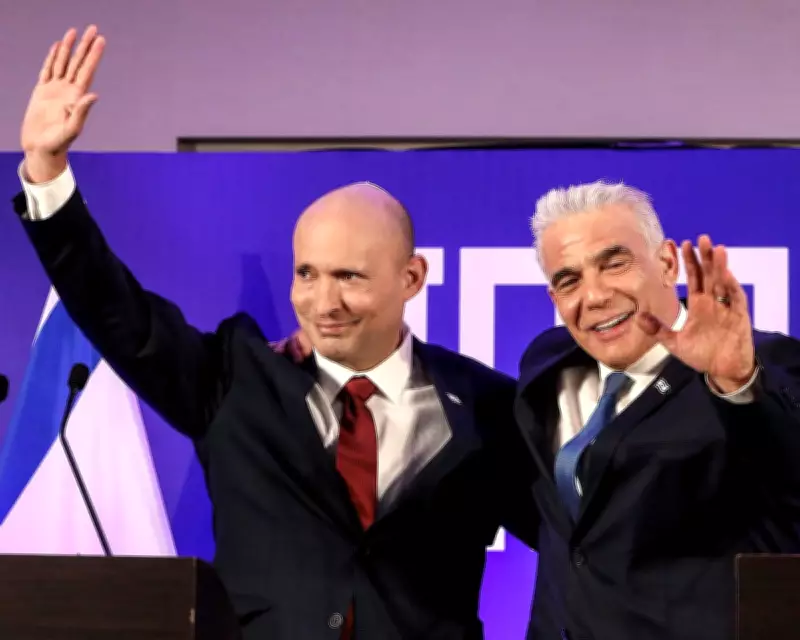
Former Israeli Prime Minister Naftali Bennett and opposition leader Yair Lapid have announced a merger of their political parties, forming a new rightwing-centrist coalition aimed at unseating incumbent Prime Minister Benjamin Netanyahu in the next election. The new party, named Together, will be led by Bennett, who declared it was time to 'open a new chapter for Israel.' Lapid echoed the sentiment, stating that 'the state of Israel must change direction.'
Coalition Details and Invitations
Bennett also extended an invitation to Gadi Eisenkot, a former Israel Defense Forces chief of staff and leader of the Yashar party, to join the alliance. Polls indicate that a combined ticket of Bennett's Bennett 2026, Lapid's Yesh Atid, and Eisenkot's Yashar would become the largest bloc in the Knesset. Eisenkot welcomed the initiative, calling Bennett and Lapid 'partners' and pledging to act 'responsibly and wisely' to achieve the needed change.
Netanyahu's Challenges
Netanyahu, Israel's longest-serving prime minister, faces a formidable challenge. Recent polls show Bennett's party tied with Netanyahu's Likud at 24 seats, while Lapid's Yesh Atid would secure seven and Eisenkot's Yashar 12. However, coalition dynamics may shift as some Likud voters oppose Lapid. Netanyahu's political survival skills have been proven before, but his security credentials have been damaged since Hamas's 2023 attack, and polls predict he will lose the next election, due by October.
Health Disclosure and Political Timing
The merger announcement came shortly after Netanyahu disclosed that he had a malignant tumor removed from his prostate, raising questions about the timing and his overall health. This issue is expected to become a focal point in the election campaign.
Historical Context
Bennett and Lapid previously joined forces in 2021 to end Netanyahu's 12-year tenure, forming a short-lived coalition that lasted only 18 months. That government included, for the first time, an Arab-majority party, the United Arab List (UAL). Bennett has now ruled out forming a coalition with Arab parties again and opposes ceding land to enemies, referencing Palestinian statehood.
Key Campaign Issues
Both Bennett and Lapid have criticized Netanyahu for failing to translate military gains into strategic victories against Iran and its proxies, Hezbollah and Hamas. They have also highlighted the contentious issue of military conscription exemptions for ultra-religious communities, which has become a central campaign theme amid military overstretch and high casualty rates.
Netanyahu, in response, posted a 2021 photo of Bennett and Lapid with the UAL leader, Mansour Abbas, with the caption: 'They did it once, they'll do it again,' referencing their previous coalition.
Public Sentiment and Polls
A survey by N12 News on April 23 showed Bennett's party winning 21 Knesset seats, compared to 25 for Likud. Other polls have consistently placed Bennett as the top contender against Netanyahu, though the political landscape remains fluid.




