
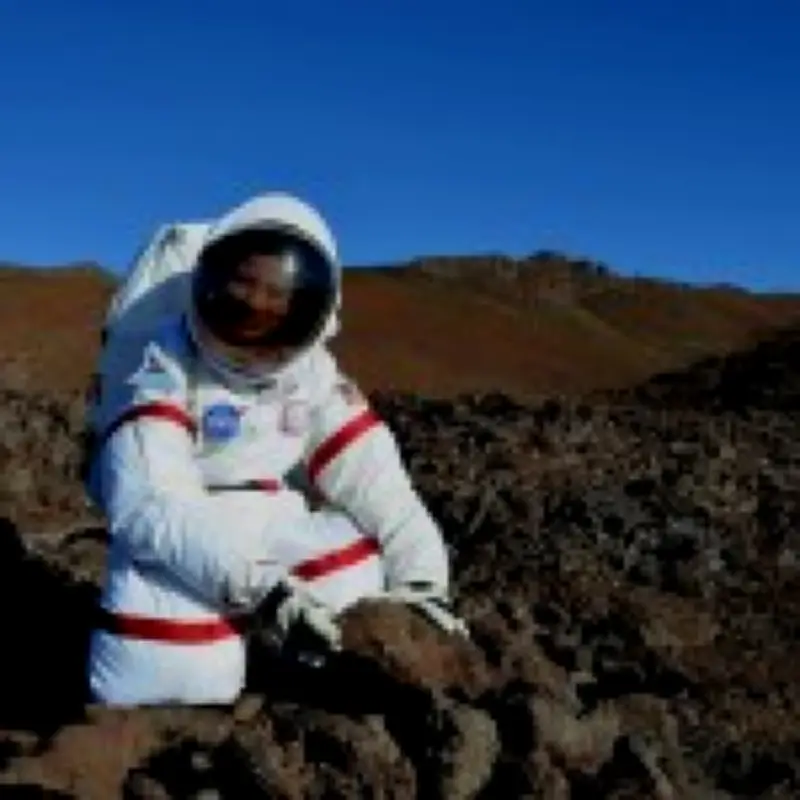
NASA is calling for volunteers to spend a year living on the moon and Mars without ever leaving Earth. The space agency recently opened applications for its next simulated deep space mission, the Moon and Mars Exploration Analog (MMEA), designed to replicate the cramped and isolated conditions of long-duration space travel.
Four crew members will live and work inside two interplanetary environments at NASA's Johnson Space Center in Houston: the HERA (Human Exploration Research Analog) habitat, a mock spaceship, and the CHAPEA (Crew Health And Performance Exploration Analog) research base. The mission includes virtual reality spacewalk simulations, Martian walks, and rover operations to exploration sites.
Mission Details and Requirements
The crew will spend approximately 366 days in isolation, with limited contact to the outside world. They will perform scheduled maintenance, scientific experiments, and respond to simulated emergencies. A mandatory social media detox will cut them off almost entirely from external communication with restricted resources.
Applicants must be US citizens or green card holders aged 30 to 55, proficient in English, no taller than 6'2" (188 cm), with no dietary restrictions, history of sleepwalking, or use of sleeping aids. A bachelor's degree in engineering, biological science, physical science, or mathematics from an accredited institution is required.
Compensation and Timeline
NASA stated, 'Research volunteers will be reimbursed,' though specific salary details were not disclosed. Some restrictions apply to NASA civil servants and contractors. Previous NASA studies have paid participants upwards of £13,000 for bed rest research on microgravity. The mission is expected to begin no earlier than August 2027, with the entire commitment lasting about 15 months, including pre-mission screening, six weeks of training, and debriefing.
Historical Context and Goals
NASA's simulated missions build on decades of analog studies. The Mars Society has run simulations in the Utah desert since 2001. A 2010-2011 Russian mission lasted 520 days, with four of six participants developing sleeping disorders. The NASA-funded HI-SEAS program in Hawaii has housed teams in domed structures for months; in 2015, six people lived in a 1,000-square-foot dome for eight months, including German physicist Christiane Heinicke, who documented her experience on social media.
NASA aims to use insights from the MMEA mission to 'keep astronauts safe and mission-ready.' Experts told Metro that NASA's goal of returning humans to the moon by 2028 will serve as a trial run for a Mars mission, as the moon is only days away while a Mars trip takes months due to orbital constraints. Findings will also support NASA's plan to establish a sustained human presence on the moon, including a research outpost, by 2032.




