
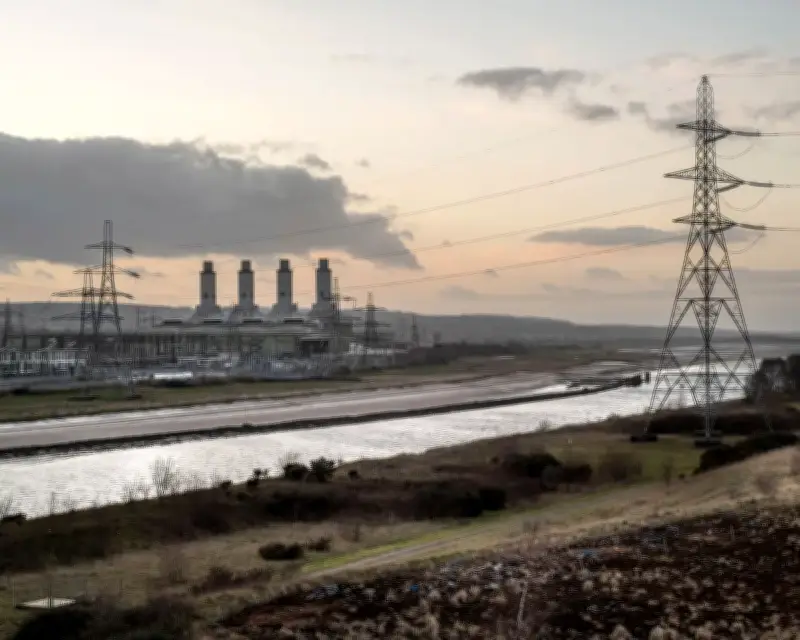
UK households are facing another increase in energy costs, with the price cap set to rise by 4% from 1 October, pushing the typical annual bill to £1,723. This comes despite government pledges to ease the cost of living crisis. Experts argue that years of political drift have left Britain with one of Europe's most expensive power systems, but they say the tools to fix it already exist.
Why are UK energy bills so high?
A typical energy bill is made up of a standing charge, a fee to keep connected to the grid, and a unit rate for the amount of gas or electricity consumed. It also includes underlying charges to maintain and operate the energy network and government-mandated levies to fund social and environmental schemes. Britain's energy market is among the most expensive in the world, largely due to how the market price for electricity is determined.
Under the “marginal pricing” system, the price paid by suppliers for wholesale electricity at any given moment is dictated by the most expensive source of generation required to meet demand. In the UK, this is often electricity from costly gas-fired power plants. Regardless of how much cheap wind or solar power is generated, this highest common denominator still sets the price. Last year, 31% of the UK's electricity was produced from burning natural gas, but it is estimated to have set electricity prices over 90% of the time.
Energy costs in the UK diverged from other European nations around 2020, according to Doug Parr, chief scientist and policy director at Greenpeace. That's when Britain ended its reliance on coal in electricity production, which as recently as 2012 was responsible for 43% of UK supply. “Gas became the marginal cost setter, which meant we were much more exposed to the gas prices than other countries,” Parr said. Subsequent wars in Ukraine and the Middle East have seen global gas prices soar, further hitting British bill-payers.
Short-term solutions to reduce bills
Energy policy experts warn that no single lever can be pulled to bring down prices without consequence, but several short-term reforms could provide relief. Cutting levies could save households £100 a year. Energy bills don't just pay for energy; additional subsidies have been added over the years, such as funding the Warm Homes Discount Scheme or paying for early renewables innovation. By 2027, these levies will add over £100 a year to the average household energy bill, according to the climate thinktank E3G. Subsidies also add over 20% to an electricity bill for most businesses. Levy reform could reduce inflation by 0.3%, according to modelling by Nesta, though government departments would have to shoulder the funding shortfall.
Dealing with energy debt could save up to £70 a year. Households struggling to pay inflated bills cost everyone. By the end of this year, individuals will owe an estimated £7bn to their suppliers. The cost of managing this debt crisis is passed on to every consumer, at between £50 and £70 a year. Immediate solutions include introducing a “social tariff” to provide cheaper energy for poor households, giving suppliers the income data they need to assess who is in fuel poverty, and tasking Ofgem with reviewing supplier debt collection practices. Once the rising debt has been curbed, a more radical option would be to write off the remaining amount.
Reactive pricing is another short-term fix. Suppliers could make flexible tariffs, which incentivise people to use energy when it is cleanest and cheapest, available more rapidly. Octopus has a specific tariff for night storage heaters, for example, which it says can benefit the average householder by £128 per year.
Longer-term fixes and market redesign
For longer-term solutions, the experts at E3G want major reform of market design, moving away from the current system where everybody picks up the highest price. “The government must put all electricity generators on to fixed price contracts,” says Susie Elks, senior policy adviser at E3G. She argues this would also reverse the failures of privatisation, where companies can make massive profits off electricity users as they have done during the past two energy crises. This approach is already used by 89 countries across the world and, according to the Common Wealth thinktank, would lower bills by an estimated £130 to £270 per household by 2030.
Controlling the crown estate is another proposed reform. The crown estate makes vast quantities of cash from the energy market, as the legal owner of the seabed around England, Wales and Northern Ireland. Wind developers paid £875m to the crown in “option fees” last year. Greenpeace has threatened to sue King Charles's property management company, accusing it of exploiting its monopoly ownership of the ocean floor and ultimately driving up the price of future energy bills. At this critical juncture, when the government plans to quadruple offshore wind power capacity by the end of the decade, Parr says the crown estate's auctioning of seabed rights have driven up costs for developers. “Like the energy market, it's the top-most bid that sets the price, so everybody will be paying for these highly inflationary leases,” he said. With the crown estate the only company who can lease the seabed, Greenpeace argues “they should be looking after the public interest and maximising the cost-effective rollout of offshore wind for decarbonisation, not maximising their own profits.”
Decoupling gas and electricity pricing could save £65 a year. Ecotricity founder and Labour donor Dale Vince has long advocated for the permanent decoupling of gas and electricity prices. Ed Miliband was known to be considering this when he was energy secretary, telling Labour MPs it was “complicated but possible”. This is “probably the biggest and most effective intervention one can make”, argues Parr. Common Wealth suggests that households could save nearly £200 a year if the government stepped into the market to act as the sole buyer of electricity. Their research found that public procurement of electricity could shave billions of pounds from electricity prices. Other research commissioned by Greenpeace argues that even removing gas plants from the wholesale electricity market and placing them into a strategic reserve could save the average household £65 a year. This would require the government to bring gas-fired power stations under government control, meaning they would no longer be able to sell power on the open market. Instead, there would be a state-operated strategic electricity reserve, ready to fire up if required to meet demand. This would make these power stations a regulated asset base, a process less expensive than complete nationalisation.
Controversial proposals and next steps
There is also zonal pricing, which the UK government's energy department rejected proposals for last year. This would have seen different parts of the UK charged different rates for their electricity, based on local supply and demand. The debate remains a bruising one, with advocates like Greg Jackson, founder of Octopus Energy, arguing it would make the market more efficient. Critics, including some of Britain's biggest renewable energy companies, are convinced the disruption would raise costs and jeopardise plans for the UK to have a virtually carbon-free power sector by the end of the decade. A report for the UK Energy Research Centre warned that implementing zonal pricing right now risked “putting the cart before the horse.”
Miatta Fahnbulleh, net zero secretary, promised yesterday that the government was exploring “what more we can do” to help those struggling with high bills. Policy analysts would argue that solutions are ready and waiting, and the government has yet to act on them.




