
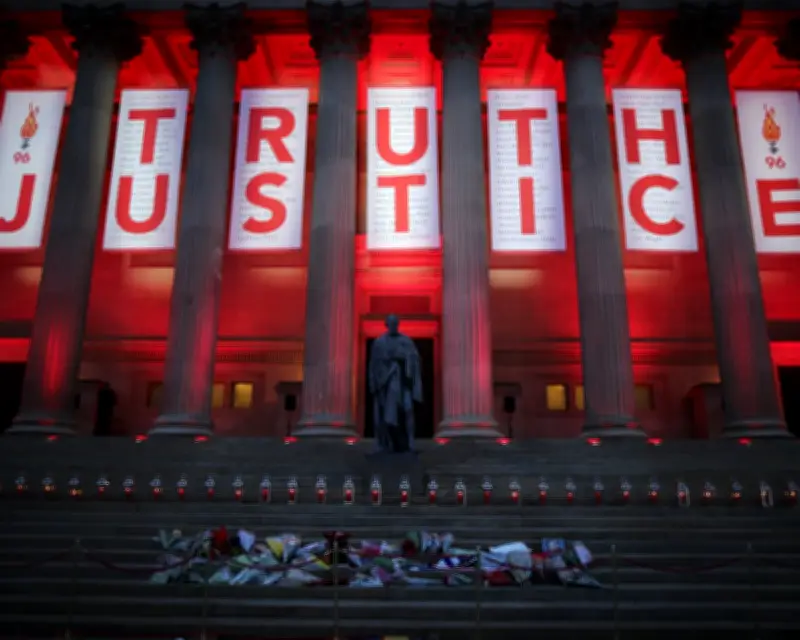
A new law criminalising public bodies and officials that lie to the British public is expected to complete its final stages in the Commons on Tuesday, pushed through by Keir Starmer as one of his final acts as prime minister. The legislation, known as the Hillsborough law, has been championed by Labour since its time in opposition, but nearly failed due to a bitter row over how it would apply to the security services.
Background: The Hillsborough disaster and the fight for justice
The Hillsborough disaster occurred on 15 April 1989, when 97 Liverpool fans died in a crush at Sheffield Wednesday's stadium during an FA Cup semi-final. For decades, South Yorkshire police presented false narratives blaming supporters, rather than taking responsibility for their own mismanagement. In 2016, a second inquest found that the victims were unlawfully killed due to gross negligence manslaughter by match commander chief superintendent David Duckenfield, and that no behaviour by Liverpool supporters contributed to the disaster.
David Conn, who has reported on Hillsborough for 30 years, said: "Immediately after the inquest, the families adopted the Hillsborough law as their positive legacy from the ordeal they had suffered. They wanted a duty of candour for public officials and authorities to be introduced and equality of funding for legal representation for people fighting for justice like them."
The battle over security services exemption
The proposed law requires those in public office to assist public inquiries with candour, and those who lie or evade face prosecution. However, after concerted briefing from the security services, the government agreed to give security chiefs the final say over what evidence would be put forward to an inquiry. Campaigners were vehemently opposed, arguing this undermined the central purpose of the law by allowing some parts of the state to continue avoiding scrutiny.
David Conn highlighted a concrete example: "At the Manchester Arena inquiry, MI5 was found to have submitted an inaccurate account of intelligence it had relating to the perpetrator of the atrocity. The inquiry chair found ultimately that the failure of MI5 to act swiftly on crucial intelligence was a 'significant missed opportunity' to take action that might have prevented the Manchester Arena attack in 2017." The Manchester Arena families joined the Hillsborough families in the coalition, insisting the security services must be included in the law.
Andy Burnham's role and Starmer's legacy
With parliamentary business plans updated late last week to include the bill's remaining Commons stages, it is understood that the final sticking point – that any decisions on excluding evidence on grounds of national security are for an inquiry chair to make – has been resolved to the families' satisfaction. David Conn noted: "This has finally been agreed in Starmer's final week; it also clearly appears significant that Burnham, the Hillsborough families' long-term supporter, is about to become prime minister."
Burnham, who will succeed Starmer as prime minister, has been a stalwart advocate for the cause. He first proposed a private member's bill in 2017, and his call for disclosure of all related documents led to the establishment of the Hillsborough Independent Panel, whose 2012 report exposed the extent of police efforts to falsely blame Liverpool supporters.
A victory for solidarity
David Conn reflected on the scale of the victory: "These families have always been underestimated. If you think about where they were after 1989: they suffered not just losing their loved ones in the most terrible circumstances but this disgraceful, toxic narrative from South Yorkshire police and a judicial system that failed to establish the truth for decades. And now they have succeeded so completely as to make it illegal for public officials to ever be less than candid about how a disaster occurred."
The Hillsborough Law Now campaign is a genuine coalition, including families bereaved by the Manchester Arena atrocity, Grenfell fire, and Covid. Conn said: "It's a really strong alliance, and they were never going to give in because they didn't accept they were putting national security at risk. This law is about the authorities learning from mistakes."




