
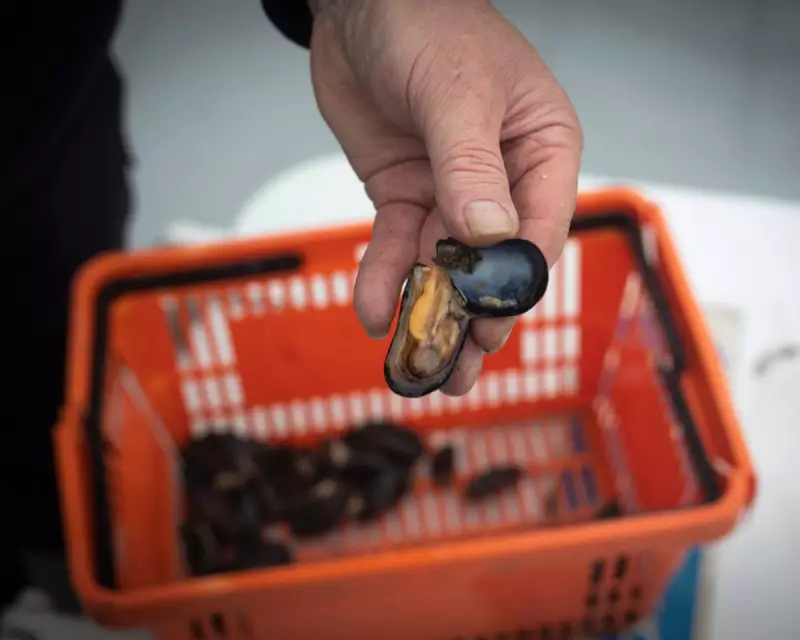
The once-thriving mussel industry in the Menai Strait has faced near-total collapse since Britain's departure from the European Union, with exports plummeting from approximately 10,000 tonnes annually to just five tonnes in 2022.
The Last Mussel Dredger
On a blustery morning in north Wales, skipper Alan Owen guides the 43-metre Valente out of Port Penrhyn near Bangor. His vessel represents the final remaining mussel dredging boat operating from this harbour, where three others have been either sold or redeployed following the industry's dramatic decline.
The Valente's owner, Myti Mussels, stands as the only one of four local mussel fishing companies still fully operational, now reduced to selling small quantities to UK customers rather than the lucrative European markets that once sustained the business.
"Our geographical position makes this probably the best place in Britain for producing mussels," Owen explains, pointing to the unique tidal conditions of the Menai Strait, where currents reach up to six knots and massive water volumes exchange nutrients that mussels thrive upon.
Natural Advantages Turned Economic Liabilities
These natural conditions helped establish the eastern Menai Strait as Britain's largest mussel farming area from the 1960s onward, employing generations of local families including Owen's father and uncle. For decades, the vast majority of production travelled across the Channel to France, Belgium and the Netherlands, where consumers have stronger traditions of shellfish consumption.
While the UK's shellfish industry represented a relatively small sector valued at under £12 million annually before Brexit, it proved crucial for coastal communities like those around the Menai Strait. The 2022 production figure of just five tonnes represents a staggering 99.95% reduction from pre-Brexit levels.
The collapse stems from longstanding EU regulations concerning imports of live bivalve molluscs - including mussels, oysters, clams, cockles and scallops - from non-member states. Waters in the Menai Strait, like most around England and Wales, carry a "class B" rating for shellfish production, determined by E coli levels detected in shellfish flesh.
Regulatory Barriers and Purification Problems
Mussels from class B waters can technically still enter EU markets, but only after undergoing purification - known in the industry as depuration. This process involves placing molluscs in tanks of sterilised seawater for one to two days, but it comes with significant drawbacks.
The purification process not only adds substantial costs but stresses the molluscs, reducing their shelf life and making them less attractive to European buyers. Compounding the problem, no purification plant in Bangor or elsewhere in the UK currently possesses the capacity to handle the volumes previously exported.
However, a glimmer of hope emerges as an Irish seafood company has fitted out a building adjacent to Port Penrhyn, awaiting certification that could potentially revive processing capabilities.
A Political Reset and Uncertain Future
The announcement in May of a "reset" deal between Keir Starmer's government and the EU offers potential relief for shellfish exporters. The agreement aims to eliminate sanitary and phytosanitary (SPS) controls at borders that formed part of post-Brexit trading requirements, along with veterinary checks and additional paperwork.
James Wilson, former owner of mussel producer Deepdock, expresses cautious optimism tempered by practical concerns. His business ceased trading after Brexit, and he now divides his time between running a fish shop and teaching at Bangor University.
"We tried every possible avenue that we could think of to try to secure some stable access to the EU market, but found a locked door at the end of it," Wilson recalls while serving customers.
With SPS agreement implementation unlikely before 2027, Wilson worries about the challenges of restarting significant mussel exports. The local mussel beds would require repopulation using seed mussels collected from natural beds, needing approximately two years to reach marketable size.
David Jarrad, chief executive of the Shellfish Association of Great Britain, confirms that many UK shellfish businesses remain "on hold," noting that "the longer it takes [to implement an SPS agreement with the EU], the less chance there is that they will be able to start trading again."
He emphasises Britain's missed opportunity, stating: "The UK is located in the sweet spot for cultivating shellfish almost anywhere in the world. Our aquaculture industry is minuscule in comparison with Spain and France and the Netherlands, even though we have a greater coastline."
Generational Shifts and Community Impact
The industry's decline has prompted difficult conversations about intergenerational continuity. While Alan Owen's son Martin followed his father into mussel harvesting, the skipper holds different aspirations for his 12-year-old grandson.
"We've taken him out on the boat a few times and he likes it, but he isn't yet old enough to decide what he wants to do for a job," Owen reflects. "He has got the brains to go into something better."
A government spokesperson confirmed ongoing negotiations for an SPS deal that could potentially add £5.1 billion annually to the UK economy by reducing costs and bureaucratic burdens for British producers and retailers.
Back at his fish shop near Port Penrhyn, James Wilson contemplates whether a future agreement might inspire new generations to enter mussel fishing. "Maybe if somebody with a bit more enthusiasm, a bit more energy, a bit of money comes in, then it might all happen."
For now, the Menai Strait's mussel industry remains in suspended animation, its future hinging on political negotiations and the possibility that favourable tidal conditions might once again translate into economic prosperity for north Wales.




