
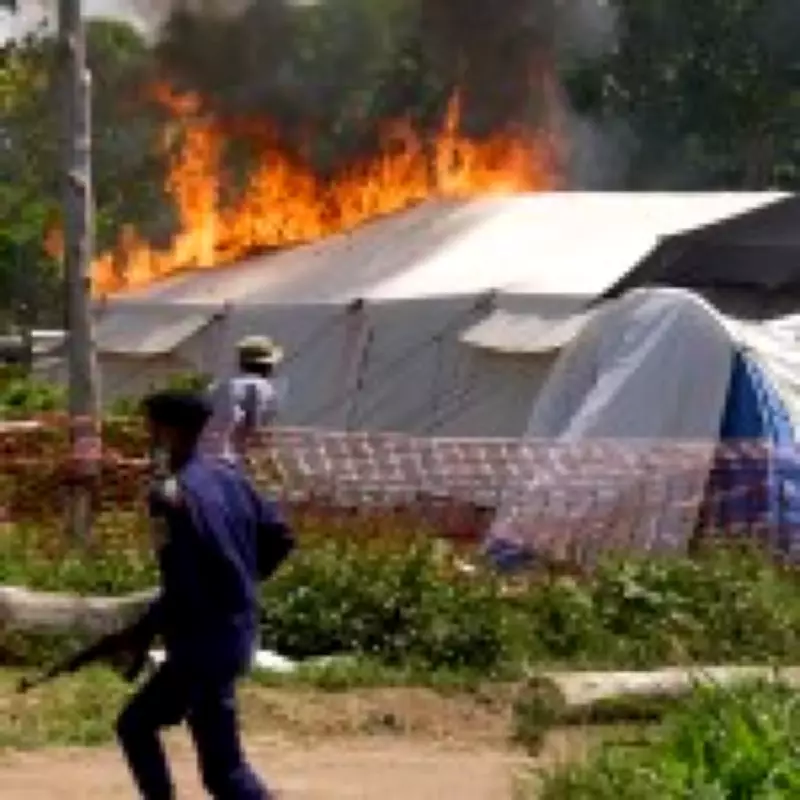
In the Democratic Republic of Congo, protesters demanding the return of the body of a person who died of Ebola set a hospital on fire. The lethal virus has killed at least 130 people in the country amid a wider outbreak in central and eastern Africa.
Incident at Rwampara Hospital
With tensions high, relatives of a young man who died of Ebola tried to take his body 'by force' from Rwampara Hospital in Ituri province on Wednesday. Family members threw stones and set two hospital tents on fire, where six patients were receiving treatment. At least one hospital worker near the city of Bunia was injured, and all staff have since been placed under military protection.
The deceased was a beloved local footballer who had played for several local teams. However, his family and many locals believe that 'Ebola is a lie,' according to Luc Mambele, vice president of the Congolese political party A2RC, who spoke to CNN. The man's mother claims he died of typhoid fever, a disease caused by contaminated water, not Ebola.
Mambele added: 'The population is not sufficiently informed or made aware of what is happening. To members of the most remote communities, Ebola is a White man's invention; it doesn't exist.' Some locals view Ebola as a money-making scheme by NGOs and hospitals.
Understanding Ebola
Ebola is an illness caused by a group of related viruses known as orthoebolaviruses. Infections manifest in two phases: dry and wet. Dry symptoms include fever, aches, pains, and fatigue, which can progress to wet symptoms such as diarrhea, vomiting, and bleeding. Since initial symptoms, appearing within 21 days, resemble the common cold or flu, many cases go undiagnosed. The virus spreads mainly through contact with bodily fluids of infected individuals or contaminated objects like clothing.
Health officials refused to release the body because the corpse of an Ebola victim is highly infectious. National police officers were deployed to the scene.
Ebola Outbreak Details
The World Health Organization (WHO) has declared the outbreak a 'public health emergency of international concern,' though a pandemic is unlikely. The strain involved, known as Bundibugyo, is rare, with no approved vaccine or treatment. The outbreak's start is unclear, but Africa's leading public health authority, the Africa Centers for Disease Control and Prevention, reported 65 Ebola deaths last week and suspects up to 671 people may be infected.
The Bundibugyo strain is also spreading in Uganda, with two cases and one death reported in Kampala. The first known case involved a healthcare worker whose symptoms began on April 24 and who later died at a medical facility in Bunia. As test results continue, health officials expect the number of cases to rise to as many as 1,000.
Fears of further spread are high, as many in Ituri have been displaced by conflict that has damaged hospitals and hindered containment efforts. The province also hosts migrant laborers drawn to its gold mines, who frequently cross borders. Public transport, flights, and ferries between Uganda and the DRC have been suspended.




